Chapter 9 — The Forms People Use
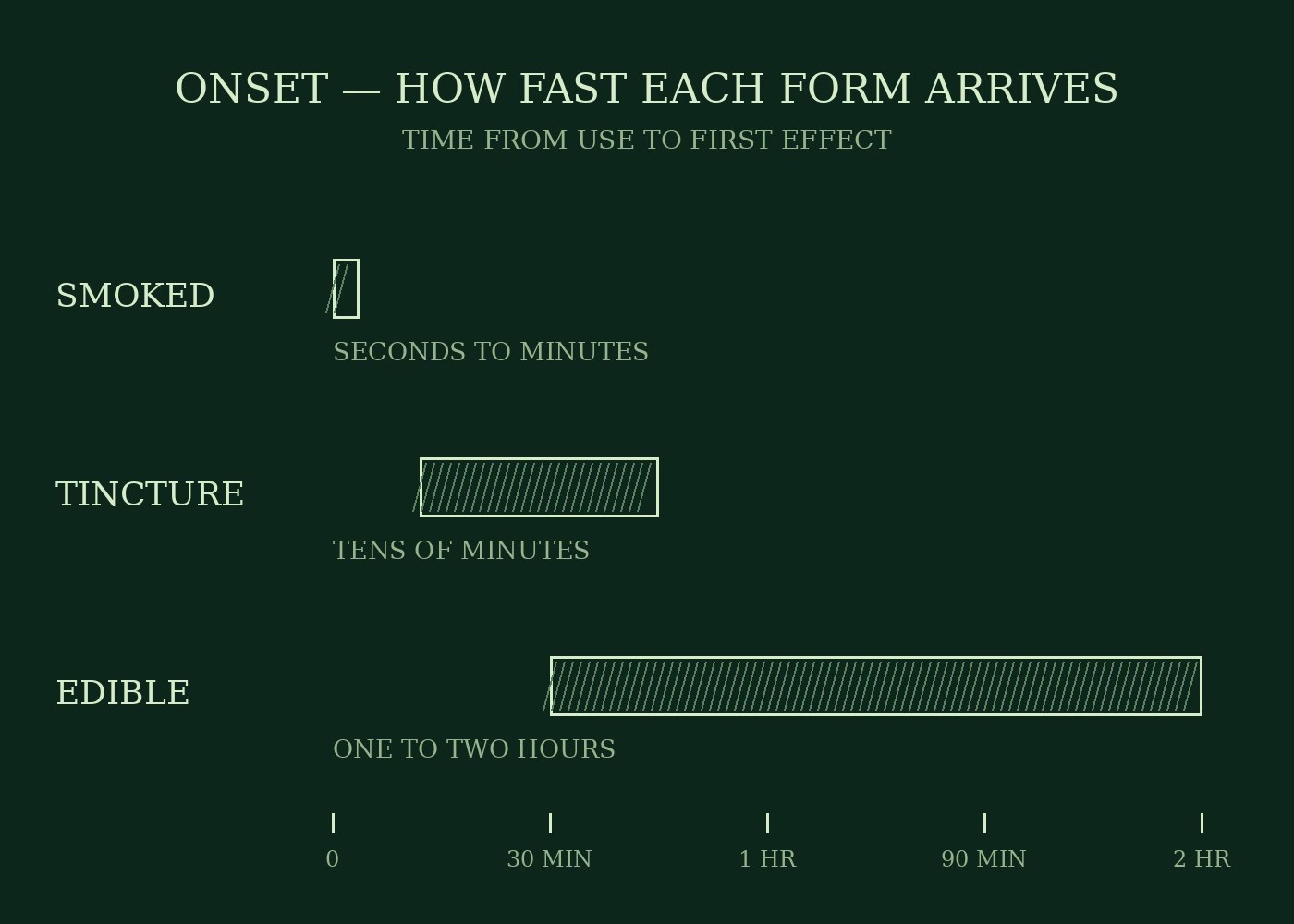
Plate — Onset and duration, by form.
One plant, one chemistry — and a dozen ways of delivering it, spread across five thousand years. The form is never a detail. It decides how fast the chemistry arrives, how long it stays, how strong it feels, and how much control the user has. This chapter walks the forms in the order history made them, and gives the beginner the one piece of practical knowledge every form carries: its timing.
Flower
The original form is the plant itself: the dried female flower, trimmed and cured, used as it grew. Smoked, it delivers its chemistry to the blood through the lungs within seconds to minutes; vaporized — heated without burning — it delivers the same chemistry with less of combustion's wreckage. Effects rise fast, peak within the half hour, and fade over one to three hours. The fast timing is its own safety feature: the user can feel each step and stop.
Flower is also the measuring stick of potency. Modern drug flower in legal markets commonly tests between 15 and 25 percent THC, some higher — against the few percent typical of the seized cannabis of the 1970s. The plant did not change species; breeders spent fifty years selecting for the glands of Chapter 4, and the numbers followed. Every other form in this chapter is, in some way, an attempt to concentrate, preserve, or re-deliver what the flower holds loosely.
The old resin world
The first improvement on flower was to collect the factories themselves — Chapter 4's detachable heads — and the old world built three forms on them.
Hashish is the heads, sieved or rubbed from the plant and pressed into a cake or ball: cannabis resin, storable, transportable, and far stronger by weight than flower. It has been made for centuries across Central Asia, the Middle East, and North Africa. Charas is its hand-rubbed Indian cousin, made from living plants in the Himalaya foothills. Kief is the unpressed stage — the loose pale powder of detached heads, gathered in the bottom of a grinder or through a sieve. India's classical trio names the whole old menu at once: bhang, a drink and food preparation of the leaf; ganja, the flower; charas, the resin. Three forms, graded by strength, already old when Europeans first wrote them down.
Tinctures — medicine's form
Steep the plant in strong alcohol and the alcohol pulls the cannabinoids out and keeps them: a tincture, dosed by drops. This was the form in which nineteenth-century Western medicine adopted cannabis — extracts and tinctures stood in the United States Pharmacopeia from 1850 until 1942, stocked in pharmacies, prescribed for pain and spasm and sleeplessness. Taken under the tongue, a tincture arrives in tens of minutes — faster than food, slower than smoke. The form never vanished; it waits in modern bottles on dispensary shelves, wearing better labels.
The modern laboratory forms
The last generation added machinery, and the forms multiplied. Solvent extracts wash the plant with butane or carbon dioxide and keep the resin — oils and waxes testing 60 to 90 percent THC. Rosin takes the solventless road: heat and pressure squeeze the resin from the flower whole. Distillate refines an extract down to nearly a single compound — THC or CBD as a clear, almost flavorless oil, the terpenes stripped and sometimes added back. Isolate goes one step further: one cannabinoid as a pure white crystal. Vaporizer cartridges put extract in a pen — the form at the center of the 2019 lung-injury outbreak, when a cutting agent used in illicit cartridges, vitamin E acetate, injured thousands; the safety book of this series gives that episode its full chapter, because it is the modern proof that the form and its supply chain, not only the plant, decide the risk.
Each step up this ladder trades the whole plant for strength and precision — and trades away flower's built-in pacing. A form that arrives in seconds can be titrated breath by breath. A form at 80 percent, in one breath, cannot.
Smoking, examined
The oldest road deserves one clear-eyed paragraph. Burning plant material — any plant material — makes smoke, and smoke carries tar, carbon monoxide, and the fine particles and combustion compounds that lungs are not built for; cannabis smoke shares most of that cargo with tobacco smoke, differing in its chemistry, not in being smoke. A water pipe cools the smoke and traps some of the water-soluble fraction; it does not make smoke clean. The vaporizer exists precisely as the engineering answer: heat the flower or extract hot enough to uncap the acids and boil off the cannabinoids and terpenes — most vaporize between roughly 160 and 220 degrees Celsius — but below the point of combustion, and the cargo of burning is largely left behind. The safety book weighs the respiratory evidence in full. Here the form itself is the lesson: smoking is the fastest road and the crudest, and every other inhaled form is an attempt to keep its speed and lose its fire.
Edibles — the slow road, and the liver
Cook the plant into fat — butter, oil — and the chemistry rides food. The fat is not a preference: cannabinoids dissolve in fat and alcohol, not water, which is why there is no true cannabis tea from plain water and why the vehicle of every edible is something fatty. The cooking also does Chapter 5's chemistry, uncapping the acids into active form.
The oral road is a different journey. Swallowed THC passes through the liver, which converts a large share of it into a related compound, 11-hydroxy-THC — stronger at the receptor and longer-lived than THC itself. Edibles therefore arrive slowly, thirty minutes to two hours; feel stronger and stranger than the same dose smoked; and last four to eight hours or more. Nearly every beginner's worst cannabis story is a timing error on this road: nothing felt at forty minutes, a second dose taken, and both arriving together. The form is not dangerous in the way poisons are dangerous, but it is unforgiving of impatience — the single most useful sentence in this chapter is that the edible has not failed to work; it has simply not arrived yet.
Topicals — the form that stays outside
Rubbed on the skin, cannabinoid creams and balms work where they are put and, in ordinary use, do not reach the blood in amounts that matter — no high, by design; their evidence and their limits belong to the medical book. The exception proves the rule: transdermal patches are engineered precisely to push the chemistry through, on a slow all-day schedule, and are labeled as the medical devices they are.
The dose problem
One warning belongs to this whole catalog rather than to any single form: doses do not translate between forms. Five milligrams of THC eaten is not five milligrams smoked — the liver's conversion on the oral road makes the eaten dose effectively stronger and far longer, as the edible section explained; and five milligrams in a concentrate arrives in a single breath that flower would spread over a session. Regulators have had to pick a standard unit anyway — many jurisdictions set the single serving of an edible at 5 or 10 milligrams of THC — but the number is a legal convention, not a biological equivalence. The practical rule the safety book builds on starts here: every form is its own country, with its own dose, its own clock, and its own customs, and experience in one buys less knowledge of another than people assume.
Holding the chapter
Flower, resin, tincture, oil, food, cream: the forms are a history of people solving delivery problems — how to store it, strengthen it, dose it, slow it, keep it out of the blood or get it in. But every road, fast or slow, ends at the same destination. However the chemistry arrives, it meets a system in the body that was built for it before anyone knew it existed. The next chapter opens that system: cannabis and the body.