What Is Cannabis
Book One
The plant, its pieces, its chemistry, and how we know what we know — an introduction to cannabis for the reader who knows nothing about it and leans neither way, built from the science, government, university, and field record, with every claim graded by the strength of its evidence
Start reading
Read the opening note
This book is written for a reader who knows nothing about cannabis and leans neither way about it. If that is you, nothing here assumes your opinion, and nothing here is trying to recruit it. The book's aim is smaller and larger than persuasion: to leave you able to see the plant clearly, in a field where almost everyone who speaks about it is selling something — a product, a policy, or a fear.
The word. This book's word is cannabis — the plant's botanical name, the one used by science and by most of the world's history. The other names appear when they are the subject: hemp when the crop and its law are meant, marijuana when the legal category is meant. Chapter 12 explains what each word carries and why the choice among them is never innocent. Here it is enough to say that cannabis is the name that belongs to the plant itself, before any use, law, or argument — and this book is about the plant first.
The grades. Almost every claim in this book carries its evidence on its face. The scale is modeled on the one used by the National Academies of Sciences, Engineering, and Medicine in its landmark review of the field, whose categories run from conclusive down to insufficient. This book speaks in plainer words, in four grades. Settled: replicated in controlled studies and held by expert consensus. Supported: good studies, consistent, not yet final. Suggestive: early or indirect evidence — a signal, not a finding. Open: lore, anecdote, or a question not yet tested. When a claim in these pages sounds exciting, check its grade before you carry it anywhere; when a claim sounds damning, do the same. Chapter 11 gives the scale its full chapter, including the difference between "no evidence of an effect" and "evidence of no effect," which are not the same sentence and are constantly traded for each other.
The plates and tables. This book is illustrated with plates — the plant whole and dissected, the life cycle, the gland at magnification — drawn to the text and labeled in the text's own words, so the pictures can be checked against the prose and the prose against the pictures. Tables gather the numbers: compounds, thresholds, timings. Every number in a table comes from the sources listed at the back of the book, and where the sources disagree, the table says so rather than choosing quietly.
The promise. Nothing in this book asks to be believed beyond its grade. Where the record is thin, the book says thin. Where it is settled, the book says settled and does not hedge for politeness. The plant has had a century of being described by its enemies and its salesmen. This series was written to give it, at last, its witnesses.
Free editions
Free. No account, no email, nothing to sign up for.
Audio edition
The whole book, read aloud. 17 parts · 1 hour 55 minutes total.
Press play on any part — the book plays straight through to the end.
- DownloadDedication0:40
- DownloadA note on words and evidence2:41
- DownloadChapter 1 — A Plant, First10:10
- DownloadChapter 2 — The Plant in Pieces8:47
- DownloadChapter 3 — The Life of the Plant9:53
- DownloadChapter 4 — The Tiny Factories7:03
- DownloadChapter 5 — The Chemistry: Cannabinoids9:05
- DownloadChapter 6 — The Aromatics: Terpenes and Flavonoids8:22
- DownloadChapter 7 — Kinds of Cannabis7:40
- DownloadChapter 8 — Hemp and Marijuana7:40
- DownloadChapter 9 — The Forms People Use8:07
- DownloadChapter 10 — Cannabis and the Body, in Brief7:46
- DownloadChapter 11 — How We Know7:31
- DownloadChapter 12 — The Words7:53
- DownloadWhat this book did not do2:43
- DownloadGlossary5:39
- DownloadSources — principal works, by chapter3:08
About the book
The plant has had a century of being described by its enemies and its salesmen. What Is Cannabis was written to give it its witnesses instead. It begins with the plant itself — what kind of plant it is, where it comes from, the argument over its name — and works outward: the pieces, the year of its life, the glands that manufacture its chemistry, the compounds one by one, the kinds and the names, the legal line drawn through the species at 0.3 percent, the forms people use, and what happens in the body, which turns out to run a system of its own that the plant's compounds happen to fit.
Almost every claim in the book carries its evidence on its face, in four plain grades — Settled, Supported, Suggestive, Open — modelled on the scale the National Academies used in its landmark review of the field. When a claim sounds exciting, the reader can check its grade before carrying it anywhere; when a claim sounds damning, the same. The closing chapters give the scale its full working, and the words themselves: what each name for this plant carries, and why the choice among them is never innocent.
This is Book One of a series that introduces cannabis book by book — its history, its prohibition and law, its medicine, its growing, its trades — each volume from the same record and under the same rule: the facts at the strength the evidence supports, and the open questions left open and labelled.
Inside the book
- Front matterDedication · A note on words and evidence
- Chapter 1 — A Plant, FirstWhat kind of plant · The family · Where it comes from · The argument over its name · What the genes added
- Chapter 2 — The Plant in PiecesRoot, stem, leaf, flower, seed — and the plant that carries both
- Chapter 3 — The Life of the PlantThe seed that waits · The long green summer · Flowering · Telling a clone from a seedling
- Chapter 4 — The Tiny FactoriesThe three factories · What the resin is for · What humans collect
- Chapter 5 — The Chemistry: CannabinoidsThe mother compound · The acid forms · The strength question, in numbers · Fresh, cured, and old
- Chapter 6 — The Aromatics: Terpenes and FlavonoidsThe scent family · Reading a terpene report · The skunk note · The cannflavins
- Chapter 7 — Kinds of CannabisThe names from science · Landraces · The seed banks · Chemotypes
- Chapter 8 — Hemp and MarijuanaThe line · The line, worldwide · One plant, two legal fates
- Chapter 9 — The Forms People UseFlower, hash, extracts, edibles · Onset and duration · The dose-translation problem
- Chapter 10 — Cannabis and the Body, in BriefThe receptors · The body's own cannabinoids · Why the plant's version overwhelms
- Chapter 11 — How We KnowThe evidence ladder · The blinding problem · The scale this series uses
- Chapter 12 — The WordsQaneh-bosm · The registers · The word that is winning
- Back matterWhat this book did not do · Glossary · Sources, by chapter
The plates
The book is illustrated with thirteen plates in the manner of the old botanical engravings — the plant whole and dissected, the life cycle, the gland at magnification — drawn to the text and labelled in the text's own words, so the pictures can be checked against the prose and the prose against the pictures. Three are shown here; all thirteen stand in the editions at the places the text calls for them.
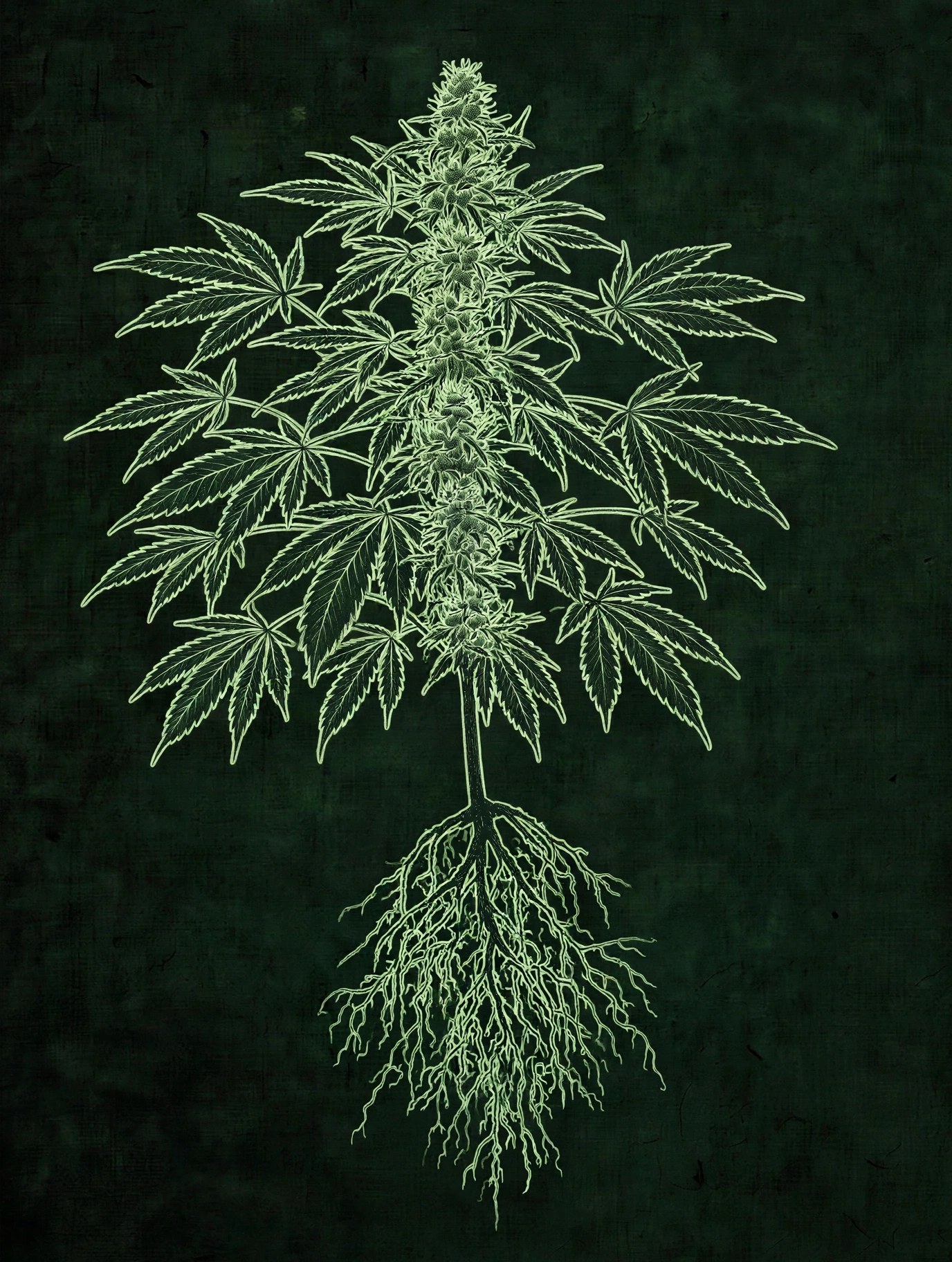
Plate 1 — The whole plant, flowering.
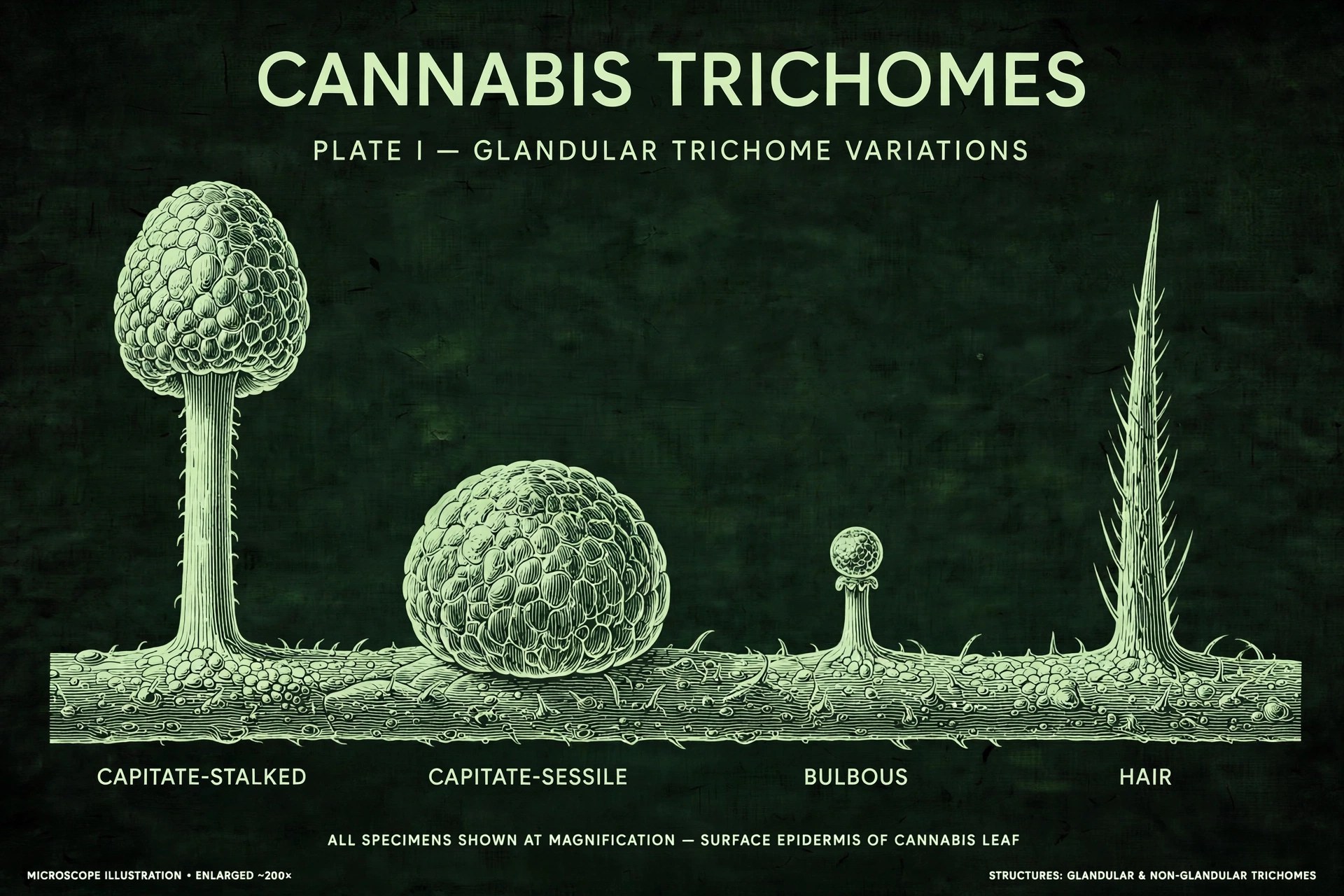
Plate 4 — The glands at magnification.
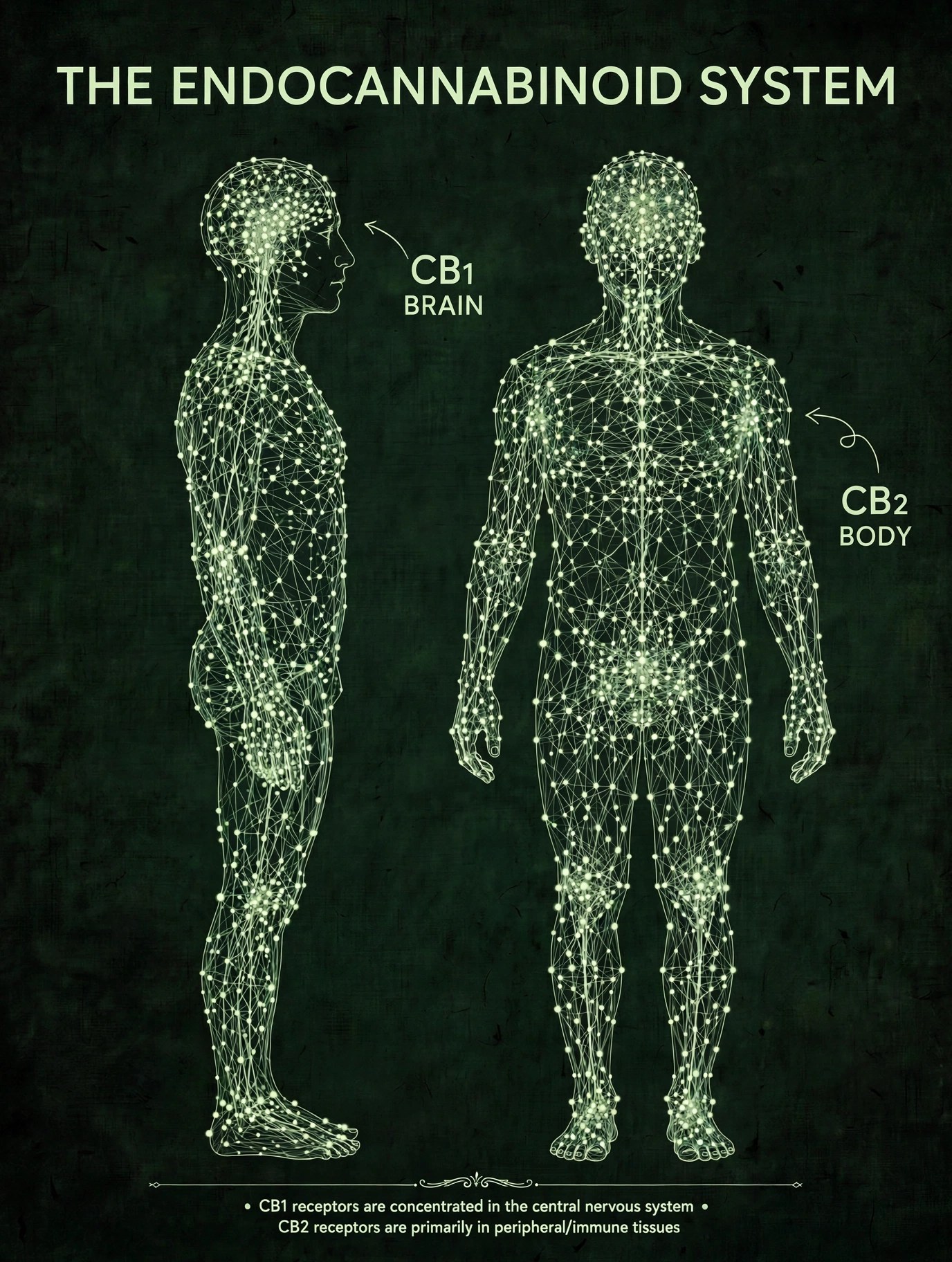
Plate 12 — The body's own system.
About the author
Douglas J. Brownfield is a human with experience. As an author, he writes about the things he has learned and uses, and believes others need to know. Cannabis has spanned nearly his entire life: first exposure in high school, the illicit market years in Chicago before legalization, learning cultivation by working on a California farm, then working professionally as an outdoor organic cultivation specialist in Sonoma, California, three seasons of private cultivation on his own off-grid acreage under a medical allotment, and consulting work in Michigan's state-regulated industry. His other interests and experience include, but are not limited to, tattoo and piercing, brick-and-mortar retail, wholesale design and production through to e-commerce, visual and audio art production, music industry management and engineering, public service works, and developing useful and compliant software and websites, augmented with AI.
This book opens a series written to introduce cannabis to the whole world of its facts, science, and truths — book by book, for the reader who knows nothing about the subject and leans neither way about it. The author came to the plant the way he comes to everything he builds: from the primary record outward, with the open questions left open and labelled. Book One is the plant itself; the books that follow take up its history, its law, its medicine, its growing, and its trades, one at a time.
The author's books stand on the same shelf rule: one subject, primary sources, no drama framing — the facts at the strength the evidence supports, and the open questions left open and labelled.