
Fair Play Economics
Nobody Has to Lose.
A plain-language field guide to how money games are actually funded — and a set of worked designs for games, reward programs, and token systems in which no participant can end with less money than they started with
Start reading
Read the introduction
Every game that handles money answers one question, whether it prints the answer or not: who pays?
Ask it of a lottery and the answer is easy. The players pay. Their ticket money becomes the prize pool, the operator keeps a share, and the mathematics guarantees that the players, as a group, get back less than they put in. Nobody hides this. It is printed in the structure of the thing, and most players understand it perfectly well: they are buying a chance, and the chance is the product.
Ask it of a modern trading challenge — the kind sold online, where you pay a fee to prove you can trade, and in return you are promised a funded account and a split of the profits — and the answer takes some digging. The fee is a few hundred dollars. The funded account is often a simulated one: your trades are mirrored, not real, and no capital of the firm's is ever at risk on your skill. The payouts, when they come, are real money. So where does that money come from?
Mostly, from the next person's fee.
The numbers tell the story plainly. In the largest dataset available — more than 300,000 challenge accounts at ten firms, reported by FPFX, the industry's own technology provider — about 14 percent of accounts pass the evaluation and reach a funded stage. Of those, fewer than half ever receive a payout. Put together, roughly 7 percent of accounts ever reach a payout at all. The average payout, when it comes, is around 4 percent of the account size the buyer was dreaming about. Meanwhile the average buyer spends about $800, across about three attempts, chasing it. One caution belongs here, because this book's promise is that every number carries its basis: that 7 percent is a per-account figure from one vendor's sample. No audited industry-wide figure exists, and the firms that publish their own funnels report different results on different denominators — from about 2 percent per evaluation at one futures firm to about 17 percent per person at another. Chapter 1 sets those funnels side by side rather than averaging them into a fog. On every basis, though, the shape is the same: most of the people who pay in are never paid.
None of this requires a villain. It only requires arithmetic. If the prize pool is funded by the entrants, and the operator's costs and profit come out of the same pool, then the entrants as a group must lose. The only question the design leaves open is which entrants — and the honest name for that question is a lottery, whatever the marketing calls it.
This pattern — the participant quietly funding the prize — is not limited to trading challenges. It runs through a surprising share of the modern rewards economy. Loyalty points that expire unredeemed become income for the company that issued them; by the accounting literature's estimates, something like 15 to 40 percent of point value is never spent. Gift cards go partly unredeemed, year after year, at rates every retailer can predict. Tournament prizes are carved out of entry fees at a percentage that is rarely printed anywhere a player will see it. In each case the structure is the same: the people inside the system are the source of the money the system pays out, minus the house's share, and the details live in terms nobody reads.
This book is about the opposite design.
It turns out there are many ways to fund a game, a reward program, or a prize in which the participant is never the source of the prize. A merchant will pay for a verified customer walking through the door. A foundation will pay, year after year, out of the earnings on money it never spends — the Nobel Prizes have run that way for well over a century. An employer will pay for an employee's education because a trained workforce is worth more than the tuition. A city power utility will pay households to use less electricity at the expensive hour, because paying them is cheaper than firing up another power plant. A sponsor will post a prize for a prediction game simply because the attention is worth the price. In each of these systems, somebody pays — there is always somebody paying; money does not arrive from nowhere — but the payer is paying for something they want, and the participant's wallet is not the fuel.
That difference is the whole subject of this book. We will call a design zero-loss when no participant can end with less money than they started with. The term needs one immediate clarification, because zero-loss does not mean costless. People contribute real things to these systems: their attention, their time, their data, their skills, their behavior. A fair system does not pretend those contributions are nothing. It names them, openly, on the label — your attention is the contribution here; here is what it earns; here is the share, printed in advance. What a zero-loss system never does is reach into the participant's pocket for the prize money and call the reaching a game.
Part I of this book takes apart the systems most readers have already met — the challenge funnel, loyalty breakage, tournament rake — and shows, with their own published numbers, where the money actually flows. None of it is secret; it is merely scattered, and some of it is written in a dialect of disclosures designed to be skipped. Part II states the principles that separate a fair funding structure from a funnel: identify the payer and their real reason; print the rates; keep the prize pipeline under independent control; name the contribution. Part III is the constructive half: twenty worked designs for games and programs in which nobody has to lose. Each one names its payer, shows its arithmetic at a small, checkable scale, states what participants contribute, and points to the closest thing that already exists in the world — including, in several cases, the honest entry none found.
Two promises govern everything that follows. First, every claim that can be checked is sourced, and every number carries the basis it was measured on; where sources disagree, the disagreement is reported rather than smoothed over. Second, designs in this book are labeled for what they are: some are running in the world today at national scale, and some are original designs presented here for the first time. Those are different kinds of statements, and they are never blurred.
The reader this book is written for is two people at once: the builder deciding how to fund a program without feeding on its players, and the player deciding whether to enter a system whose funding they cannot yet see. Both need the same skill, and it is a small one. Before you join, before you build, before you believe — ask who pays, and keep asking until the answer is a name and a reason, not a fog.
If the answer is you — quietly, through fees, expirations, and fine print — you are not looking at a prize. You are looking at the pool.
Free editions
Free. No account, no email, nothing to sign up for.
Audio edition
The whole book, read aloud. 10 parts · 2 hours 28 minutes total.
Press play on any part — the book plays straight through to the end.
- DownloadIntroduction6:46
- DownloadPart One — How the Money Games Actually Work34:02
- DownloadPart Two — Principles of No-Loss Design24:27
- DownloadPart Three — Chapter 10: Funded by Marketing9:10
- DownloadPart Three — Chapter 11: Funded by Time8:41
- DownloadPart Three — Chapter 12: Funded by Attention and Data12:28
- DownloadPart Three — Chapter 13: Funded by People Who Want You Skilled10:33
- DownloadPart Three — Chapter 14: Funded by Each Other, Honestly10:17
- DownloadPart Three — Chapter 15: Funded by Savings and Surplus16:57
- DownloadClosing — The Saturday League + Conclusion14:53
Watch
The book on film, on DJByt — the Douglas J. Brownfield Books YouTube channel. The trailer follows the money in five minutes; the three Shorts take Who Pays, Breakage, and the Merchant's Table one at a time. The complete audiobook film follows when the channel's long-video tier opens.
Watch the trailer — Nobody Has to Lose: Zero-Loss Games, Prop Firms, and Breakage
About the book
Every game that handles money answers one question, whether it prints the answer or not: who pays? In the largest dataset available — more than 300,000 challenge accounts at ten prop firms, reported by the industry's own technology provider — about 7 percent of accounts ever reach a payout at all, and the payouts, when they come, are funded mostly from the next person's fee. If the prize pool is funded by the entrants, and the operator's costs and profit come out of the same pool, then the entrants as a group must lose. It only requires arithmetic.
Fair Play Economics is a plain-language field guide to how money games are actually funded — and a set of worked designs for games, reward programs, and token systems in which no participant can end with less money than they started with. Part I takes apart the systems most readers have already met — prop-firm challenges, loyalty points, tournament prizes — and shows where the prize money really comes from. Part II states the design principles that make a no-loss system possible. Part III presents twenty worked models: who pays, why paying is worth it to them, the arithmetic at small scale, what participants honestly contribute, and what already exists in the world that resembles each one.
Every model in Part III is labelled — found, original design, or a stated mix — and each carries a drawing of its mechanics: who pays, what it funds, what the player receives, and what the player puts in. Designs that fail the book's test are named as failing it, not quietly included; one of them, the most transparent entry-fee pool the research found, is set out in the conclusion with the reason it is excluded.
The book has a working proof. FreeDough, the free arcade built on these designs, runs the models as games anyone can play: this book sets out the designs, and the arcade is the same designs running live. The four paintings in this book hang there, as the top shelf of its prize counter.
Inside the book
- IntroductionThe Only Question That Matters
- Part I — How the Money Games Actually WorkThe Funnel · Where the Payout Money Comes From · Breakage: The Quiet Harvest · Rake, Fees, and the Second Engine
- Part II — Principles of No-Loss DesignWho Pays, and Why Paying Is Worth It · Transparency Is the Product · The Consideration Point · Name the Contribution · For the Builders, and the Players (the hinge chapter)
- Part III — The Models: Twenty Worked DesignsFunded by Marketing · Funded by Time · Funded by Attention and Data · Funded by People Who Want You Skilled · Funded by Each Other, Honestly · Funded by Savings and Surplus
- Closing CaseThe Saturday League
- ConclusionA Five-Minute Audit for Any Program
The art
The four paintings in this book come from FreeDough, the working arcade built on the models in Part III, where they hang as the top shelf of its prize counter — the shelf reserved for the rewards a player earns only over a long season of play. They are reproduced here as plates because the tie between the book and the arcade is the point: this book sets out the designs, and FreeDough is the same designs running live, where anyone can play them. The arcade is the book's working proof, and the book is the arcade's workings, shown.

The Riverboat Herself — the frontispiece. Art: Douglas John Brownfield

The First Baker — opens Part I. Art: Douglas John Brownfield

Your Named Star — opens Part II. Art: Douglas John Brownfield
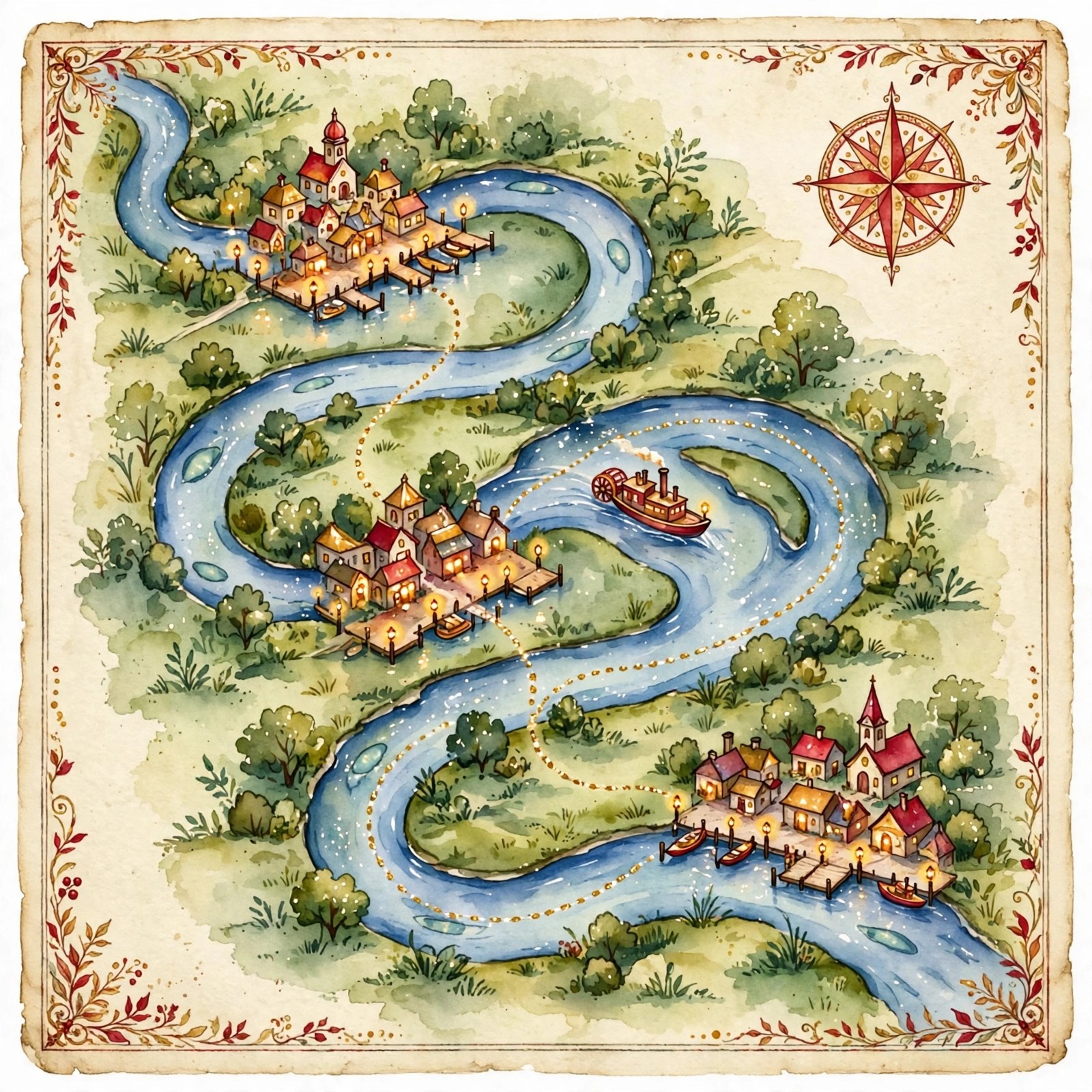
Every Port of Call — opens Part III. Art: Douglas John Brownfield
The twenty mechanics diagrams in Part III were drawn for this book; each carries its model's own worked figures, as printed in its entry.
About the author
Douglas J. Brownfield is an independent builder and artist based in America. He builds self-custodial software tools — programs designed so the people who use them keep hold of their own work — and he writes about what it is actually like to work with AI day after day: where it shines, where it guesses, and where it has to be watched.
His artwork — from book art to ink on canvas to graphic apparel design — takes its cues from whatever he's been looking at: deep space, riverboats, and more to come. One of them carries the art of his first book; a second, in four stages, carries the second.
His second book, Before Q-Day, grew out of his own preparation as a holder — a scheduled change to the mathematics his holdings depend on, researched the way he builds: from primary sources, with the unknowns stated plainly.