Chapter 10 — Cannabis and the Body, in Brief
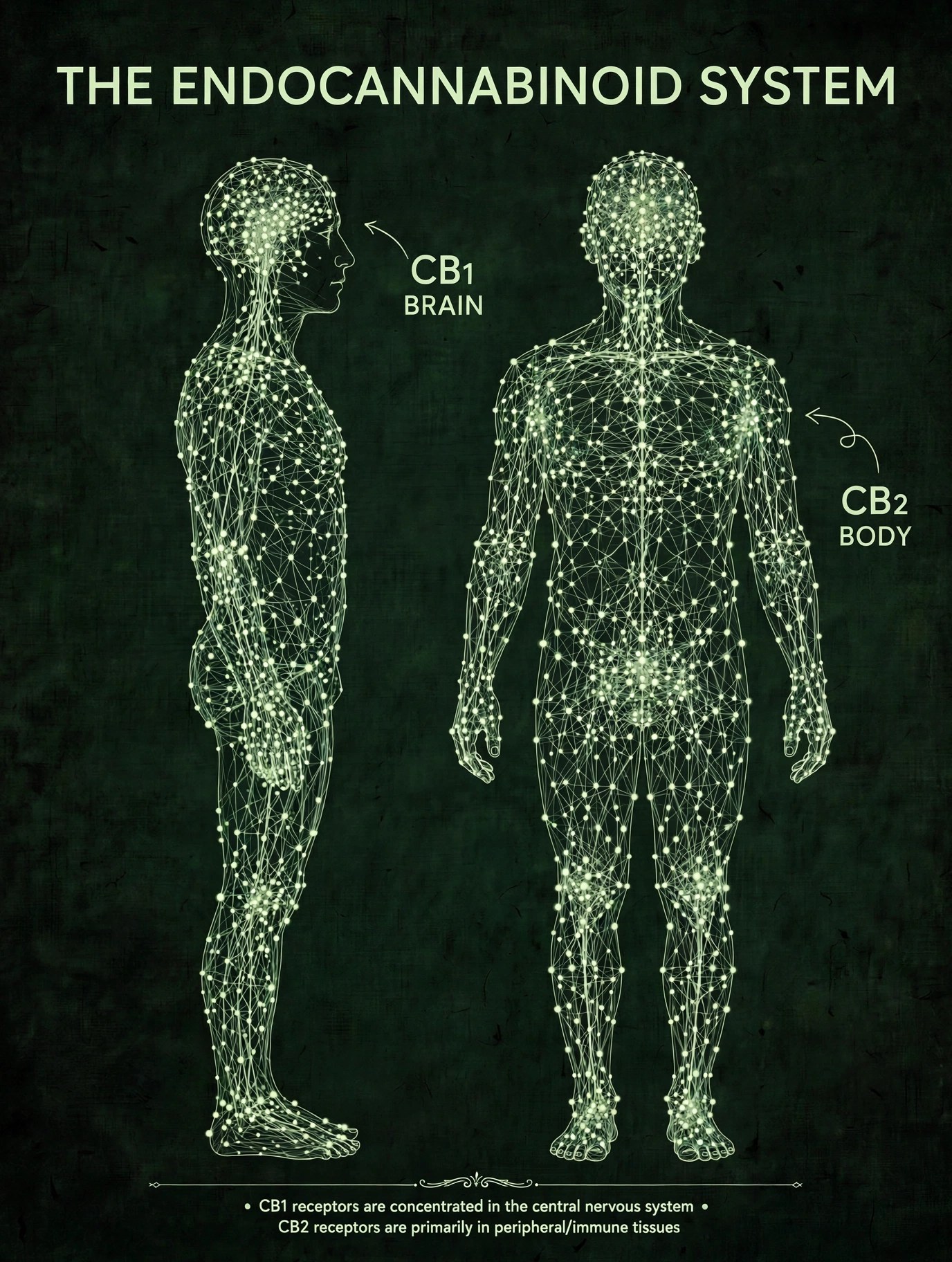
Plate — The body's own system.
Here is the strangest fact in this book. For most of history, nobody asked why cannabis works on the human body — it plainly did, and that was enough. When science finally asked, in the late twentieth century, the answer turned out to be stranger than the question: the body carries a whole signaling system that the plant's chemistry happens to fit — a system nobody had noticed, running in everyone, cannabis user or not. This chapter is that system, in brief; the medical book gives it the volume it deserves.
Found backwards
The discovery ran in reverse. Usually medicine finds a system in the body and then looks for drugs that touch it. Here the drug came first: THC was isolated in 1964, and for two decades nobody knew what it touched. In 1988 researchers demonstrated the lock it fits — a specific receptor in the brain, now called CB1. In 1993 a second receptor, CB2, was found, mostly in the immune system.
A receptor with no known key is a riddle, and the riddle's answer arrived in 1992: the body makes its own key. Raphael Mechoulam's laboratory in Jerusalem — the same school that had isolated THC — identified the first of the body's own cannabinoids and named it anandamide, from the Sanskrit ananda: bliss. A second, called 2-AG, followed in 1995. Together these molecules are the endocannabinoids — endo, from within — and the whole apparatus, receptors, keys, and the enzymes that build and dismantle the keys, is the endocannabinoid system.
The parts
The system has four kinds of part, and a beginner can hold all four.
Two receptors. CB1 stands thick across the brain — in the cortex, the memory centers, the movement centers, the appetite circuits — and more sparsely through the body. CB2 stands mostly on immune cells and in the body's outskirts, rising where there is injury or inflammation.
Two keys of our own. Anandamide and 2-AG are not stored in advance like most of the body's messengers; they are made on demand, from the fatty material of the cell's own membrane, at the moment and place they are needed.
A cleanup crew. Enzymes — FAAH dismantles anandamide, MAGL dismantles 2-AG — destroy the keys within moments of their making. Our own cannabinoids are whispers: local, brief, and gone.
And one direction of travel that surprised everyone. Most signals in the brain run forward, from a sending cell to a receiving one. Endocannabinoids run backward: the receiving cell sends them back across the junction to tell the sender to quiet down. The system is, in its basic posture, a dimmer switch — the brain's way of turning down its own volume, junction by junction.
What the system is for
A dimmer on everything would be a strange thing to evolve, until its jobs are listed: appetite and energy, pain, mood, memory, sleep, immune balance, stress recovery. Researchers who work on the system summarize it in five verbs — eat, sleep, relax, forget, and protect — and the common thread is balance: the endocannabinoid system is one of the body's great regulators, nudging excited systems down and quiet ones up, keeping the whole within its working range. It is running in you now, whether or not cannabis has ever come near you. The plant did not create this system. The plant's chemistry eavesdrops on it.
The resting level — tone
Because the system is a regulator, researchers speak of its resting state as a tone: the background level of endocannabinoid activity a body runs at, person to person, system to system. Tone explains a puzzle a beginner will meet everywhere in this field — why the same dose of the same plant can barely touch one person and overwhelm another. The receptors differ, the cleanup enzymes differ in speed, and the tone the plant's chemistry lands on differs before the first breath is taken. One research program has gone further and proposed that several hard-to-treat conditions — migraine, fibromyalgia, irritable bowel — share a low underlying tone, a clinical endocannabinoid deficiency. The proposal is graded suggestive here: the pattern is real enough to publish and nowhere near proven enough to build treatment on. The medical book examines it in place. For this chapter, tone is the idea to keep: the plant does not act on a blank body. It acts on a system already set, by inheritance and by life, to its own level.
The system at play
One modern finding shows the system doing its ordinary work in a place nobody expected. For decades the euphoria after long exercise — the runner's high — was credited to endorphins, the body's own opioids. The evidence has shifted: endorphins cross into the brain poorly, while anandamide rises measurably in the blood during sustained exercise, crosses easily, and in animal studies the calm, pain-dulled state after a run disappears when cannabinoid receptors are blocked, and stays when opioid receptors are blocked instead. The grade here is supported, not settled — human work is still catching up to the animal work — but the direction is plain enough to teach the chapter's lesson in one example: this system is not a drug system waiting for a plant. It is a working part of ordinary life — appetite, mood, pain, exertion, rest — and the plant is the imitator, not the inventor.
Why the plant's version overwhelms
THC fits CB1 because its shape resembles anandamide's closely enough to turn the same lock. But the resemblance ends at the lock. Anandamide arrives in pinpoint amounts, at one junction, and is dismantled in moments. THC arrives everywhere at once, at every CB1 receptor in the brain simultaneously, and the cleanup crew cannot dismantle it quickly — it lingers for hours. The difference between the body's signal and the plant's is the difference between a whisper in one ear and a shout in every room of the house at once. That single contrast explains both the breadth of the cannabis high — appetite, time, memory, mood, body, all turned at once — and its occasional overshoot into anxiety: every dimmer in the building, pushed down together, further than the system ever pushes itself.
Two honest footnotes belong here. The brainstem — the deep center that runs breathing — carries very few CB1 receptors, which is why cannabis, unlike the opioids whose receptors crowd that center, does not stop breathing; the absence of a fatal-overdose mechanism of that kind is anatomy, not advocacy. And with heavy, daily use the brain adapts, thinning its CB1 receptors — tolerance — and restores them in abstinence; dependence is real, is carried in full by the medical and safety books, and begins in this reversible thinning.
CBD, the other famous compound, barely fits either lock — its low grip on CB1 and CB2 is exactly why it does not intoxicate — and it works instead by smaller touches on many systems at once, which is why its science is real and its claims need the grading the medical book gives them.
Holding the chapter
The body keeps a cannabis-like system of its own, for balance; the plant makes molecules that fit it, louder and longer than the originals. Every effect in this series — medical, recreational, harmful — is a footnote to that fit. But a fair question now stands over everything this book has told you: how solid is any of it? The next chapter grades the evidence itself — because a series that began by promising grades owes the reader the scale.