Chapter 8 — Hemp and Marijuana
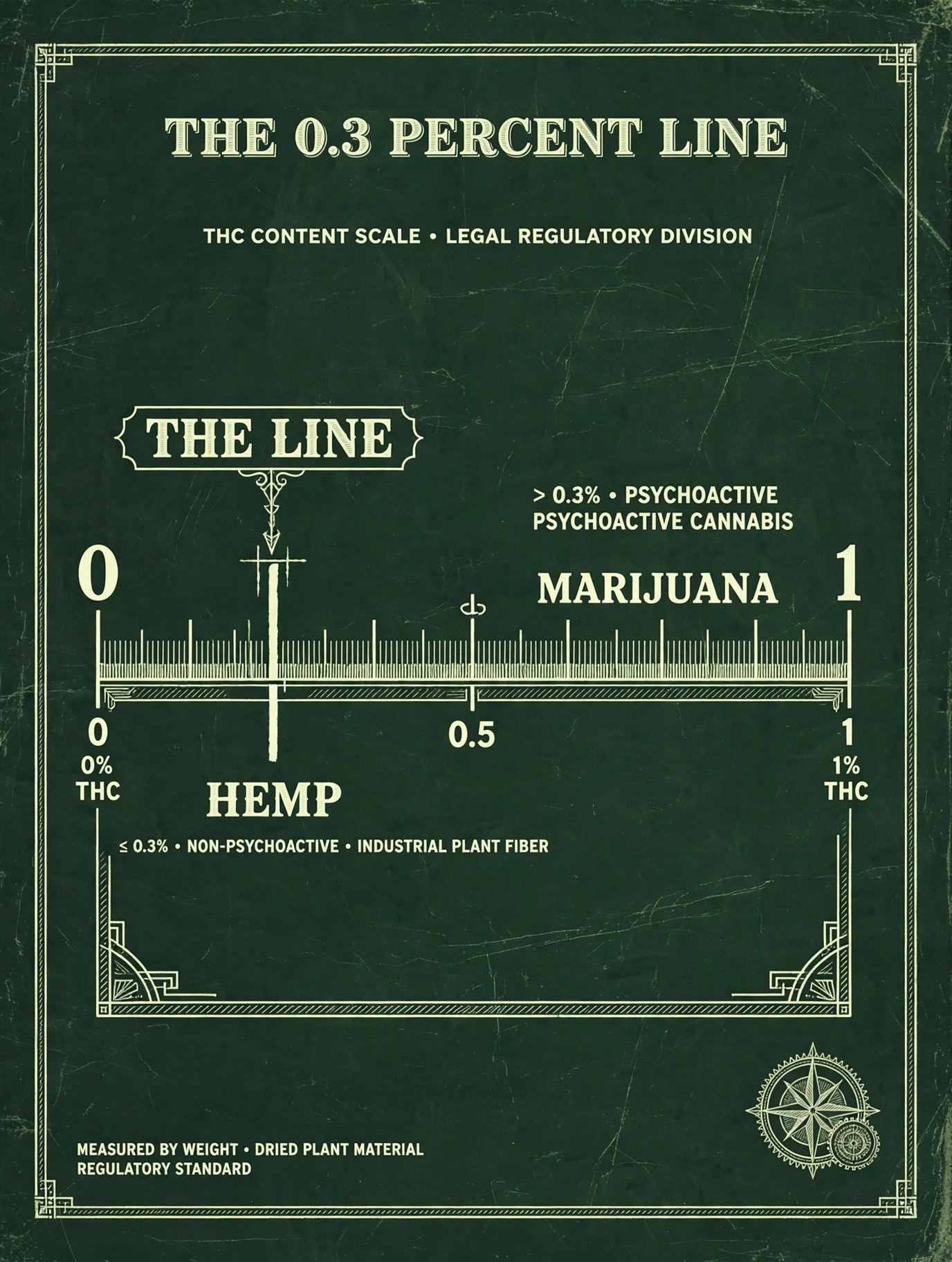
Plate — The line at 0.3 percent.
Two fields can stand side by side, planted with the same species, grown from cousin seed, and exist in different legal universes — one a farm commodity, the other a controlled substance. Nothing about the plants explains it. The difference is a line drawn by law across the middle of one species, and this chapter draws it where a beginner can see it: what the two words originally meant, where the line sits, how it is measured, and what it costs the people who farm near it.
The old word
Hemp is the plant's oldest English name — it descends from the Old English hænep and its Germanic cousins, and for most of history it meant cannabis itself, full stop: the fiber crop, the seed crop, the plant in the herb-garden. Nobody asked how strong a hemp plant was, because the question the word answered was what the plant was for: rope, cloth, sail, seed, oil. The fiber book of this series is, in that old sense, the hemp book — and it begins where this word does, in a world that had only one name because it had only one relationship with the plant.
The newer word
Marijuana is a much younger word in English. It comes from Mexican Spanish — marihuana — and it rose in American usage in the early twentieth century, attached specifically to the plant as a smoked drug, at exactly the moment the plant was being recast in American public life as a foreign menace. The prohibition book of this series tells that campaign in full; the fact needed here is simpler. When the United States wrote its first federal law against the plant in 1937, it legislated against "marihuana" — and exempted the stalks, fiber, and sterilized seed of the old hemp economy in the same text. From the beginning, the law has kept two vocabularies for one plant: the crop and the drug. Botany never made that split. Law did.
The line
The modern form of the split is a number. Under the United States' 2018 Farm Act, hemp is defined as Cannabis sativa and every part of it with a delta-9 THC concentration of not more than 0.3 percent, measured on a dry-weight basis. At or under the line: hemp, a legal agricultural commodity, removed from the Controlled Substances Act. Over it: marijuana, a controlled substance under federal law, whatever a given state's own law says.
Where did 0.3 come from? Not from the plant. In the 1970s the Canadian researcher Ernest Small, working on the taxonomy problem of Chapter 1, needed a practical dividing line between drug-type and fiber-type plants for his classification, and he drew one at 0.3 percent — a line he has acknowledged was a pragmatic choice, not a boundary found in nature. The line was picked up by regulators, first in Canada, then in Europe and the United States, until a taxonomist's convenience became the legal definition of two different plants that are not two plants. Other jurisdictions draw it elsewhere — the European Union long used 0.2 percent before raising its line to 0.3; a few countries allow up to 1 percent. The plant does not know any of these numbers. Enzymes, as Chapter 5 showed, do not read statutes.
How the line is measured — and the crop it destroys
The measurement carries a catch, and the catch ruins harvests. Because THCA becomes THC with heat, regulators test for total THC — the THC present plus the THC the acid would become. A crop can sit under the line on one measure and over it on the other. And a living crop will not sit still: THC climbs as flowering advances, and heat and stress can push it, so a field legal in August can test "hot" in September. Over the line, the crop is not sold at a discount. Under the rules it is destroyed, at the farmer's loss, by the farmer's hand or under supervision. Every hemp farmer in the regulated world farms with one eye on that number, harvesting early against it — a whole agriculture shaped by the gap between a botanical gradient and a legal cliff.
The line, worldwide
The 0.3 line is American law, not world law, and the map of other lines shows how arbitrary any single one is. Switzerland permits hemp up to 1 percent total THC — more than three times the American line — and sells low-THC flower openly as a tobacco substitute, a market that cannot legally exist across its borders. The European Union farmed for years under 0.2 percent before raising its line to match the American 0.3. Canada draws its line at the same 0.3. Colombia allows 1 percent. The same plant, the same enzymes, the same field could be a legal crop in Zurich, a regulated crop in Toronto, and a felony in Texas. Nothing in that sentence is about botany. It is the cleanest demonstration in this book that hemp and marijuana are not kinds of plant. They are kinds of permission.
The third agriculture: grain
Between the fiber field and the drug garden stands a third way of farming this plant, older than both in spirit: growing it for the seed itself. Grain hemp is planted like a cereal crop, the sexes left together, pollination not merely allowed but required — no seed without it — and the harvest taken by combine like wheat. The seed that comes off those fields is the food of Book 6 of this series: roughly a quarter protein, a third oil, carrying the essential fatty acids in proportions nutritionists praise. The same plant that law sorts into two boxes is farmed, quietly, in a third — for the one part of it that was never intoxicating, never fiber, only food. A beginner who holds all three agricultures in view at once — fiber, grain, and flower — has the whole plant in a way the law's two words never give.
Sinsemilla — the other consequence
Chapter 2 left a debt: why growers remove the males. Here is the payment. Drug cannabis is grown for the unfertilized female flower. Pollinate her and her economy turns to seed — resin production stalls, the harvest fills with seed instead of flower, and the product is weaker by weight and worse to use. So the males go, and the females flower unfertilized to the end. The product has a name from the Spanish: sinsemilla, "without seed." The seedless flower was known for centuries in the old hashish countries; it became the standard of the modern drug crop in the 1970s, and it is why the drug and the fiber crops are farmed in opposite ways — fiber hemp is planted dense and harvested by machine, seed and all welcome, while drug cannabis is planted wide, sexed, weeded of males, and picked by hand. One species, two agricultures, and the split between them is not in the seed. It is in what the buyer wants and what the law allows.
Holding the chapter
Keep the two vocabularies separate and both will serve you. In botany, there is one plant, with fiber forms and drug forms shading into each other along a chemical gradient. In law, there are two plants, divided by a line at 0.3 percent that a taxonomist drew for convenience and parliaments adopted for control. Nearly every confusion in the public conversation about cannabis — and several books of this series — live in the gap between those sentences. The plant, meanwhile, goes on making its chemistry without regard to either. The next chapter catalogs what people actually do with it: the forms in which cannabis is used, from the oldest flower to the newest laboratory glass.