Chapter 7 — Kinds of Cannabis
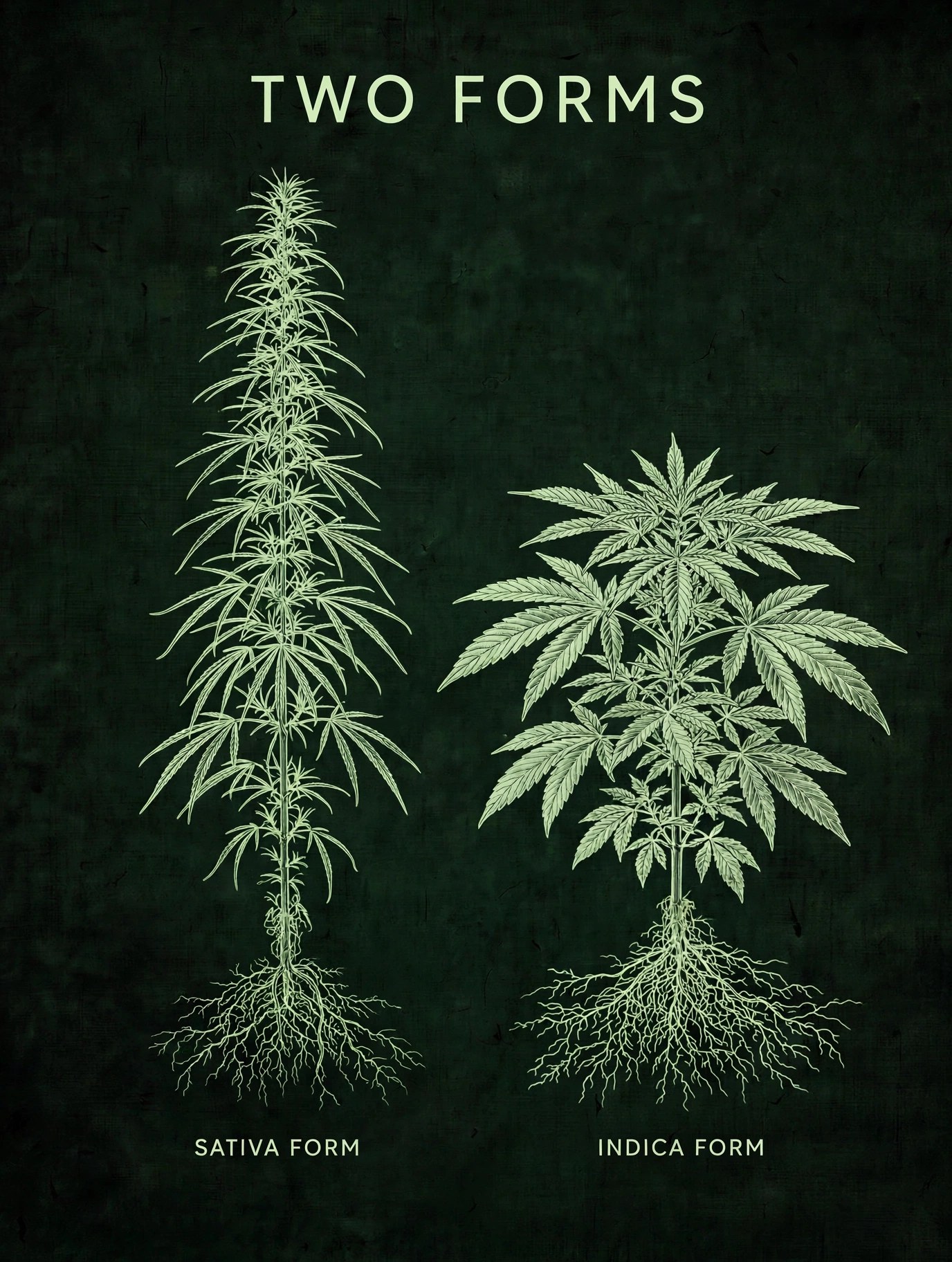
Plate — The two forms, side by side.
Walk into a shop where cannabis is sold and the first question is usually a choice between two words: sativa or indica? The words are offered as if they were kinds of the plant, with kinds of effects — one uplifting, one sedating. This chapter traces those words from their scientific birth to their shop-counter present, and gives the reader the classification that actually predicts something: not the label, but the chemistry.
The names from science
Chapter 1 told the short version. Linnaeus, in 1753, named the plant he knew — European fiber hemp — Cannabis sativa, sativa meaning simply "cultivated." In 1785 Lamarck received specimens from India: shorter, denser plants with broader leaflets and a noticeably stronger intoxicating power, and he named them a second species, Cannabis indica — indica meaning "of India." In 1924 the Russian botanist Janischevsky described a tough wild plant of the northern steppes and gave the world a third name, ruderalis, from ruderal — growing where ground is disturbed, roadsides and waste places. That wild northern plant is the ancestor of the autoflowering kinds from Chapter 3: it traded the night-signal for flowering by age, under skies where summer nights are too short to measure.
Modern genetics, as Chapter 1 said, leans toward one species wearing all three names as regional forms. The forms are real. What the names can bear is another matter.
The shapes underneath the folklore
The folklore grew from real plants. The tall, narrow-leafleted kinds come from equatorial regions — Thailand, Colombia, southern Africa, Mexico — where the season is long; they grow like climbers, flower slowly, and their effect was traditionally described as bright and cerebral. The short, broad-leafleted kinds come from the mountains of Central Asia — the Hindu Kush country of Afghanistan and Pakistan — where the season is short and harsh; they grow like shrubs, flower fast, and their effect was described as heavy and bodily. Generations of growers knew these two silhouettes the way farmers know breeds of dog, and the silhouettes are genuine: leaf shape, height, and pace do travel with ancestry.
The trouble began when the shapes were crossed. A century of breeding — and an intense few decades of it under prohibition, indoors, where short and fast was survival — hybridized nearly everything. Most drug cannabis grown today is a blend of both ancestries in unknown proportions, whatever its label says. The two silhouettes survive as tendencies. The pure lines survive mostly as heirlooms.
Landraces — the kinds a place made
Before the breeders, there were landraces: populations shaped by one place over generations, half by the land and climate, half by the local farmers keeping seed from the plants they liked. Afghan, Thai, Colombian, Durban, Acapulco — the old names on the map are landrace names, and the landraces are the original gene pools from which all modern breeding descends. They matter to this series twice: as history (the deep-history book walks their roads) and as genetics (the seed book treats them as the library the future breeds from). A landrace is a kind of cannabis the way a dialect is a kind of language: made by a place, over time, out of use.
Strain names — and why they wobble
The shop's other vocabulary is the strain name — the colorful, trademarked- sounding names on the jars. A beginner should know three things about them. First, the correct horticultural word is cultivar, a cultivated variety; "strain" is borrowed from microbiology, where it means something stricter. Second, cultivar names in cannabis are unregulated: there is no registry with legal force, no standard a name must meet, and nothing to stop two unrelated plants being sold under one famous name, or one plant under five. Third, studies that compared labeled products against their actual genetics and chemistry found exactly the wobble that predicts: the same name from different sources is often chemically different, and the sativa/indica label on the jar predicts the chemistry inside only weakly. The names are not lies, exactly. They are folklore with a price tag — sometimes attached to the real lineage, sometimes not, with no way for the buyer to tell from the name alone.
The seed banks
The modern kinds were made in a specific place and time, and the place was, of all places, the Netherlands. In the 1970s and 1980s, breeders carrying landrace seed out of Afghanistan, Thailand, Colombia, and Mexico gathered where the law gave them a crack of light, crossed the old silhouettes deliberately, and stabilized the results as named, reproducible seed lines — sold by mail, in catalogs, under rules of craft the drug underground had never had: keep the parents, select ruthlessly, name honestly. Almost every variety in a modern shop descends from that work and its American continuations. It is the moment cannabis breeding changed from a folk practice of farmers keeping seed to a deliberate discipline of crossing and selection — and, as the strain section warns, the naming discipline of that era has not survived into the age of the jar label.
The feral kind
One more kind deserves its paragraph, because no one planted it — lately. Across the American Midwest, in Indiana, Illinois, Nebraska, Iowa, and Kansas, cannabis grows wild in ditches and along field edges: the descendant of the fiber hemp planted under government encouragement during the Second World War and abandoned to the birds when the program ended. Locals call it ditch weed. It is cannabis returned to the wild — reverted, over eighty generations of nobody selecting it, toward the hardy, low-strength wild form its ancestors started as. Its THC is negligible; generations of teenagers have confirmed this experimentally and been disappointed. Law enforcement programs have spent decades eradicating it by the millions of plants, a war against a weed that is, chemically, barely the drug at all. The feral kind is the plant's own argument for Chapter 1's position: left alone, it does not stay a drug crop or a fiber crop. It just goes on being cannabis.
The classification that predicts: chemotypes
Science's working answer is to classify by chemistry — the chemovar, or chemotype: what the plant actually makes, measured. The scheme most used divides cannabis into five types:
Type I — THC-dominant. Most modern drug cannabis. Type II — mixed, THC and CBD in comparable measure. Type III — CBD-dominant, with little THC. Most legal "hemp" flower. Type IV — CBG-dominant, bred from the parent compound's line. Type V — essentially no cannabinoids at all; fiber and seed plants at their purest.
A chemotype does not tell you everything — the terpenes ride along and shade the experience, as Chapter 6 graded honestly. But a type number predicts the main event of a plant's effect in a way no silhouette and no jar label can. When this series needs to be precise about kinds, it reaches for the chemotype first, the ancestry second, and the shop label last.
Holding the chapter
So what should a beginner do with sativa and indica? Use them the way they deserve: as a rough sketch of ancestry and shape — a tall narrow plant and a short broad one — and as the first word of a conversation, never the last. The plant's chemistry is its identity; everything else is its biography. The next chapter takes up one more pair of names, the most consequential of all, because these two are written into law: hemp and marijuana.