Chapter 6 — The Aromatics: Terpenes and Flavonoids
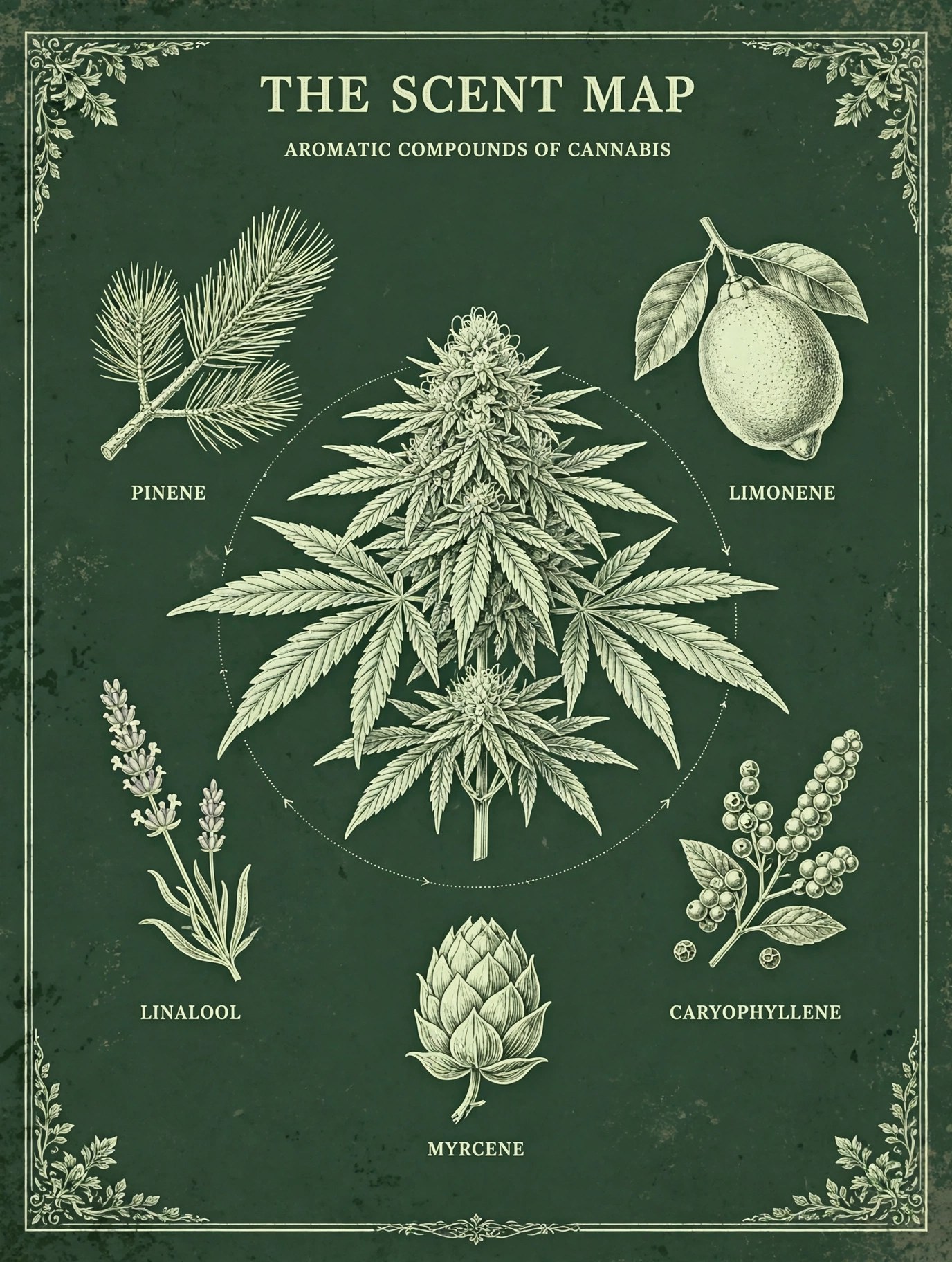
Plate — The scent map.
Cannabis announces itself. The smell crosses rooms and property lines, and it has started more arguments, and more police visits, than any other property of the plant. Yet the famous compounds of the last chapter have almost no smell at all. The announcement is made by a second family of chemicals, made in the same gland heads, doing different work: the terpenes — and behind them, quieter, the flavonoids, the pigments. This chapter names them.
Terpenes — the scent family of the whole plant kingdom
Terpenes are not cannabis's invention. They are the largest family of natural compounds on earth, built by nearly every plant — the smell of pine forest, lemon peel, lavender, and rain on herbs is terpenes, all of it. They are assembled from a simple five-carbon building block, joined into tens (the light, quick-evaporating monoterpenes, the bright top notes of any scent) and fifteens (the heavier sesquiterpenes, the deep base notes). Cannabis makes well over a hundred of them, and a plant's particular mixture — its terpene profile — is most of what makes one kind smell of citrus and another of pine, one of pepper and another of flowers.
The majors, the ones a beginner will meet again and again:
Myrcene — earthy, musky, a little fruity. Usually the most abundant terpene in modern drug cannabis. Also the main scent note of hops — the plant's own cousin — and present in mangoes and lemongrass.
Limonene — unmistakably citrus. It is the smell of lemon and orange rind, where it also lives in quantity.
Pinene — pine resin, a walk in conifers. Among the most common terpenes in nature; rosemary carries it too.
Linalool — floral and soft. It is the signature scent of lavender.
Caryophyllene — warm, peppery, spicy: the bite in black pepper and cloves. It earns a paragraph of its own below.
Humulene — dry, woody, hoppy; another cousinly compound, named for hops.
Terpinolene — fresh, piney, citrus-herbal all at once; the dominant terpene in a minority of varieties, where it gives a bright, almost lilac character.
None of these belongs to cannabis. What belongs to cannabis is the recipe — the proportions — and the company they keep: nowhere else in nature do these common aromatics sit dissolved in a bed of cannabinoids.
Reading a terpene report
Where cannabis is sold legally, laboratory reports increasingly list the terpenes beside the cannabinoids, and a beginner can learn to read one in a minute. Three habits suffice. Read the total first: the terpenes together usually make up only one to three percent of the flower's weight — the scent family is a small share of the mass doing an outsized share of the talking. Read the leader second: the single dominant terpene, often a third or more of that total, sets the scent's character more than the long tail behind it. And read presence last and skeptically: a terpene listed at a hundredth of a percent is a fact, not a flavor. The report, read this way, is the plant's recipe card — the same discipline Chapter 11 teaches for every claim in this field, applied to a label.
The skunk note
One part of the smell long refused to be filed under terpenes at all: the skunky reek that the strongest modern varieties give off, the note that carries furthest and offends most. It is not a terpene. In 2021, researchers analyzing the headspace above flowering plants identified its source as a small family of volatile sulfur compounds — chief among them a molecule also found in garlic and in the spray of an actual skunk. These compounds are present in tiny amounts and are potent out of all proportion to their quantity, which is why the skunk note can dominate a whole plant's scent while the terpenes do the quieter work beneath it. The discovery is a useful lesson in how this plant keeps being measured: a smell humanity has known for centuries waited until 2021 for anyone to name the molecule responsible.
The boundary-crosser
Caryophyllene deserves its extra line because it breaks the filing system. Most terpenes are scent and only scent, as far as the body is concerned. But caryophyllene also fits the body's CB2 receptor — the second cannabinoid receptor, found mostly in immune tissues — and switches it on, which makes this pepper terpene, by function, something like a cannabinoid as well. Researchers call it a dietary cannabinoid: you season food with it. It is the standing proof that the plant's two chemical families are not strangers to each other, and it is one of the firmer footholds for the idea, examined below, that the families work together.
What the scent is for
For the plant, scent is not perfume; it is communication and defense carried on air. Terpenes repel some insects and sicken others; some slow the growth of rival plants and microbes; the plume rising off a flowering female is a chemical announcement to the whole neighborhood of insects — keep off, in most dialects. The same volatility that does this work is why cannabis smells so far: these molecules are built to leave. They evaporate at room temperature, break down in light and air, and fade — which is why old cannabis smells flat and tired, why careful curing and storage are really terpene conservation (the post-harvest book is half about this), and why the smell of the fresh plant is, chemically, the plant spending itself into the wind.
The entourage question — graded honestly
Do the terpenes change the effect of the cannabinoids they travel with? The idea has a name — the entourage effect — proposed in the late 1990s by researchers in Mechoulam's circle and argued since by many. It is the claim behind a common experience: two plants with the same THC percentage can feel noticeably different, and their clearest chemical difference is the terpene profile.
Here is the honest grade, in this series' manner. The ingredients are real, the interactions are plausible, and laboratory studies support some of them — caryophyllene's receptor action above is the hardest fact in the file. But direct proof in humans, at the doses actually present in a flower, is thin; the famous sub-claims — that myrcene is what makes some cannabis sedating, for instance — rest more on lore and animal work than on settled trials. The entourage effect is best described as a live hypothesis with strong ingredients, not a proven law. Later books return to it wherever it is invoked, with the same grade attached. A reader who knows nothing deserves the excitement and the grade in the same breath.
Flavonoids — the pigments
The third family is the quietest. Flavonoids are the pigments and protectors of the plant world — tens of thousands of them across nature, coloring flowers, screening ultraviolet, signaling to insects. Cannabis carries about twenty. Most are shared with ordinary foods — the same flavonoid families that color blueberries and onions appear here. The purple in purple varieties of cannabis is anthocyanin, the blueberry pigment, often drawn out by cold nights — a color, it should be said plainly, that says nothing reliable about strength.
Two flavonoids, though, are cannabis's own: the cannflavins, found nowhere else in nature so far as is known. On the laboratory bench they show anti-inflammatory activity — in one early study, stronger than aspirin in a dish — and they are studied still. A dish is not a body, and this series does not promote bench findings into medicines; the cannflavins are recorded here as what they are: a signature compound family, unique to this plant, at the beginning of its evidence road rather than the end.
Holding the chapter
Three families, then, come out of the one small factory: cannabinoids for the body's receptors, terpenes for the air, flavonoids for color and screen — defense, announcement, and armor from a single gland. And since every plant mixes the three in its own proportions, no two kinds of cannabis are quite the same chemistry. Which raises the question the next chapter takes up: what are the kinds, and what, if anything, do their names mean?