Chapter 5 — The Chemistry: Cannabinoids
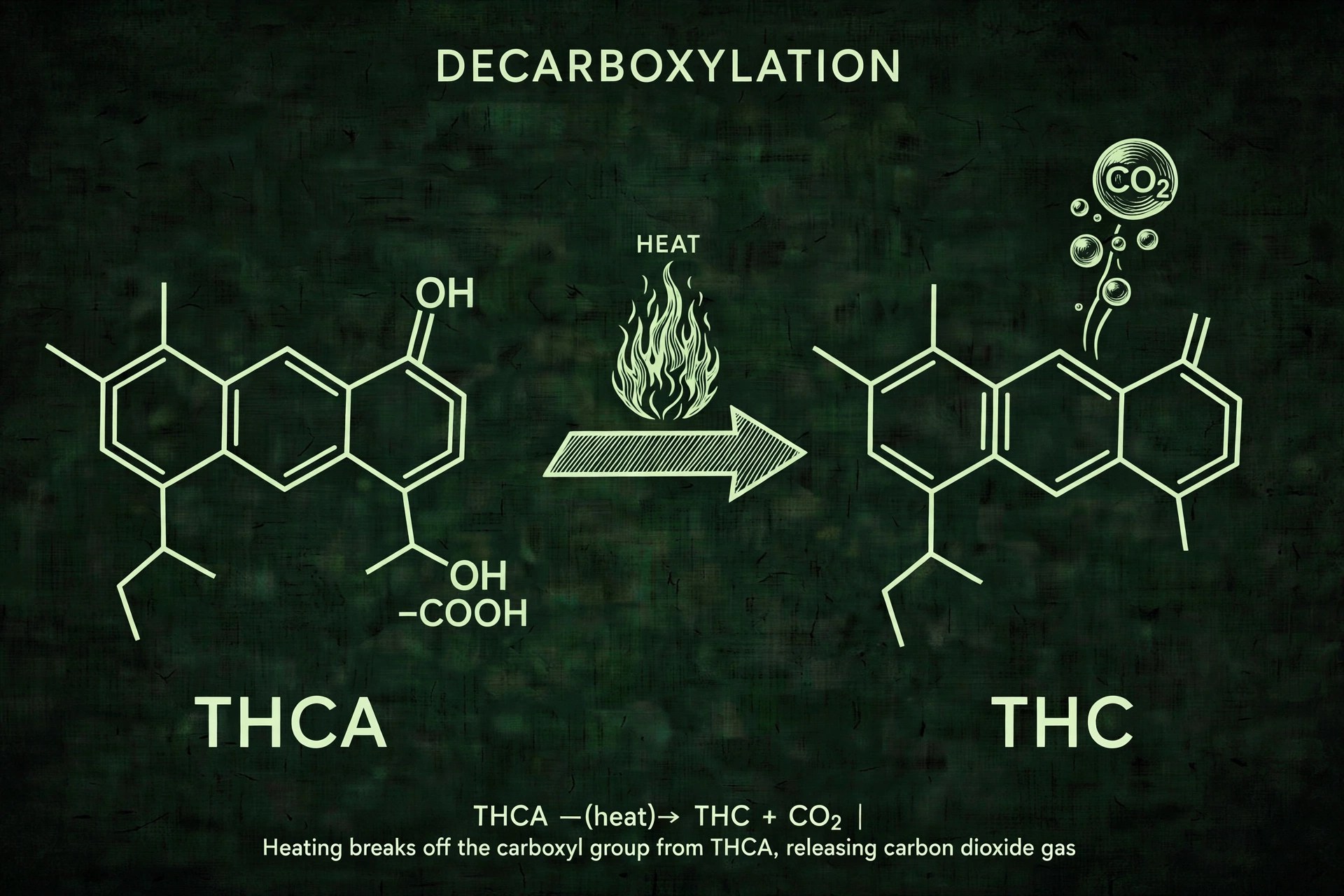
Plate — Heat and time: the acid becomes the compound.
Open one of the factory heads from the last chapter and analyze what is inside and you find a family: more than a hundred related chemical compounds, found almost nowhere else in nature, called cannabinoids. This chapter introduces the family properly — where they all come from, the two famous members, the supporting cast, and one fact that overturns most people's picture of the plant: fresh cannabis is not, in the usual sense, intoxicating at all.
The mother compound
Every cannabinoid begins as one molecule. Deep in the gland head, the plant assembles a compound called CBGA — cannabigerolic acid — and CBGA is the parent of the clan. The gland holds a set of enzymes, molecular machines each shaped to do one job, and they take CBGA and fold it into different children: one enzyme makes THCA, another makes CBDA, a third makes CBCA. Which enzymes a plant carries is written in its genetics — which is why one plant grows up rich in THC and its cousin, carrying different enzyme instructions, grows up rich in CBD. The chemistry of a cannabis plant is, at this level, an inheritance. The genetics book of this series takes up that inheritance in full; the terpenes and minor-compounds book takes up the rest of the family tree.
What is left over, unconverted, stays CBGA and becomes CBG — the parent surviving in small amounts among its children. Remember that name; it returns below.
The acid truth
Now the overturning fact. The plant does not make THC. It makes THCA — tetrahydrocannabinolic acid — and likewise CBDA and CBGA: the cannabinoids in a living or freshly picked plant are almost all in these acid forms, each carrying an extra chemical attachment, a carboxyl group, like a cap on the molecule.
The cap matters. THCA does not produce the cannabis high; it does not engage the body's receptors the way THC does. Eat raw cannabis flower and, that chemistry aside, essentially nothing happens. The cap comes off with heat — or slowly, with time. Chemists call the uncapping decarboxylation: heat the material and the acid sheds its extra piece as carbon dioxide and becomes the neutral compound — THCA becomes THC, CBDA becomes CBD. Smoking does it instantly. Cooking does it deliberately. Drying and aging do it a little. Every intoxicating use of cannabis in human history has depended on this one small chemical event, most of it performed unknowingly, by fire.
THC — the famous one
THC — delta-9-tetrahydrocannabinol, to give it its working name — is the principal intoxicating compound of cannabis, the one that engages the CB1 receptors of the brain and produces the high, with all its pleasures and its risks; Chapter 10 explains the engagement, and the medical and safety books weigh the consequences. Its structure was determined in 1964, in Jerusalem, by the chemist Raphael Mechoulam and his colleague Yehiel Gaoni — the first time anyone could point at the molecule responsible for an effect humanity had known for millennia. THC is also fragile: with heat, light, air, and time it degrades, oxidizing into another compound — which brings in the supporting cast.
CBD — the famous other
CBD, cannabidiol, is THC's sibling and opposite in reputation. It is made by the parallel road — CBDA, uncapped by heat — and it does not produce a high: it does not engage the brain's CB1 receptors in THC's manner at all. What it does instead is subtler and still being mapped; it interacts with many systems at once, modestly. One thing about it is settled at the highest level of evidence: purified CBD is an approved medicine — the drug Epidiolex, approved by the U.S. Food and Drug Administration in 2018 for certain severe childhood epilepsies — the first cannabis-derived drug to pass that bar. Beyond that approved use, claims for CBD run far ahead of the proof, and this series grades them claim by claim in the medical book. Here it is enough to know what CBD is: the non-intoxicating cannabinoid, bred to dominance in whole families of modern plants.
The supporting cast
Four more members deserve a first introduction; the minor-compounds book gives the full roll.
CBG, cannabigerol — the parent compound's own neutral form, left over in small amounts after the enzymes take their shares. Long ignored because there was so little of it, now bred for directly.
CBN, cannabinol — the compound THC becomes. As THC ages and oxidizes, it converts to CBN, which is only mildly intoxicating and is associated in growers' and users' lore with heaviness and sleep; the lore runs ahead of the studies, and the safety book grades it. CBN is also the answer to a promise made in Chapter 3: the glands' turn from cloudy to amber is the visible sign of this slow chemistry — maturation, then the beginning of decay. The gauge growers read is, in part, THC quietly turning into something else.
CBC, cannabichromene — the third child of the parent compound, present in meaningful amounts in some plants, non-intoxicating, studied for a range of possible effects and proven for few so far.
The varins — THCV and CBDV — the family's leaner branch: same architecture as THC and CBD but built with a shorter chemical tail, which changes their behavior; THCV at ordinary doses does not behave like THC and may blunt it. And a name to file for later books: delta-8-THC, a near-twin of THC that the plant itself makes only in traces — the delta-8 sold widely today is mostly manufactured from CBD in laboratories, a fact that belongs to the synthetics and hemp-loophole books, where it gets the full hearing it requires.
Fresh, cured, and old — the chemistry of keeping
A harvested plant's chemistry does not freeze; it drifts, and the drift has a direction. In stored flower, the acid forms slowly shed their caps even at room temperature, so an old sample holds more neutral THC than it did fresh. The THC itself then oxidizes toward CBN, steadily, faster in heat and light. The terpenes, built to evaporate, leave first and fastest — which is why age flattens a flower's smell before it flattens anything else. The net result is the profile users describe in old cannabis: duller in scent, heavier and sleepier in effect, weaker at the peak. Curing — the slow, controlled drying of the post-harvest book — is the craft of slowing this drift and steering it: moisture leaves gradually, harsh compounds break down, and the acids convert in an orderly way. Every jar on every shelf is a slow chemical argument between the plant's chemistry and time, and storage is how the argument is refereed.
The strength question, in numbers
How much THC does cannabis actually carry? The honest answer is a range so wide it explains half the arguments in this field. At one end stands hemp: by law under 0.3 percent THC, and in practice usually far under. At the other end stand modern drug varieties, bred for fifty years toward one trait: their flower commonly tests between 15 and 25 percent THC by dry weight, and the strongest exceed 30. Concentrates go further still — the laboratory forms of Chapter 9 can pass 80 or 90 percent, numbers the plant itself never reaches.
The range was not always so wide. The longest-running measurement program in the United States, which has analyzed seized and submitted cannabis for decades, records the average THC of flower rising from around 4 percent in the mid-1990s to roughly 16 percent by the early 2020s — a fourfold climb in one generation of breeding, while CBD in the same material fell away to almost nothing. Two consequences follow. Comparisons across eras are treacherous: the cannabis of a 1970s study and the cannabis of a modern dispensary are the same species and barely the same drug. And dose — the subject the safety book weighs in full — cannot be judged by the plant's name or form alone. It lives in these numbers, which is why the testing book of this series exists.
Holding the chapter
One parent, a set of enzymes, a cap that heat removes: that is the whole architecture. THC and CBD are two roads from the same molecule, chosen by the plant's inheritance. The acids are what the plant actually makes; the famous compounds are what fire and time make of them.
But cannabinoids are not the whole of what the factory produces — they are nearly odorless, all of them. The smell of cannabis, the thing that announces it through a wall, is a different family of compounds entirely. The next chapter follows your nose.