Chapter 4 — The Tiny Factories
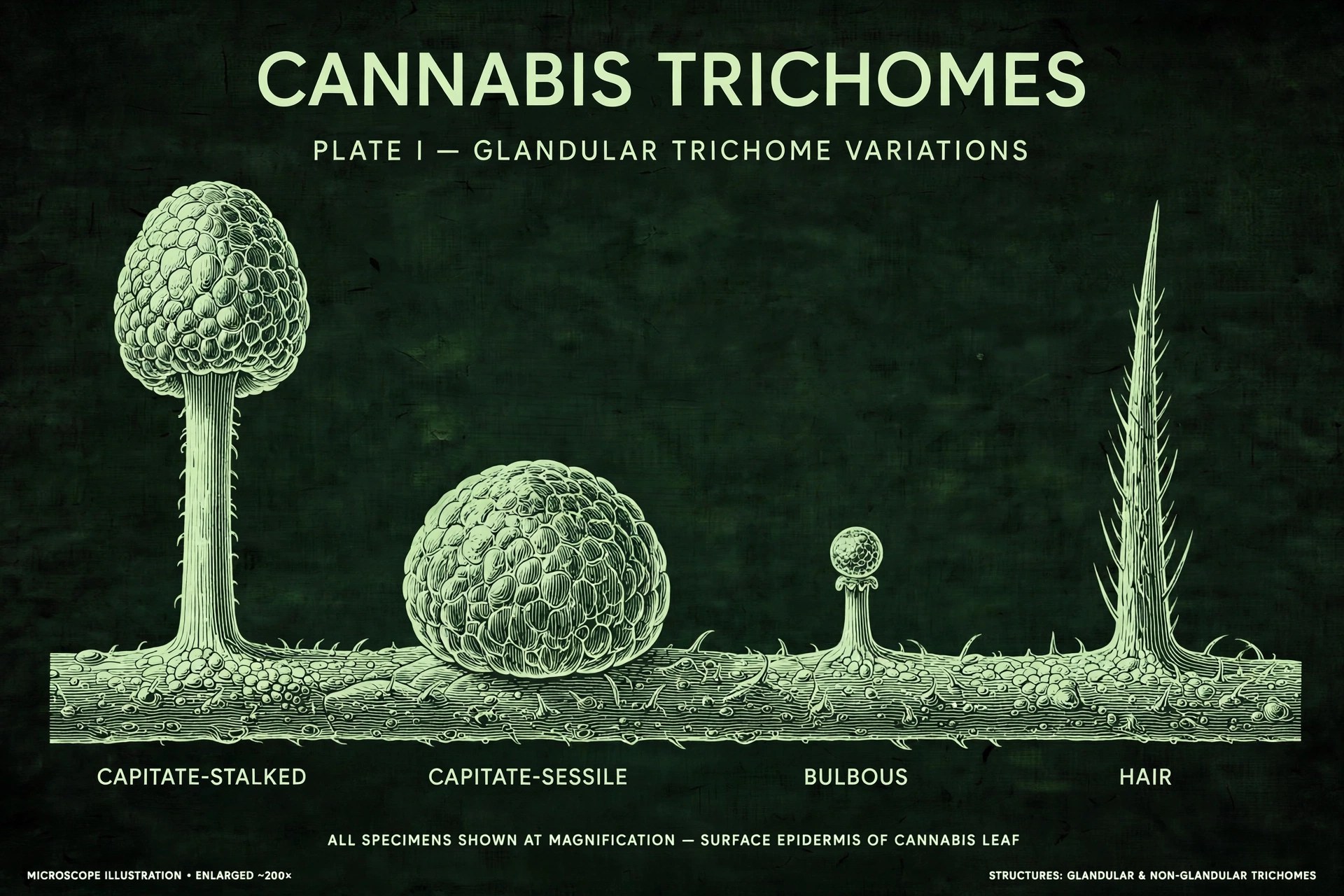
Plate — The glands at magnification.
Everything this series is about — the medicine, the drug, the money, the law — is manufactured in structures too small to see clearly with the naked eye. Growers carry a jeweler's loupe to look at them. Under that loupe, the surface of a ripe female flower stops looking like a plant and starts looking like a forest of tiny glass mushrooms, crowded shoulder to shoulder, glistening. Those are the trichomes, and this chapter is theirs.
What a trichome is
A trichome is an outgrowth of the plant's skin — a hair, a scale, or a gland that a plant builds on its surface. Many plants have them: tomatoes are fuzzy with them, nettles sting with them. Cannabis carries several kinds at once, and they divide into two companies: plain hairs that only protect, and glandular trichomes that manufacture.
The plain hairs are the simpler story. They give the leaves their slightly rough, sandpapery feel — some are stiff little spikes mineralized with calcium carbonate, hard on the mouthparts of small insects. They are the plant's fence. The glandular kinds are its factories, and there are three.
The three factories
The smallest are the bulbous trichomes: a tiny ball of resin on a stalk so short it is barely there, scattered over the whole plant. They make chemistry in miniature, in small amounts, everywhere.
Next are the capitate-sessile trichomes — a gland head sitting almost directly on the surface, like a ball resting on the ground. They coat the flowers and the leaves near them and contribute their share of resin.
The third kind does most of the work and gets most of the fame: the capitate-stalked trichome. It stands on a stalk of cells, and on top sits a round head — a ball of secretory cells wrapped in a waxy skin. These are the glass mushrooms of the loupe, fifty to a hundred-odd micrometers across the head, and they stand thickest exactly where Chapter 2 left them: on the bracts of the female flower and the little sugar leaves among the clusters. The overwhelming share of the plant's cannabinoids and aromatic compounds is made and stored in these heads. When a grower judges ripeness by the glands — clear, then cloudy, then amber — it is these she is reading: the factory's own gauge, changing color as its chemistry matures.
Inside the head
The head is a factory with the machinery in the walls and the warehouse in the middle. The secretory cells around its base build the resin's compounds from simple ingredients the plant supplies, and then export them — out of the cells, into the space under the waxy skin. The ball swells with stored resin as it works, the way a balloon fills. The finished chemistry never stays inside living cells; it is stockpiled outside them, in that shining dome, held by a film of wax.
This arrangement is the whole ballgame, for plant and human alike. Because the resin sits outside the cells, in detachable heads on stalks, it can be collected without destroying anything else — a fact the next sections return to. And because the heads are fragile, they break: brush a ripe flower and the scent that rises, and the stickiness on your fingers, is broken factories spilling their stock.
Why the plant builds them
Not for us. That must be said plainly, because everything about these glands makes sense once their real customer is named: the plant itself, defending its seed.
The evidence supports several jobs. The resin is bitter, sticky, and laced with compounds that sicken or repel insects and discourage grazing animals — a chemical fence around the seed at exactly the place a threat lands first, as Chapter 2 noted. The cannabinoids also absorb ultraviolet light, and plants grown under stronger sun — high altitudes, fierce climates — tend to make more of them, which supports the reading of the resin as a kind of sunscreen for the flower's precious cargo. There is evidence, too, of antimicrobial action: a resin coat is a poor home for molds. Which of these jobs came first in evolution is a live question; that defense and sun protection are among them is the supported core. The plant is not making medicine or merriment. It is making armor and shade, out of chemistry.
The male's smaller factories
The factories belong mainly to the female, but not entirely. Male plants carry the same kinds of glandular trichomes, sparser and smaller, on their leaves and around their flowers, and they make the same chemistry at a fraction of the female's scale — a male is not the chemical blank he is often assumed to be. Breeders have always known a version of this: the male half of a cross contributes to the resin of the daughters, which is why serious seed-makers judge their males by more than their shape. The female is the factory floor. The male is a branch office of the same firm, and his chemistry is part of the inheritance every seed receives.
How a factory gets built
A gland does not appear finished. It begins as a single cell of the plant's skin that swells outward — a bump on the surface. In the stalked kind, cells divide and stack beneath the bump to raise a stalk, while the cells at the top multiply into a cluster, flatten into a disc of secretory cells, and begin their work. As resin pours out of those cells, the waxy skin over them lifts and stretches into the dome that holds the stock — the balloon filling, day by day, through the flowering weeks.
The glands arrive in sequence with the plant's own development. The sessile kind appears early, on young leaves, before the plant has any thought of flowering; the great stalked factories rise as the female flowers form, and their density on the bracts climbs as flowering deepens. At the peak of ripeness the fields of heads stand at their fullest and their contents at their richest — and then the factories themselves begin to fail. Stalks weaken, heads grow brittle and break away at a touch, and the resin left exposed darkens and degrades in the air. The harvest window growers speak of with such anxiety is, at this scale, simply the interval between the factories finishing their work and the factories falling apart.
What humans collect
Humankind's oldest cannabis concentrates are nothing more than these heads, gathered. Rub ripe flowers between the palms and the broken heads smear into a dark resin — the hand-rubbed hash of the Himalaya foothills. Sieve dried flowers and the detached heads fall through as a pale powder — kief. Wash the flowers in ice water and the frozen heads snap off their stalks and can be filtered out nearly pure. Three technologies, centuries apart, one idea: the plant stores its chemistry in detachable balls, and people learned to detach them. The extraction book of this series builds whole laboratories on that single anatomical fact.
But what, exactly, is inside the heads? Open one and you find not a substance but a crowd — over a hundred related compounds, plus the aromatics, each with its own properties. The next chapter opens the factory doors and names what it makes: the cannabinoids, one by one.