Chapter 3 — The Life of the Plant
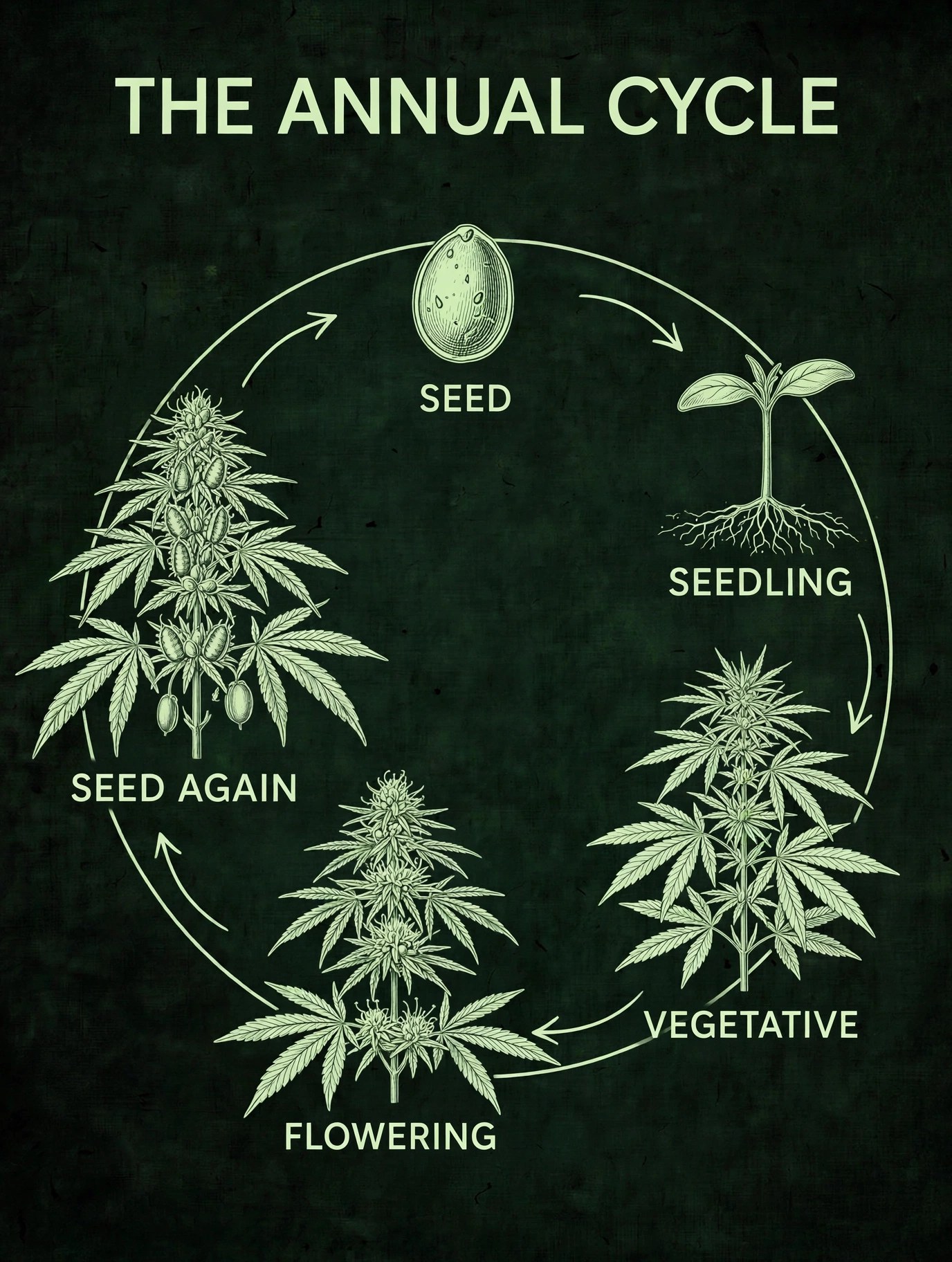
Plate — The year of the plant.
A cannabis plant lives its entire life between one spring and one autumn. Four to eight months, depending on the kind and the latitude, is all it gets — and in that span it must sprout, grow taller than a person, flower, and set the seed that carries it into a year it will never see. This chapter follows that one life through, stage by stage. Every grower in the cultivation books of this series is, in the end, just managing these stages. Learn them here and the rest of the craft is commentary.
Germination — the waking
A seed at rest is nearly inert: a hard coat, an embryo, a packed lunch. Give it water and warmth and it wakes. First it drinks — the seed takes up water and swells. The coat splits. Out comes the radicle, the first root, which turns downward by gravity before it has seen any light at all. Then the shoot pushes up, wearing the empty seed coat like a helmet it soon throws off, and opens its first two leaves.
Those first two are not true leaves. They are the cotyledons — round, smooth, unserrated — and they are the seed's packed lunch made visible, feeding the infant plant until its real leaves can take over. A germinated seed is a promise already kept once: the embryo was alive the whole time it waited.
The seedling
For its first weeks the plant is small and fragile and does almost nothing but build leaves. The first true leaves have a single leaflet each. The next set has three, then five, then more, the leaflets multiplying as the plant gains strength — a grower can read a young plant's vigor in its leaflets the way you read a child's height on a doorframe. Roots are racing underground the whole time, building the foundation everything later will stand on. The seedling's whole strategy is patience: light above, water below, no hurry. The hurry comes next.
The vegetative stage — the long green summer
While the days are long, the plant grows. This is the vegetative stage, and it is pure construction: stem thickening, branches reaching, fan leaves unfolding like hands to catch the light. A plant in strong vegetative growth can add inches in a day. It has one job — get big — because its size now decides how much flower it can hold later.
Here is the stage's remarkable secret: it has no fixed end. As long as the days stay long, most cannabis plants simply keep growing, season be forgotten. Growers indoors exploit this ruthlessly, holding mother plants under long light for years — an annual that never flowers, kept in a permanent summer, cloned again and again. The plant's clock is not counting days. It is watching the nights.
The signal — measuring darkness
Cannabis is what botanists call a short-day plant, which is a misleading name: what it measures is not the shortness of the day but the length of the unbroken night. Inside the leaf is a pigment system that tracks darkness the way an hourglass tracks sand. Through summer the nights are too short, and the plant grows. As autumn approaches and the nights lengthen past a threshold — for most kinds, roughly when darkness stretches toward ten or more hours — the signal lands, and the plant's whole economy turns from building to breeding.
The signal's precision matters. Interrupt the night with light and the plant can be confused, delayed — or stressed, and stress, as the last chapter showed, is one of the roads to the plant that carries both kinds of flower. There is also an exception in the family: kinds descended from the tough wild plants of the far north, where summer nights barely exist, gave up on the signal entirely and flower by age instead, a few weeks after sprouting whatever the light does. Growers call them autoflowering. Evolution wrote both strategies into one species, for different skies.
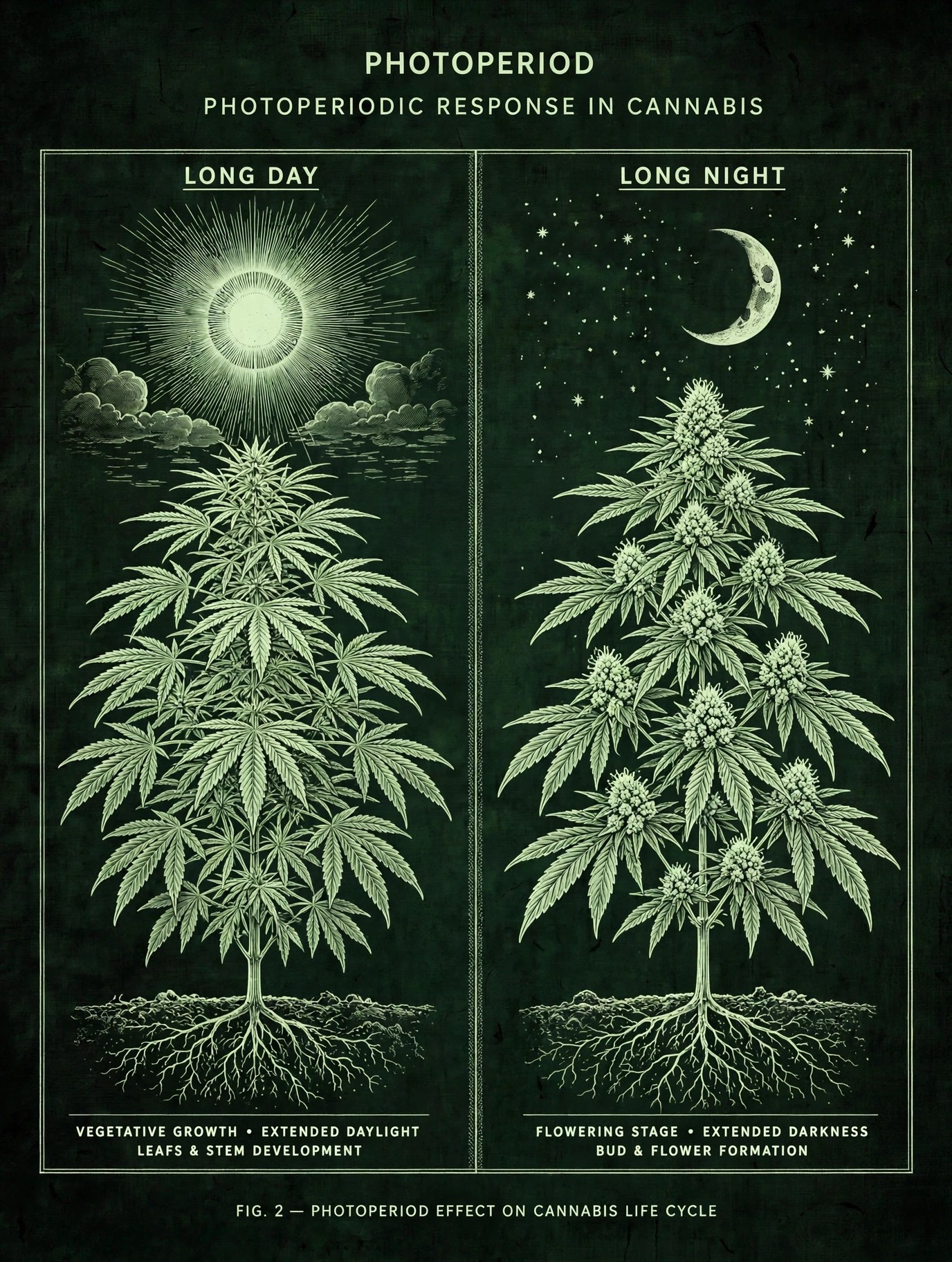
Plate — Light and the turn to flower.
Flowering
Flowering begins with a stretch — the plant surges upward, sometimes doubling in height, as if spending its savings. Then the sexes show, exactly as Chapter 2 described: the males loosen their pollen to the wind and are done; the females begin stacking flowers. Week by week the clusters thicken. The stigmas stand white, fishing for pollen. And over the bracts, the resin glands multiply and swell — the plant is now building, at full effort, the chemistry this whole series is about.
If pollen lands, the female's priorities change overnight: flower-building stops, and everything goes to the seeds, which ripen in about five or six weeks. If no pollen comes — the condition growers protect with such vigilance — she keeps building and waiting, building and waiting, piling up resin in a vigil that, in the wild, would simply mean she was not chosen.
Ripening and the end
Ripeness announces itself. The stigmas brown and curl. The glands shift in color — clear, then cloudy, then amber — a slow chemistry that Chapter 5 will name precisely, and that growers read the way farmers read wheat. If the plant was pollinated, the seeds harden and darken, ready to fall.
Then the annual pays its bill. The great fan leaves yellow as the plant pulls their nitrogen and sugars inward, toward the seed — nothing wasted, even at the end. The stem hollows and dries. The plant dies standing, in the field, in the first cold. It does not survive the winter. Its seeds do: in the soil, in the cold and the dark, carrying the whole design in a coat the size of a grain of rice, waiting for water and warmth to say the one word they understand.
The calendar by latitude
The life in this chapter is timed by the sky, and the sky differs by latitude — which is why the kinds of Chapter 7 keep different calendars. A plant from the equator, where day and night stand near twelve hours all year, reads that balance as the flowering signal almost from birth and may grow and flower in overlapping waves for many months. A plant from the far north, where midsummer nights barely darken, cannot use the signal at all — hence the autoflowering kinds. And a plant from the temperate middle latitudes runs the calendar this chapter described: long summer days to grow, lengthening autumn nights to flower, seed ripe before the frost. Move a kind to the wrong latitude and its calendar breaks — equatorial plants brought north are still flowering when the frost arrives, unfinished. The plant's whole life is a negotiation between its inheritance and its sky, and every traditional kind is a record of one sky, negotiated successfully.
The seed that waits
The life described in this chapter runs spring to autumn, but the seed plays a longer game. A ripe seed that falls into soil and finds no good season does not die on schedule: cannabis seed holds its life in reserve, dormant, and can wake years later when conditions finally suit it. Farmers who once grew hemp know this as a nuisance — volunteer plants rising in fields seasons after the last sowing — and seed keepers know it as a gift: kept cold, dry, and dark, cannabis seed stays viable for many years, which is why the world's seed vaults can hold the plant's whole genetic inheritance in envelopes.
Dormancy is not sleep so much as patience with a trigger. The seed is measuring its world through its coat — water, temperature, light at the soil surface — and refusing to spend its one life cheaply. For a plant with a single season to live, the decision of when to start is the most consequential one it ever makes, and it makes that decision before it has a single leaf.
The life that skips the seed
There is one more way this plant lives, and it belongs to the human chapter of its story. A cutting taken from a growing plant, given water and light, will root and become a plant in its own right — genetically the same individual, continued. Growers call the kept parent a mother plant and her cuttings clones, and a prized female can be continued this way for years, even decades, long past the autumn that would have ended her. Every cutting is the same age, in a sense, as the original seed she came from, and carries her exact chemistry — which is why one exceptional plant can become, through cloning, the ancestor of a whole region's gardens without ever making a seed.
Telling a clone from a seedling
A grower handed two young plants in their green stage can tell which came from a seed and which from a cutting, without asking — the plant's node structure gives it away.
A plant grown from seed builds symmetrically. Through its vegetative stage its branches leave the stem in opposite pairs, two at each node, mirror images of each other, rung after rung like a ladder. Only as the plant approaches maturity does the arrangement loosen into the alternating pattern Chapter 2 described.
A clone never has that ladder. A cutting is taken from a branch of an already mature plant, and it keeps the maturity it was cut from: its nodes come staggered from the very first one, branches alternating up the stem, one side then the other, with none of the seedling's paired symmetry. The difference continues underground. The seedling drives the single taproot of Chapter 2; the clone, having no embryonic root, builds a fibrous mat of roots out from the cut stem's base instead. Opposite pairs and a taproot: a seed's childhood. Staggered nodes and fibrous roots: a cutting's. The plant carries its own birth certificate in its structure, readable at a glance by anyone who knows the two patterns — and the cultivation books of this series work with both kinds throughout.
Seed to seed, in a single year — that is the life. But through the flowering weeks, the plant was doing something this chapter kept deferring: covering itself in microscopic glands and filling them with chemistry. The next chapter goes down to that scale, to the tiny factories themselves.