Chapter 2 — The Plant in Pieces
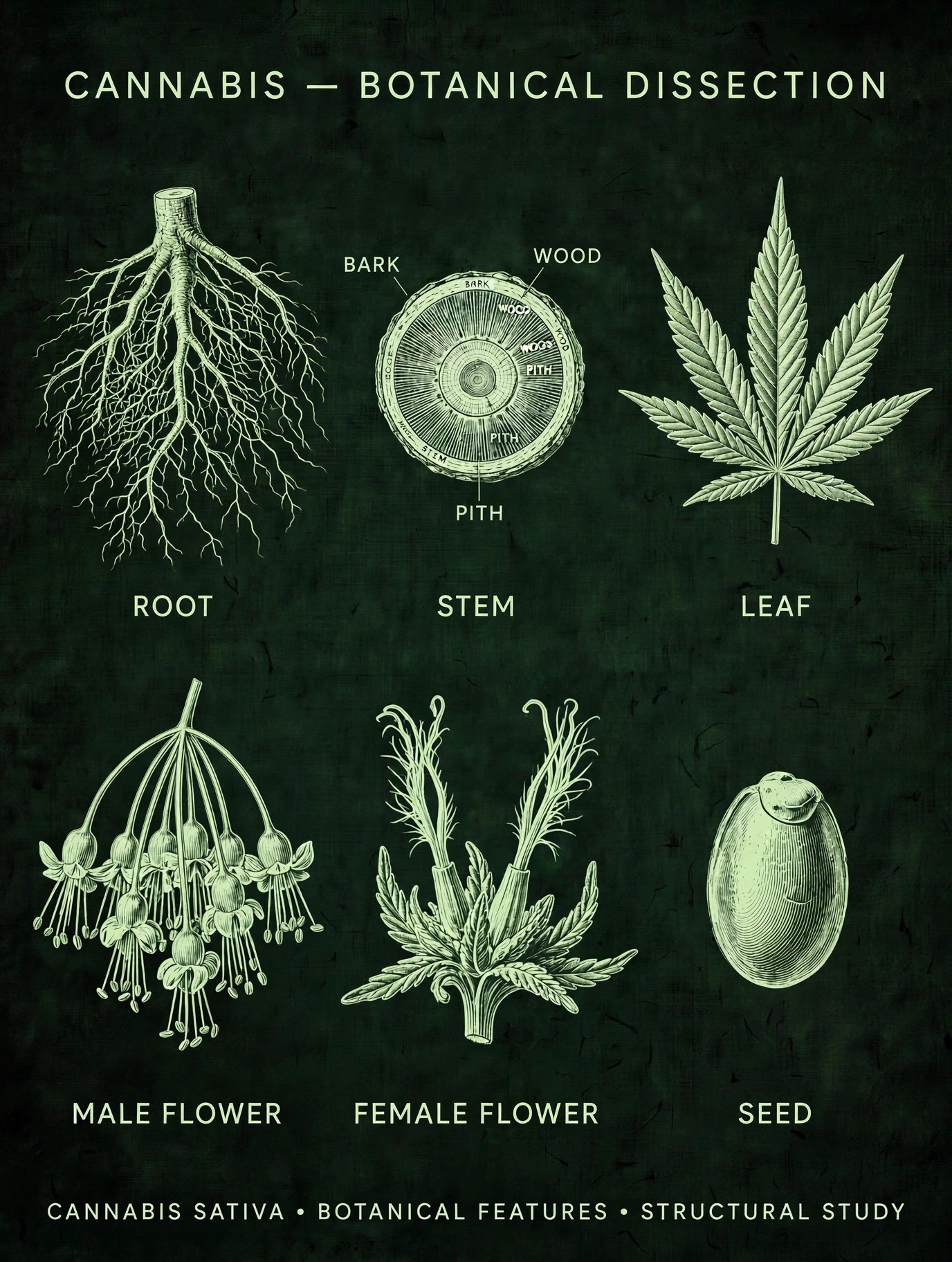
Plate — The plant in pieces.
Take the plant apart and it stops being an argument and becomes a machine — each part with a job, each job understandable. This chapter names every piece, from the root underground to the seed at the end of the line. The plates in this book draw each part as it is described, so the words and the pictures can be read together. By the end of the chapter you will be able to look at any cannabis plant, at any stage, and say what you are looking at.
The root
Everything starts underground. A cannabis plant grown from seed drives a taproot — one strong central root going down — with finer roots branching off it to the sides. The root does three jobs: it anchors the plant against the wind it depends on, it drinks, taking up water and dissolved minerals, and it stores a reserve. A plant grown from a cutting has no taproot; cuttings root from the stem instead and build a fibrous web of many equal roots. Same jobs, different architecture — and the first quiet lesson of the plant: how it began shapes how it stands.
The root is also where the plant in this book's cover ended its story: pulled whole from its pot, roots hanging in a long mass. Growers read roots the way mechanics read engines. White and branching means health; brown and slimed means trouble. The underground half is half the plant, and it is the half beginners forget.
The stem
The stem is the plant's spine and its highway. Water climbs it from the roots; sugars descend it from the leaves. It grows from its tip, lengthening at the top while it thickens below, and along its length sit the nodes — the joints where leaves and branches attach, separated by stretches of bare stem called internodes.
A mature cannabis stem is not solid wood. At its center is a soft pith; around that, a woody core; and around that, the bark — and the bark is famous. Running the length of the bark are long, strong fibers called bast fibers. Those are the hemp fibers of commerce, the raw material of rope, canvas, and cloth for thousands of years. Strip the bark and the woody core that remains is called hurd — once a waste product, now used for animal bedding and building material. The fiber book of this series returns to both in full. For now, hold the shape: pith, wood, bark, and the long fibers in the bark.
The leaf
The famous leaf is not the flower, not the drug, and not the point of the plant — it is the plant's solar panel and its signature. A cannabis leaf is palmately compound: several pointed leaflets, usually five to nine, radiate from a single point at the end of the leaf stalk, like fingers from a palm. Each leaflet has a saw-toothed edge. Young plants low on the stem carry their leaves in opposite pairs; as the plant matures the arrangement shifts and the leaves come off the stem one at a time, alternating. Botanists read that shift as a sign of maturity, the plant changing its posture as it approaches flowering.
Small leaves that grow directly out of the flower clusters later in the season are called sugar leaves, for the frosting of glands on them. The big shade leaves are fan leaves. Both do the same work — catching light — at different posts.
The male plant
When the days shorten, the plant flowers, and its sex shows. The male plant tends to grow taller and leaner, and at the nodes along his upper stems he produces clusters of small, hanging, greenish-yellow flowers. Each one is simple: five small petal-like parts and five stamens, the pollen-makers, which dangle so the wind can strip them. A single healthy male releases pollen in the millions of grains. His work done, he yellows and dies ahead of the females — the annual's deadline falls on him first.
Growers of drug cannabis remove males on sight, for reasons Chapter 8 and the cultivation books explain. Growers of seed cannot do without them. The male is half the species; a book about the whole plant gives him his paragraph.
The female plant
The female grows bushier, and her flowers form tight clusters stacked along the upper stem and branches — the structure the world calls a bud. It is worth knowing what a bud actually is, because it is not a single flower. It is a crowded neighborhood of many small flowers, leaves, and glands.
Each individual female flower is modest: a single ovary — the seed-to-be — wrapped in a green sheath called a bract, and from its tip, two feathery stigmas. The stigmas are the pollen catchers. Young, they stand white and fresh; unfertilized, they keep standing, and the plant keeps building more flowers around them; fertilized, they wither as the seed inside swells. The white hairs turning amber that growers watch so closely are those stigmas, aging.
The bracts are coated in the plant's resin glands — so densely that a good female flower cluster glistens. Why she builds all that resin is Chapter 4's question. Where it sits is here: on the outside of the seed's green cradle, exactly where a threat to the seed would land first.
The seed
If a stigma catches pollen, the ovary becomes a seed — properly, an achene, a small hard fruit with one seed inside, though the whole world calls it a seed and this book will too. It is a self-contained starting kit: an embryo plant, a store of food rich in oils and protein (which is why hemp seed feeds people, Book 5 of this series), and a hard mottled coat. A cannabis seed can wait years for its one spring. The seed enthusiast's shelf of this series takes up its keeping in full.
The plant that carries both
And then there is the exception — the plant on this book's cover. Sometimes a single plant bears both kinds of flower. Botanists call such a plant monoecious, one house instead of two. It happens two ways. Some hemp varieties are bred that way on purpose, so a field can seed itself evenly. And sometimes a female drug plant, stressed — by interrupted darkness, heat, age, or damage — pushes out male flowers among her own, a survival move: no mate coming, so she makes her own pollen as a last resort. Growers call those plants hermaphrodites and pull them the moment they are seen, because one such plant can seed an entire room, and a seeded crop is a ruined one for most purposes. The plant in the cover photograph was pulled for exactly that reason, and held up to the light — which is where a book about this plant properly begins: with the whole thing, roots and all, in the open.
Telling it from its look-alikes
The leaf is so famous that it is constantly being seen where it is not. Several common garden plants carry palmate, serrated leaves and are mistaken for cannabis every summer by somebody: the Japanese maple, the false aralia, the cleome, the Texas star hibiscus, even the young okra. The beginner's field marks separate them plainly. Cannabis leaflets have coarse, saw-tooth serrations along their whole edge and come to a long, drawn-out point; the leaf stalk joins all the leaflets at exactly one point, like the ribs of a fan; and the plant, handled, gives off the family's unmistakable smell from its glands — no look-alike does that. Botanical identification, here as everywhere, is a matter of several marks agreeing, never one mark alone. The forensic shelf of this series builds whole procedures on that principle; this chapter's version is the one a gardener needs.
The pieces, by measure
It helps to put numbers on the pieces, because cannabis is a plant of extremes within its own small frame. The taproot, given loose soil, can drive down a meter or more in a season, with a wide skirt of side roots beneath the surface — which is why the plant tolerates dry country better than its thirst suggests. The stem of a fiber plant can top five meters, taller than a house's eaves, and the bast fibers running through its bark are among the longest single fiber bundles of any crop plant — one reason hemp rope held the age of sail together. A single male plant, in his few weeks of flowering, releases pollen not in the thousands of grains but in the hundreds of millions. And the seed, the piece everything reduces to, runs about fifty to the gram for small kinds and fifteen for large — each one a complete plant, folded.
Hold those numbers together and the plant's strategy is visible: enormous reach above and below ground, enormous generosity with pollen, and then everything it owns packed into a seed small enough to lose in a pocket seam.
Root, stem, leaf, flower, seed — and the glands still unnamed, waiting on the flower's surface. The next chapter steps back and watches the whole machine run: one life, from seed to seed, in a single year.