Chapter 1 — A Plant, First
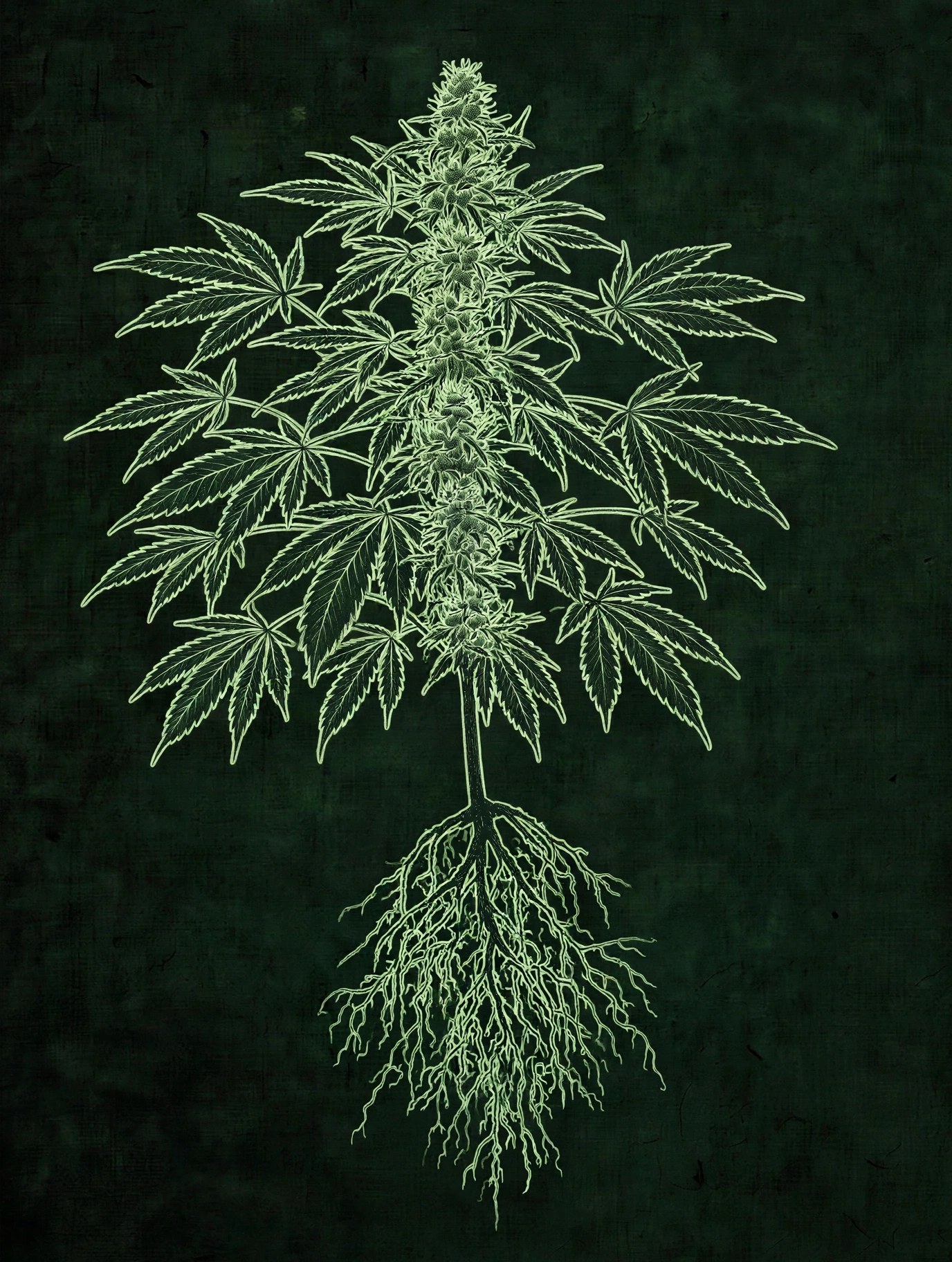
Plate — The whole plant, flowering.
Before it is anything else — before it is a medicine or a crime, a crop or a controversy — cannabis is a plant. That sounds too simple to be worth a chapter. It is the most important fact in this book, and everything else in the series stands on it. Laws change. Markets change. A plant goes on being a plant, following the same instructions it has followed for a very long time. Start with the plant, and the rest can be understood. Start anywhere else, and it cannot.
What kind of plant
Cannabis is an herb — not in the cook's sense of the word, but in the botanist's: a plant with a soft green stem instead of a woody trunk, which dies back when its season ends. It is also an annual. An annual completes its whole life in one growing season: it sprouts from a seed in spring, grows through summer, flowers, sets seed, and dies, all in a single year. Everything the plant does, it does on that deadline. Its height — anywhere from under a meter to over five in a good season — its hunger for light, its rush to flower as the days shorten: all of it is the behavior of a living thing that has one summer to finish everything.
Like every green plant, it feeds itself from light. Its leaves take in sunlight, water, and air, and build sugar from them — photosynthesis, the quiet chemical trick on which nearly all life on Earth depends. Nothing about that is unusual. What is unusual is where cannabis sits in the plant kingdom, and what it makes.
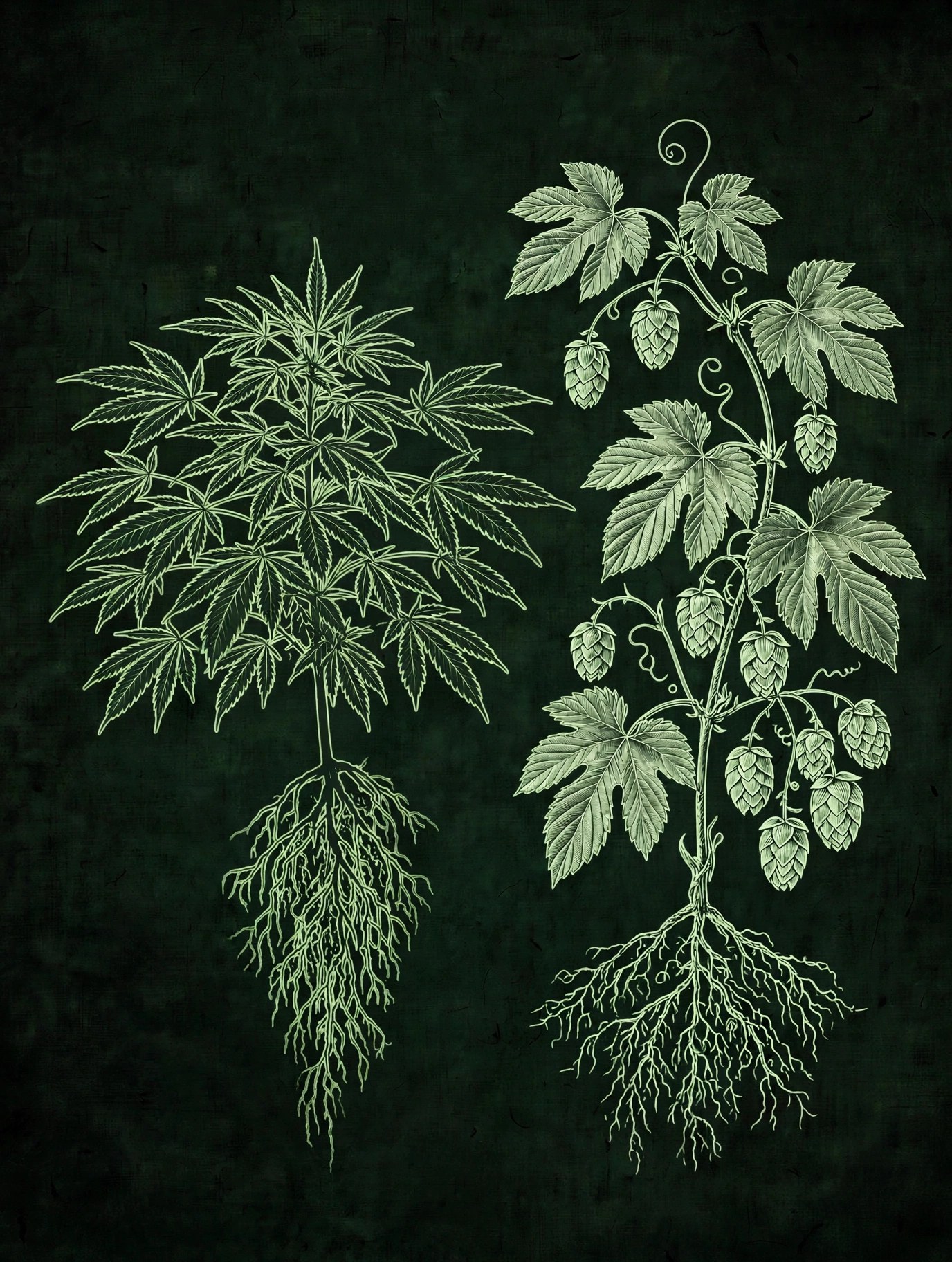
Plate — The cousins — hop and the wider family.
The family
Every plant belongs to a family, the way every person belongs to a lineage, and cannabis belongs to a small one: the Cannabaceae. Its closest living relative may surprise you. It is the hop — the plant whose flowers flavor beer. Hops and cannabis are cousins, and the family resemblance is real once you know to look: both grow fast and tall in a single season, both keep their male and female flowers on separate plants, and both cover their flowers in tiny resin glands. In hops, those glands make the bitter, aromatic compounds that brewers prize. In cannabis, as later chapters will show, they make something found almost nowhere else in nature.
The wider family holds a few other genera, including the hackberries — actual trees, which shows how far one family's forms can stretch — and beyond the family, cannabis sits in the order Rosales, which makes it a distant cousin of roses, apples, elms, figs, and nettles. This is worth pausing on. Cannabis is not a botanical freak from outside the order of ordinary things. It is a rose-cousin that took a particular path.
Its habits
Two habits of the plant matter for everything that follows.
First, it keeps its sexes apart. Most flowering plants carry both male and female parts in the same flower. Cannabis, like its cousin the hop, usually does not: there are male plants and there are female plants, and a grower can tell them apart once they flower. (Chapter 2 takes the plant apart piece by piece, including the famous exception — the plant that carries both.) This separation shapes how the plant is bred, how it is grown, and, it turns out, why the female plant makes so much resin: unfertilized, she keeps building flowers and waiting.
The separation of the sexes is itself unusual, and worth a sentence of its own. Only a small minority of flowering plants — roughly one in twenty species — keep male and female on separate individuals. The great majority carry both in one flower and hedge their bets. Cannabis belongs to the minority, alongside its cousin the hop, the date palm, and the holly tree. Everything in this book that turns on sex — the removed males, the seedless crop, the resin vigil of the unfertilized female — grows out of that one uncommon arrangement.
Second, it trusts the wind. Cannabis flowers are small, green, and dull, with no scent or color meant to attract bees, because no bee is coming. The male plant simply releases pollen in enormous quantities and lets moving air carry it. Wind pollination is an old, plain strategy, and it works: cannabis pollen can travel for kilometers. Remember that when later books take up seeds, neighbors, and the law — the wind does not respect fences.
Where it comes from
The wild homeland of cannabis is Central Asia — the broad steppe country between the mountains, in what is now the region spanning Kazakhstan, Mongolia, and northwestern China. The evidence is of several kinds: fossil pollen in lake sediments, the genetics of the oldest wild and feral populations, and the sheer antiquity of the plant's partnership with people in that part of the world. A large genetic study published in 2021 compared cannabis genomes from around the world and pointed to domestication in East Asia roughly 12,000 years ago — among the earliest of all domesticated plants, taken into human company at about the same time as wheat's ancestors in the west. From there it traveled with us in every direction: as fiber, as food, as medicine, and as a drug, which is to say it traveled as four different plants while remaining one.
That is the deep history, and Book 2 of this series is given to it entirely. Here it is enough to hold the plain fact: this is an Asian steppe herb that human beings have carried around the planet for some twelve thousand years.
The argument over its name
In 1753, Carl Linnaeus — the Swedish botanist who built the naming system science still uses — gave the plant its formal name: Cannabis sativa. Thirty years later, the French naturalist Lamarck examined specimens from India, decided they were a different species, and named them Cannabis indica. In 1924 a Russian botanist added a third, Cannabis ruderalis, for the tough little wild plants of Central Asia. Botanists have argued ever since about whether cannabis is one species or several, and the argument is not settled by vote or by age; it is a real scientific question about where the lines between kinds should be drawn.
Here is what the genetic evidence shows, stated as plainly as it can be: all of these plants interbreed freely, and their genomes form one connected family with deep regional structure — distinct populations shaped by geography and by human selection, above all the split between plants bred for fiber and seed and plants bred for drug strength. Whether that structure deserves the rank of separate species is the unsettled part.
This book takes the working position most modern references take: one species, Cannabis sativa L., with great variety inside it. Chapter 7 examines the words indica and sativa in full — what they meant, what they mean in a shop today, and why the two meanings parted company. For now: one plant, many kinds.
What the genes added
The naming argument was fought for two centuries with pressed specimens and measurements. In the last decade it gained a new kind of evidence: the plant's own DNA, read at scale. Three findings matter here.
First, the split that runs deepest in the genome is not the split on the shop shelf. A widely cited genetic study published in 2015 compared hundreds of cannabis samples and found that the clearest division was between hemp — plants bred for fiber and seed — and drug-type plants bred for strength. The famous indica and sativa labels, by contrast, matched the genetics only loosely: plants sold under the two names do differ on average, but the names predict far less than their reputation suggests. Chapter 7 takes that up in full.
Second, the 2021 study of genomes from around the world, mentioned above, found something no one had quite expected: a surviving wild group in China that stands near the root of the whole family tree — the closest living relatives of the first domesticated plants. Every cultivated kind on Earth, fiber and drug alike, descends from that early East Asian stock. The plant's family history has a single hearth.
Third, the family's age can be dated, roughly. Fossil pollen that matches the cannabis-and-hop line appears in sediments in Central Asia going back some 28 million years — long before there were people to name anything. The two cousins, cannabis and hops, parted company somewhere in that deep past and have been running variations on the same body plan ever since: fast annual growth (the hop cheats by dying back to a perennial root), separate sexes, and flowers armored in resin glands.
None of this settles the species argument, because that argument is about where humans should draw a line, and nature is under no obligation to draw it where we would like. But it does fix the ground the argument stands on: one interbreeding family, one ancient origin, and a history written first by geography and then, for the last twelve thousand years, by us.
Why this one
The plant kingdom holds some 400,000 species. Almost none of them are known by name to ordinary people in every country on Earth, argued over by governments, and grown in secret and in billion-dollar facilities at the same time. Cannabis is. The reason is not the fiber, though the fiber is excellent, nor the seed, though the seed is good food. The reason is a family of chemicals — the cannabinoids — that this plant produces in its resin glands in a variety and quantity no other plant matches. (One distant liverwort makes a single similar compound; it is the exception that shows the rule.) Among those chemicals is one that fits, with unusual precision, a system built into the human body — a system most people have never heard of, which Chapter 10 introduces.
That fit is the hinge of the whole story: the medicine and the drug, the fortunes and the prisons, all of it swings on the chemistry of a wind-pollinated steppe herb that would happily have gone on making resin for nobody but itself.
So: a plant first. An annual herb of the hop family, male and female, carried by the wind and then by us, out of Central Asia and into every argument of the modern world. The next chapter takes it apart, piece by piece, and names everything.