Chapter 12 — The Words
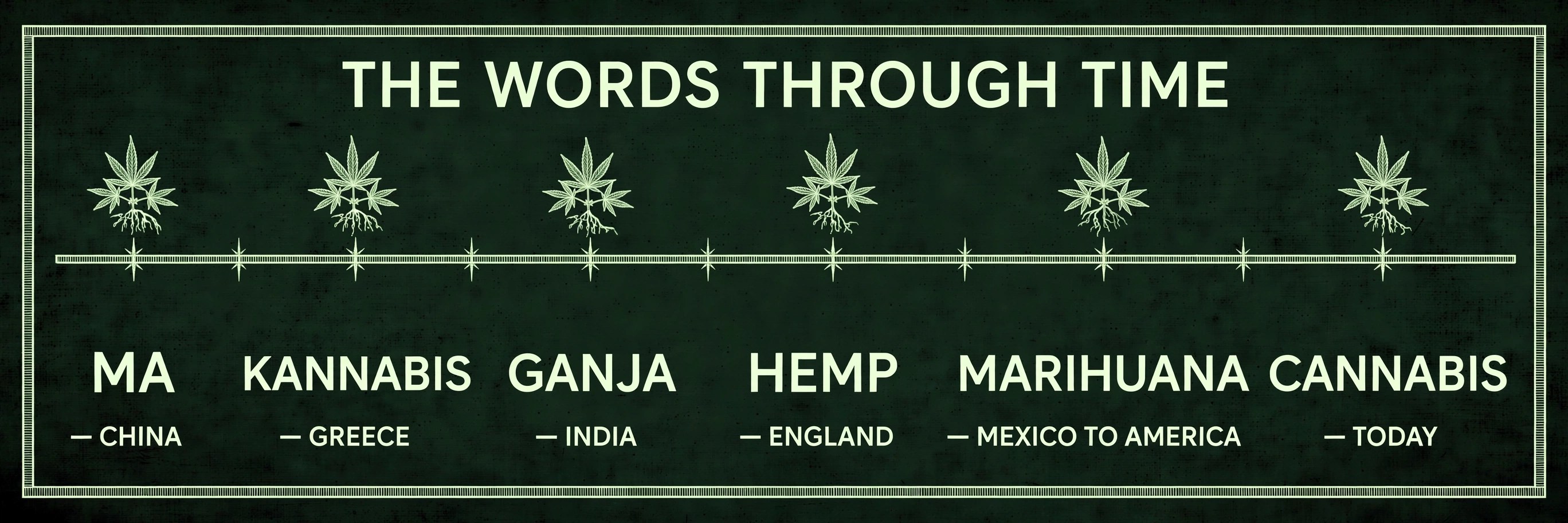
Plate — The words, in their centuries.
This book ends with its smallest subject and its most used one. Every argument about cannabis is, in part, an argument about words — which name gets used, by whom, and what the name quietly decides before the facts arrive. A beginner who owns the words cannot be talked past. So the last chapter is a sorting: the names this plant has carried, the registers they belong to, and the loads some of them smuggle.
The names of the world
The plant has been named by every culture that met it, and the names are a map of its travels. Cannabis itself comes down from the Greek kannabis, likely borrowed from the Scythians, the horse peoples of the steppe who threw the plant on hot stones in their tents — the Greek historian Herodotus described it in the fifth century before Christ, in the oldest eyewitness account of the plant's use that survives. In India it is ganja and bhang, from Sanskrit. In China it is ma — one of the oldest words in that language, a character so old it pictures the plant hanging to dry, and for most of Chinese history it meant fiber and medicine before it meant anything else. In Morocco the prepared resin is kif; in South Africa, dagga; in Hawaii, pakalolo, "crazy tobacco." Hemp is the Germanic name. Marihuana came last to English, through Mexico, in the twentieth century.
No culture named it carelessly. Each name carries its relationship: the crop, the medicine, the sacrament, the smoke, the menace. When you hear a name, you are hearing which of those relationships is speaking.
The registers
Modern English keeps at least five vocabularies for this one plant, and a fluent reader can hear them change rooms.
Botany speaks Latin and structure: Cannabis sativa, trichome, bract, chemotype — words built to be exact and to travel across languages unchanged. Law speaks in thresholds and definitions: hemp, marijuana, controlled substance, total THC — words built to draw lines a court can enforce, precise about numbers and silent about everything else. Medicine speaks in systems and grades: endocannabinoid, indication, adverse event — words built to be cautious in public. The street speaks in slang, and slang turns over by the generation — pot, grass, weed, and their hundred cousins — words built for belonging, which is why they date so fast and pretend to nothing else. And marketing speaks in promise: natural, premium, craft, wellness — words built to sell, and the only register whose purpose is not to describe the plant at all.
None of these registers is the true one. Each is a tool with a job. Trouble starts when a word crosses registers without changing clothes — when a legal category is quoted as if it were a botanical fact, or a marketing word is worn as if it were a medical one.
Words that smuggle
Some words arrive with the conclusion already inside them, and the beginner should learn to hear the smuggling.
Drug, medicine, and substance can be the same molecule on three different days: a drug in the arrest report, a medicine in the pharmacy, a substance in the laboratory. The molecule does not change. The word announces the speaker's verdict before the evidence is heard. Official language once built the verdict into the diagnosis itself — for decades the clinical term was cannabis abuse, a name that presumes what a neutral description would have to prove; the field has since moved to cannabis use disorder, which at least describes a pattern instead of a crime. Natural is marketing's favorite smuggler: hemlock is natural, and so is fiber, and the word settles nothing in either direction. Recreational and adult use are the same activity in two suits — one chosen by the industry's critics, one by the industry — and medical, in most laws, names not a property of the plant but a permission slip from a state. Even marijuana carries its history: historians of the prohibition era note that American officials of the 1930s favored the foreign-sounding word over the familiar hemp and cannabis precisely because it sounded foreign — the campaign's full story belongs to the prohibition book, but its fingerprint is on the word itself, and it has never quite washed off.
Against all of these, set the words this book has tried to give you, because they were built to carry facts and nothing else: cultivar, chemotype, trichome, decarboxylation, sinsemilla, endocannabinoid. A reader who can say "a Type III cultivar, decarboxylated" has said something checkable in any country on earth. That is what precision words are for — not to impress, but to make a claim that can be tested, by anyone, anywhere. It is the same virtue as the evidence grades of the last chapter, in miniature: language at the right strength, claiming exactly what it can hold.
The word that is winning
The sorting has a direction, and a beginner entering the field now should know which way the language is moving. In statute after statute, the word marijuana is being retired and the word cannabis put in its place — several American states have rewritten their laws to make the swap, on the stated ground that the old word carries the prohibition era inside it. The industry, for its own reasons, prefers the Latin word too: it sounds like science and shelves well. Even the slang is being outlived by the legal word, as shops and clinics normalize it. This book chose cannabis on the first page for the plainest reason — it is the plant's scientific name, the one word every register can share — but it is worth seeing that the choice is also where the language itself is going. Words, like the plant, are cultivated. What gets planted everywhere eventually looks like what was always there.
The qaneh question
One word-fight deserves its own paragraph because it shows every register of this chapter colliding at once. In the Hebrew Bible, a fragrant plant called qaneh-bosm appears among the ingredients of the holy anointing oil. In 1936 the Polish scholar Sula Benet argued that the word is cannabis — qaneh sounding, to her ear, like the plant's name in other ancient tongues. The claim has been repeated ever since, usually as a settled discovery: cannabis in the Bible. Weighed on this book's scale, it is open. The sound-resemblance is real; the mainstream of biblical scholarship reads the word as a different aromatic reed or grass, the ancient translations do not support Benet, and no residue or artifact has settled it. The sacred-plant book of this series gives the argument its full hearing. Here it stands as the chapter's working example: a claim can be old, beloved, and repeated in a thousand places, and still be exactly as proven as it was in 1936.
The end of the first book
You came to this book, if the book did its work, knowing nothing in particular about an annual herb of the hop family. You leave it knowing the plant's pieces and its one-year life; its tiny factories and the three families of chemistry they make; its kinds and the limits of their names; the line the law drew through it and the crop that line destroys; the forms people use and their timings; the system in your own body that the plant's chemistry fits; the grades by which every claim in the field should be weighed; and now, the words.
What you do not yet know fills the rest of the series — the deep history, the prohibition, the medicine and the harms weighed in full, the growing and the making, the markets and the money, the questions still open at the back of this book. All of it stands on what stood here first, unchanged since the first page: before the arguments, before the laws, before the words — a plant, first. It is still out there being one, in fields and windowsills and wild roadsides, indifferent to everything said about it. The series continues whenever you are ready. The plant will keep its own schedule either way.