Part III — The Models: Twenty Worked Designs
Plate — Every Port of Call
Art: Douglas John Brownfield
Chapter 10 — Funded by Marketing
Three models in which the payer is buying customers — the most familiar honest reason in this book.
Model 1 — The Merchant's Table [FOUND]
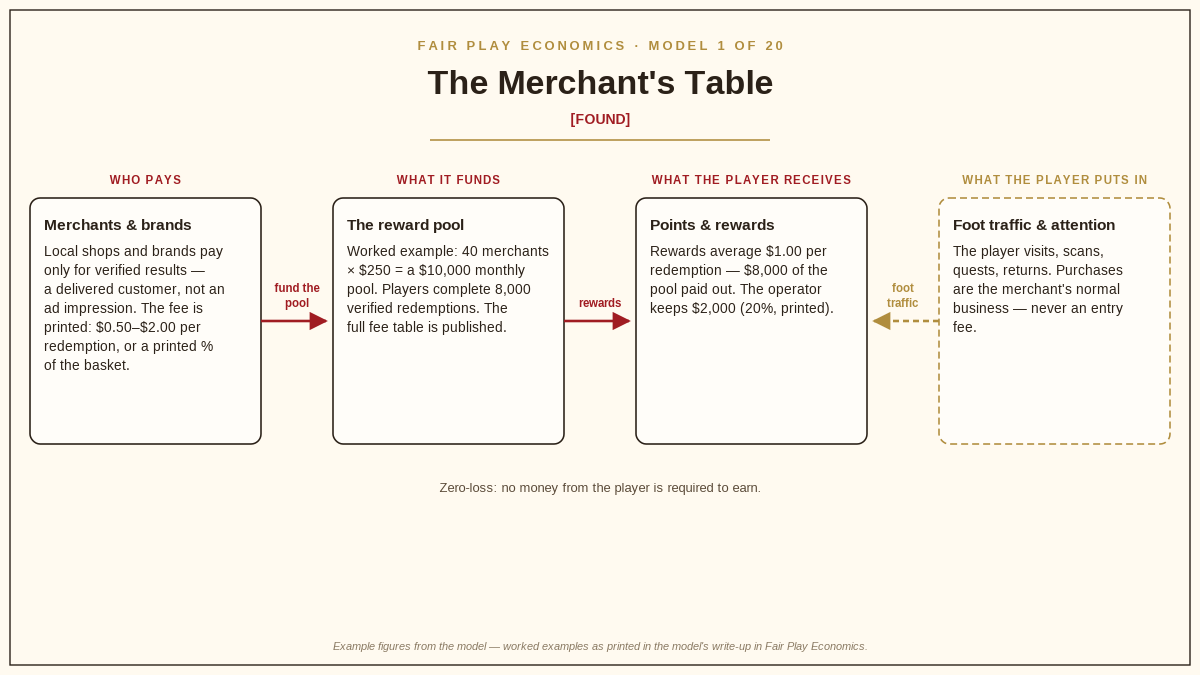
Diagram — The Merchant's Table: who pays, what it funds, what the player receives, what the player puts in.
The payer and their reason. Local merchants and brands. A customer who walks in because of the game and redeems an offer is a delivered customer — the same result merchants already pay coupon networks, card-linked-offer platforms, and delivery apps to produce, except that here they pay per verified result, not per impression.
The flow. A publisher runs quests — visit, scan, buy anything, return visit. Completing a quest earns points or direct rewards from a pool the merchants fund. The merchant pays the operator a printed per-redemption fee (say $0.50 to $2.00) or a printed percentage of the redemption basket, and the operator funds rewards from those fees at a printed rate. The full fee table is published.
The arithmetic. A café group funds a monthly pool: 40 merchants × $250 = $10,000. Players complete 8,000 verified redemptions; rewards average $1.00 per redemption ($8,000), and the operator keeps $2,000 — 20 percent, printed. A merchant whose $250 bought about 200 redemptions paid $1.25 per delivered visit, cheap against typical local advertising, with every cent accounted to a visit that happened.
The contribution, named. Foot traffic and attention: the player goes somewhere and does something. No money from the player is required to earn; purchases at the merchant are the merchant's normal business, not an entry fee.
The precedent. Partial analogue. Fetch, founded in 2013, runs the brand-funded half at national scale: brands pay commissions and fund bonus points when shoppers scan receipts showing their products, and pay again for the aggregated purchase data — a General Mills executive described receiving about 62 million lines of data per day from the partnership. Fetch proves merchants and brands will fund consumer rewards at scale when redemption is verified. The quest form itself — rewards for verified visits and tasks, funded per redemption — is also running in the world: Niantic's sponsored locations in Pokémon GO charge sponsors on a cost-per-visit basis, and shared merchant pools paid out by a published rule exist in cashback platforms (GenieGenerate runs one, filled by local shops' cashback and paid by a printed rule). The mechanic is found, in use, on both halves.
The verdict. Workable now. Verification tooling exists off the shelf — Fetch is the existence proof for the verification half. The merchant side clears on ordinary numbers: $1.25 per delivered visit, all-in, against typical local baskets of $8 to $15, works if even a third of quest visits are incremental. The model's fragile point is merchant churn if attribution is disputed — publish the verification method alongside the fee table. Quests decided by chance need the sweepstakes treatment of Chapter 7, and paying per purchase must never make a purchase the only way to earn: keep a free quest path.
Working exhibit: The Café, aboard FreeDough — the café and shops fund the games because the games bring the crowd.
Model 8 — Sponsor-the-Board [FOUND mechanic / ORIGINAL fee-wrapper packaging]
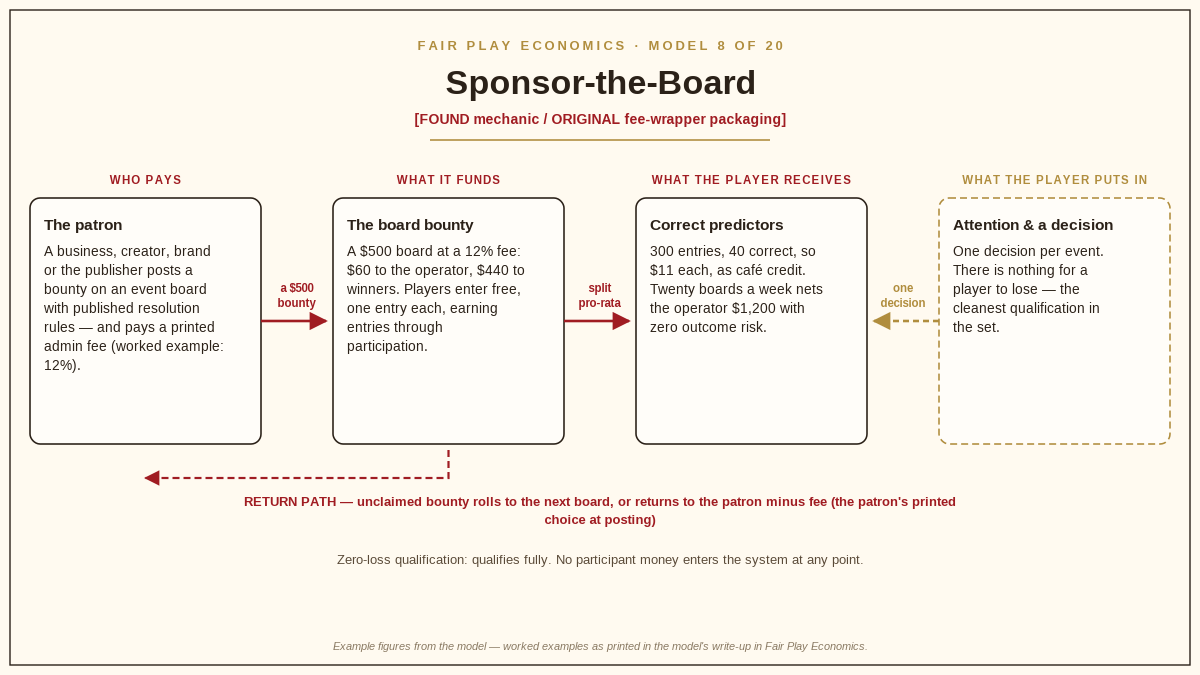
Diagram — Sponsor-the-Board: who pays, what it funds, what the player receives, what the player puts in.
The payer and their reason. A patron — a business, a creator, a brand, or the publisher — posts a bounty on an event board with published resolution rules, and pays because verified attention, and, where winnings are paid as store credit, verified foot traffic, is worth a known price. The operator charges the patron a printed admin fee.
The flow. Players enter free, one entry each, earning entries through participation. Correct predictors split the bounty pro-rata. An unclaimed bounty rolls to the next board publicly, or returns to the patron minus the fee — the patron's printed choice, made at posting.
The arithmetic. A $500 board at a 12 percent fee: the operator takes $60, and $440 reaches the winners. With 300 entries and 40 correct predictors, each receives $11 as café credit. Twenty boards a week nets the operator $1,200 a week with zero outcome risk.
The contribution, named. Attention and one decision per event. There is nothing for a player to lose; this is the cleanest qualification in the set, since no participant money enters the system at any point.
The precedent. None found as a standing system; partial analogues exist. Brand sweepstakes and radio promotions run one-off versions of sponsor-paid prizes; prediction markets run the board without the sponsor; free-entry, sponsor-funded prediction play exists in sweeps formats. The standing, rules-published, rollover-accounted board — with the patron paying a printed fee for the posting itself — is the element that appears unused, plausibly because patron acquisition is a sales job and prediction economics chase trading volume instead.
The verdict. Workable now. The constraint is patron sales, not mechanics — at $60 a board in admin fees, resolution and anti-bot operations are covered at modest volume, and the operator carries zero outcome risk throughout. Where winners among correct predictors are chosen by a tie-break draw, chance enters and sweepstakes duties apply, including the registration thresholds of Chapter 7 as boards grow. Two operating rules carry the design: the resolution source must be named and contracted in advance, and free entries invite automation, so entries should be tied to participation that is costly to fake.
Working exhibit: The Board, aboard FreeDough — sponsors post bounties, and players claim them by answering.
Model 15 — The Empty Seat Exchange [ORIGINAL DESIGN; partial analogues]
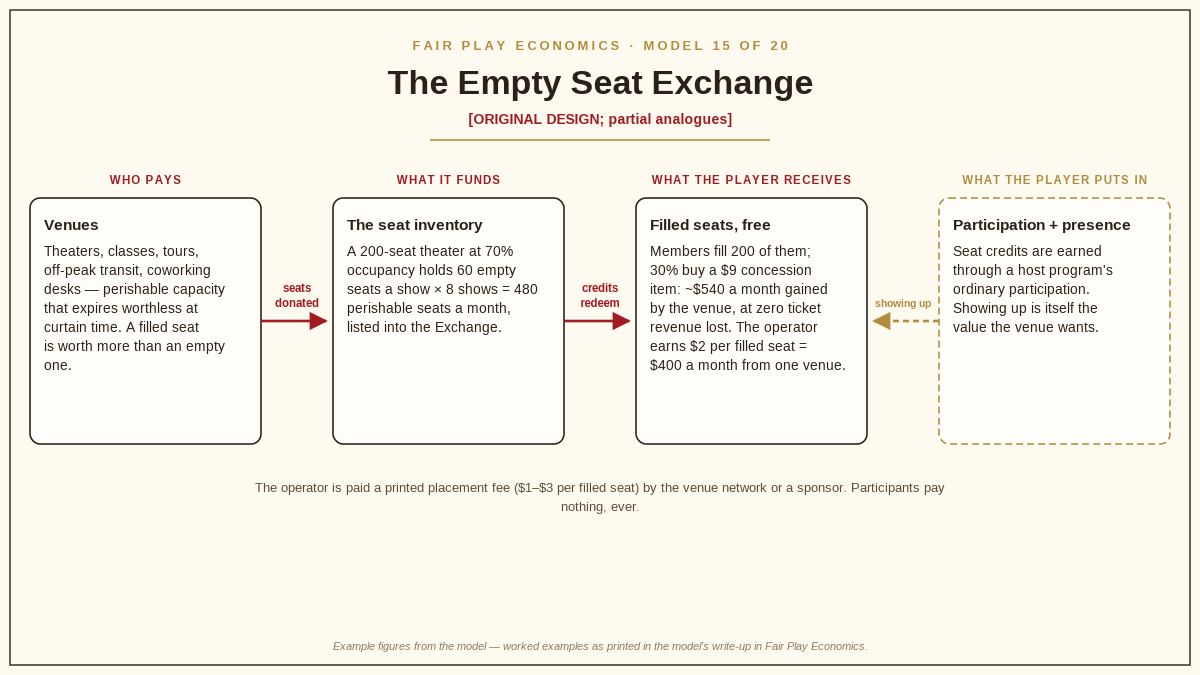
Diagram — The Empty Seat Exchange: who pays, what it funds, what the player receives, what the player puts in.
The payer and their reason. Venues and operators of perishable capacity — theaters, classes, tours, off-peak transit, coworking desks — hold inventory that expires worthless at curtain time. They donate seats as rewards because a filled seat is worth more than an empty one: concessions, audience energy, reviews, future sales. The operator is paid a printed per-redemption placement fee by the venue network or a sponsor.
The flow. Participants earn seat credits through a host program's ordinary participation — quests, learning rungs, community tasks. Venues list perishable inventory into the Exchange; credits redeem first-come. The venue pays nothing to list; where no sponsor carries the fee, the venue can pay in kind — a share of listed inventory for the operator's own community.
The arithmetic. A 200-seat theater runs at 70 percent occupancy: 60 empty seats a show, 8 shows a month, 480 perishable seats. If Exchange members fill 200 of them and 30 percent buy a $9 concession item, the venue gains about $540 a month in concessions plus 200 audience members it did not have, at zero ticket revenue lost — the seats were empty. The operator, at $2 per redemption, earns $400 a month from one venue. Participants pay nothing, ever.
The contribution, named. Participation in the host program, and presence — showing up is itself the value the venue wants.
The precedent. Partial analogue, with the funding direction inverted. Fill-a-seat membership clubs distribute unsold tickets to members, but members pay subscriptions for access, which makes the member the payer. Broadway-style digital lotteries allocate cheap or free seats by chance as marketing one-offs. The Exchange — seats as earned rewards inside an unrelated program, with the operator paid per redemption — was not found operating.
The verdict. Workable now. Perishable-inventory donation is the cheapest payer contribution in the entire set, since the inventory's alternative value is zero, which makes venue recruitment the easiest sales conversation in this book. The fragile points are prime-inventory leakage — venues must list genuinely perishable stock, released close to showtime, or members learn to wait for free seats instead of buying — and no-shows: a redeemed-but-empty seat is worse than an unlisted one, and refundable-credit no-show rules, borrowed from Model 10's bond logic, are the standard mitigation.
Chapter 11 — Funded by Time
Two models in which the payer is patience: capital given once and never spent, and money that earns while it waits.
Model 2 — The Endowment Season [ORIGINAL game-season arrangement; funding structure FOUND]
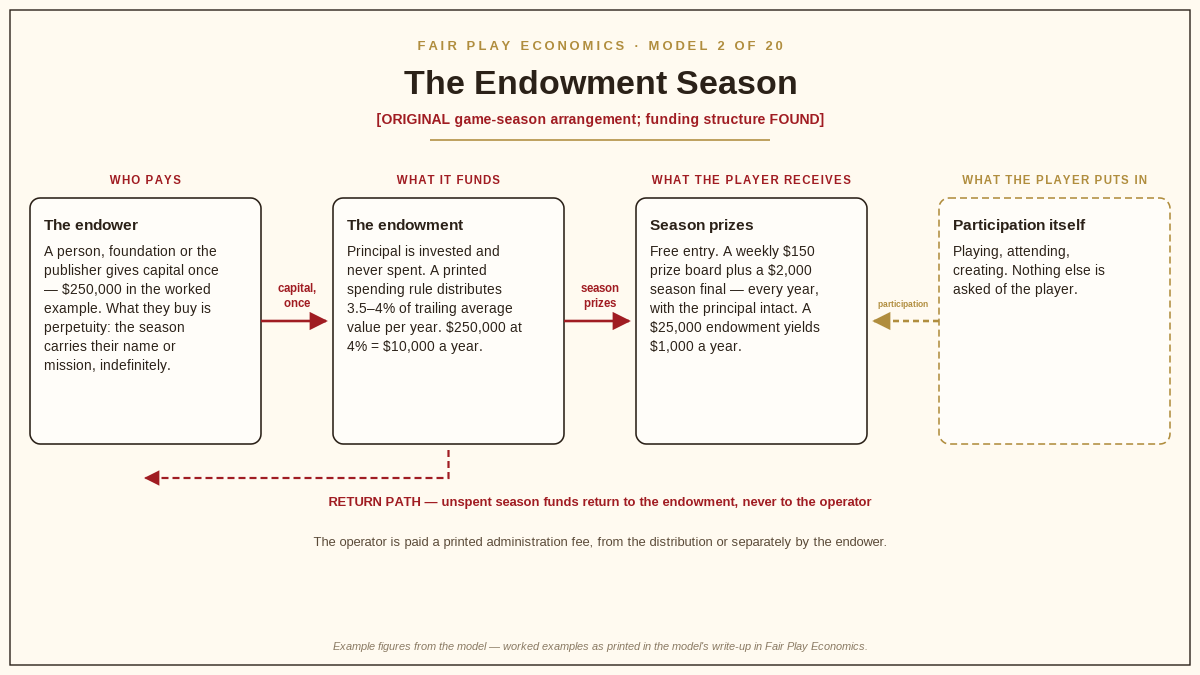
Diagram — The Endowment Season: who pays, what it funds, what the player receives, what the player puts in.
The payer and their reason. An endower — a person, a foundation, or the publisher itself — gives capital once. The endowment's investment returns fund a recurring season of prizes, indefinitely; the principal is never spent. The payer buys perpetuity: the season carries the endower's name or mission at a one-time cost.
The flow. The endowment is invested conservatively under a printed spending rule — distribute up to about 4 percent of trailing average value per year. Each season's prize fund is the spending-rule amount. Players enter free. Unspent season funds return to the endowment, compounding future seasons, never to the operator; the operator is paid a printed administration fee from the distribution or separately by the endower.
The arithmetic. A $250,000 endowment at a 4 percent spending rule yields $10,000 a year — a weekly $150 prize board plus a $2,000 season final, every year, indefinitely, with the principal intact. A $25,000 endowment yields $1,000 a year: a modest but genuinely perpetual local season. The ratio is the model's honesty and its limit in one line: at a 4 percent rule, every $1,000 of annual prizes needs $25,000 of endowment, and no marketing changes that.
The contribution, named. Participation itself — playing, attending, creating. Nothing else.
The precedent. Full precedent for the funding structure, and the strongest feasibility evidence any model in this book has. The Nobel Foundation has run on this structure for 125 years: Alfred Nobel's bequest of about SEK 31 million in 1895, invested; invested capital stood at SEK 6,744 million at the end of 2025, and the 2025 prizes were SEK 11 million each. The Foundation's stated goal is a return of at least 3 percent above inflation to preserve the base, and the prize amount is set annually based on its finances — it cut the prize by 20 percent in 2012 when capital required it. A widely repeated claim that the Foundation follows an iron-clad rule of never withdrawing more than 3.5 percent could not be verified against the Foundation's own sources and appears only in social-media retellings; this book prints the target-and-annual-setting version, because that is the version the record supports. What appears original is the arrangement: a recurring game prize season funded solely by yield on preserved principal. The funding structure is a century and a quarter old; the game-season application is this book's.
The verdict. Workable now; prize size is scale-bound. The structure is proven — the only variable is how much endowment a given publisher can raise. Governance follows endowment norms (in the US, UPMIFA-style spending rules for institutional funds). One boundary matters: participants are never invited to contribute to the endowment expecting returns; if they were, the securities analysis would change completely. In this design, they are not.
Model 9 — The Zero-Rake Float Pool [FOUND core concept / ORIGINAL flipped allocation — novelty unverified]
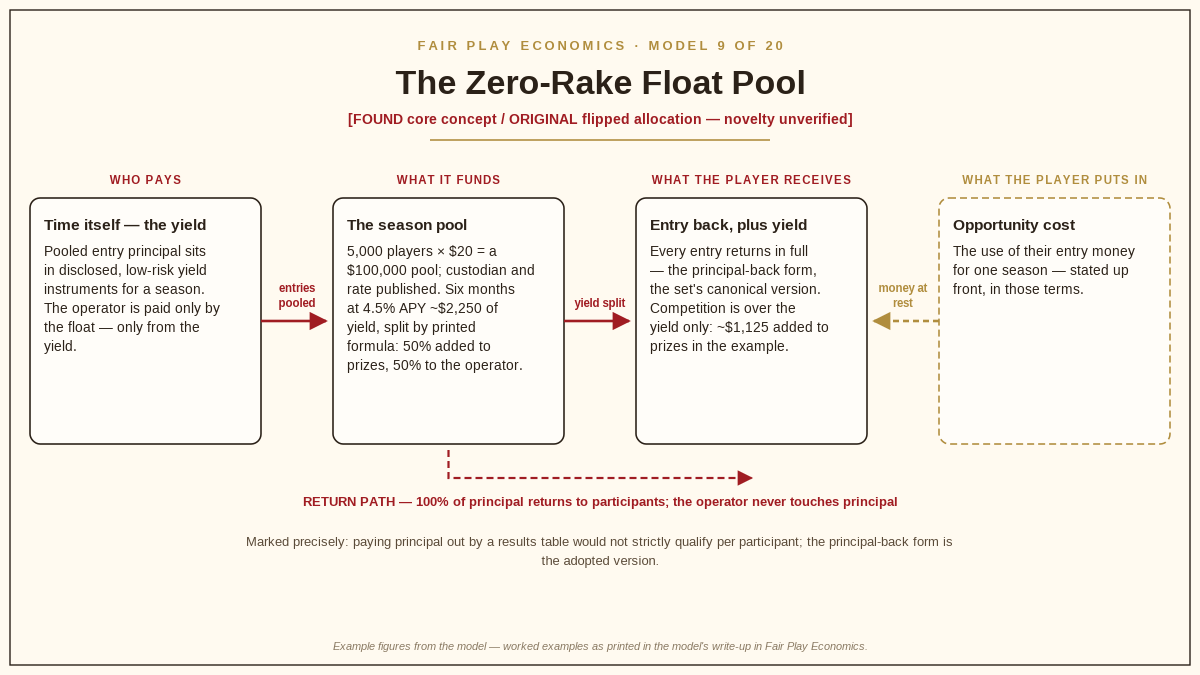
Diagram — The Zero-Rake Float Pool: who pays, what it funds, what the player receives, what the player puts in.
The payer and their reason. Time. Players' pooled entry principal sits in disclosed, low-risk yield instruments for a season; the yield is split by a printed formula. The operator is paid only by the float — never by the principal, and never by a rake on prizes.
The flow. Entries are pooled with a published custodian at a published rate. In the form this book adopts — and the qualification matters, so it is stated here rather than footnoted — every participant's entry is returned in full, and competition is over the yield (and any sponsor top-up) only: at season end, principal goes back to its owners, and the yield is distributed as prizes under a printed split, part to prizes and part to the operator. Before entry, the player sees four numbers: pool size, custodian, current yield, split.
A second form of the design exists and does not strictly qualify: distributing the full principal as prizes by a results table, under which a player who places low receives less than their entry. That form's guarantee is pool-level — all principal returns to participants as a class, and the operator never touches it — but it is not a per-participant guarantee, and this book's definition is per-participant. The set therefore adopts the principal-back form as canonical and records the other rather than smoothing it over.
The arithmetic, stated honestly. 5,000 players × $20 = a $100,000 pool; a six-month season at 4.5 percent annual yield produces about $2,250; at a 50/50 split, the operator's share is about $1,125 a season. At 100,000 players — a $2 million pool — the operator's share is about $22,500 a season. At 0.5 percent yield it earns nearly nothing, and the design must say so on its face. Float pays for patience and size, and at small size it pays almost nothing; any small operator presenting it as a business is overselling.
The contribution, named. The opportunity cost of the entry money for one season, stated up front in those terms.
The precedent. Partial analogue. Insurance float — premiums invested before claims come due — is the funding logic at industrial scale, and the endowment of Model 2 is its cousin; refundable entries pooled for yield have live relatives in prize-linked savings products. The core concept — pooled refundable entries, invested, with the return as the prize component and the operator paid from the return — is found, including in patent territory dating to 2006. The possibly original element is a single allocation flip: principal returned in full, prizes drawn from yield, and the operator paid only a printed share of yield. That flip sits over a dense family of prior designs, and its novelty is unverified; this book claims the arrangement, not the invention. The design's natural home follows from its math: a large, patient, distributed community, or a publisher whose real revenue is earned elsewhere — books, content, a marketplace — and who wants a prize system that is provably not eating the players.
The verdict. Fragile at small scale; workable at scale as an ecosystem feature. The math is the verdict: float pays for patience and size, and at small size it pays almost nothing — any small operator presenting it as a business is overselling. The design also inherits a reputation problem it did not earn: yield-bearing customer pools were the shape of the opaque lending products that collapsed in 2022–23, and the honest version, disclosed custodian and all, will be read in their light until its own record says otherwise. Legal flags are the heaviest in the set: pooling participant money that earns yield invites securities analysis (the Howey question of Chapter 7) and money-transmission and custody questions. The principal-back form, with yield treated as a prize pool rather than promised returns, mitigates the analysis but does not eliminate the need for counsel.
Chapter 12 — Funded by Attention and Data
Four models in which the participant's contribution is the product being sold — attention, data, study responses, and idle capacity — and in which naming that contribution is therefore not a courtesy but the entire design.
Model 3 — The Attention Dividend [FOUND]
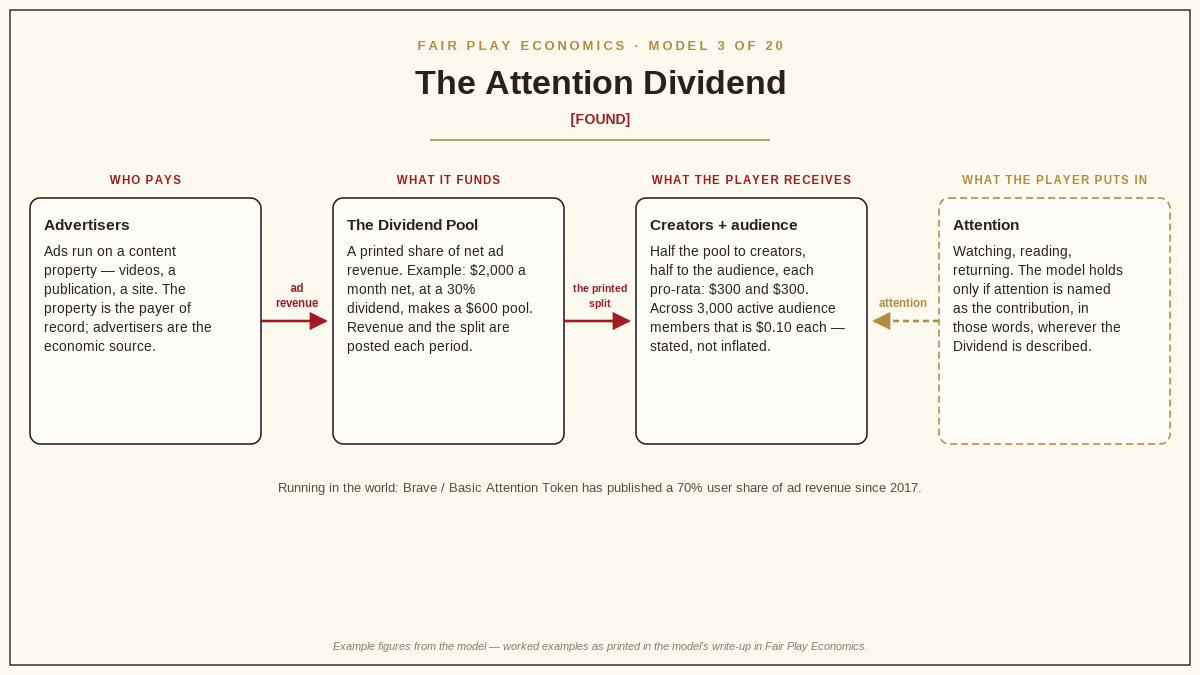
Diagram — The Attention Dividend: who pays, what it funds, what the player receives, what the player puts in.
The payer and their reason. Advertisers, through a content property's advertising revenue. The property — videos, a publication, a site — earns advertising money because an audience shows up; the Dividend prints the share of that revenue returned to the audience and the creators who drew it. The payer of record is the property; the economic source is the advertiser.
The flow. The property publishes a rule: a stated percentage of net advertising revenue for the period goes into a Dividend Pool, split by a printed formula — say half to creators pro-rata by the watch or read time they drew, half to audience members pro-rata by verified participation. Balances, revenue, and the split are posted each period.
The arithmetic. A small channel nets $2,000 a month in advertising revenue. At a 30 percent dividend, the pool is $600: $300 across creators, $300 across, say, 3,000 active audience members — ten cents each. Honest, and small. At $200,000 a month net, the same rule pays $30,000 to each side. The model's candor requirement is the point: publish the per-person number even when it is a dime. A dime stated is worth more than a fortune implied.
The contribution, named. Attention — watching, reading, returning. This model satisfies the definition only if attention is named as the contribution, in those words, wherever the Dividend is described.
The precedent. Partial analogue for the mechanic — and full precedent for the printed share. Microsoft Rewards runs attention-for-points at platform scale: points for searches, quizzes, and browser use, funded from a budget that includes search advertising revenue. Microsoft does not publish what fraction of search revenue returns as points (third-party estimates put the effective rate at roughly a tenth of a cent per point). The printed share itself is already running elsewhere: Brave's advertising program has published a 70 percent share of ad revenue to users since 2017. Attention-for-rewards is found; a published percentage of revenue is found; the model is the combination, stated as a standard any ad-supported property can adopt.
The verdict. Workable now, thin at small scale. Any ad-supported property can adopt the rule tomorrow; the constraint is arithmetic — at typical online rates, a participant-hour of attention is worth cents, and the Dividend cannot promise more than a share of those cents. Fraud — automated accounts farming participation — is the main operating cost. Pay in cash, credit, or prizes; paying audience shares in a token with expected appreciation attaches securities flags, and the amount must be printed as varying with revenue, because it does.
Model 6 — The Data Dividend [FOUND mechanic / ORIGINAL fixed-share commitment]
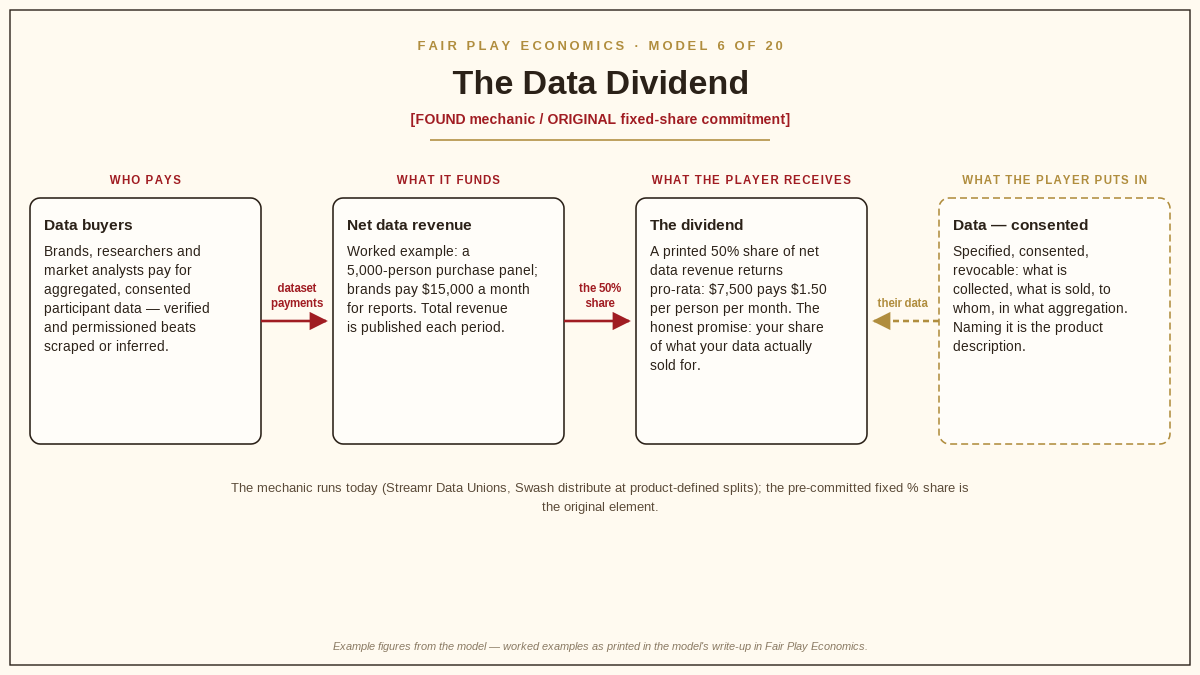
Diagram — The Data Dividend: who pays, what it funds, what the player receives, what the player puts in.
The payer and their reason. Data buyers — brands, researchers, market analysts — pay for aggregated, consented participant data: purchase histories, panels, telemetry. Verified, permissioned data is more defensible, and often richer, than scraped or inferred data. The Dividend is the participants' printed share of that payment, paid pro-rata.
The flow. Participants opt in to specified data sharing — the specification is the consent: what is collected, what is sold, to whom, in what aggregation. Buyers pay the operator for datasets and reports. A printed share of net data revenue distributes pro-rata to contributing participants each period, with the total revenue and the per-person dividend both published.
The arithmetic. A 5,000-person purchase panel: brands pay $15,000 a month for reports. At a 50 percent printed share, $7,500 returns — $1.50 per person per month. At 500,000 participants and $1.5 million a month, it is the same $1.50: data revenue per head is roughly linear, so the honest promise is "your share of what your data actually sold for," which at real prices is small, and must be said. The model's claim is fairness of split, not size of payment.
The contribution, named. Data — specified, consented, revocable. Naming it is the product description.
The precedent. Partial analogue, in two halves that exist separately. Fetch sells brands aggregated, anonymized purchase-data insights, and pays participants in brand-funded points — but publishes no revenue share or dividend rate. Whether that constitutes "selling your data" is genuinely disputed: one consumer-finance analysis answers "the short answer is yes" about shopping behavior sold to companies, while Fetch's own framing is aggregated, anonymized insights with no personal identifiers or card data. Both characterizations are reported here because the disagreement is about the definition of "your info," and a reader deserves the distinction rather than a side picked for them. Google Opinion Rewards shows the direct-payment half: researchers pay Google; respondents receive credit or cash per survey, roughly $0.10 to $2 — and the rewards expire after one year, a breakage feature the Dividend should not copy. Live data-union products distribute pooled data revenue to contributors pro-rata, at splits the product defines. The element no operator was found offering is a pre-committed fixed percentage of data revenue, printed in advance and held to — a rule-level commitment, recorded here at its true, modest size.
The verdict. Workable at scale. Below a few thousand participants the data is worth little and dividends are symbolic; above that, the model is a normal panel business with a fairer split. Panel data pricing runs to low dollars per participant per month — any design promising more is inventing revenue. The legal flags are the heaviest of this chapter's family: privacy-law consent and "sale/share" definitions (California's CCPA/CPRA; the GDPR for any European participants), revocation mechanics, and the rule that consent given for one dataset cannot silently stretch to another.
Model 17 — The Research Bounty Board [FOUND]
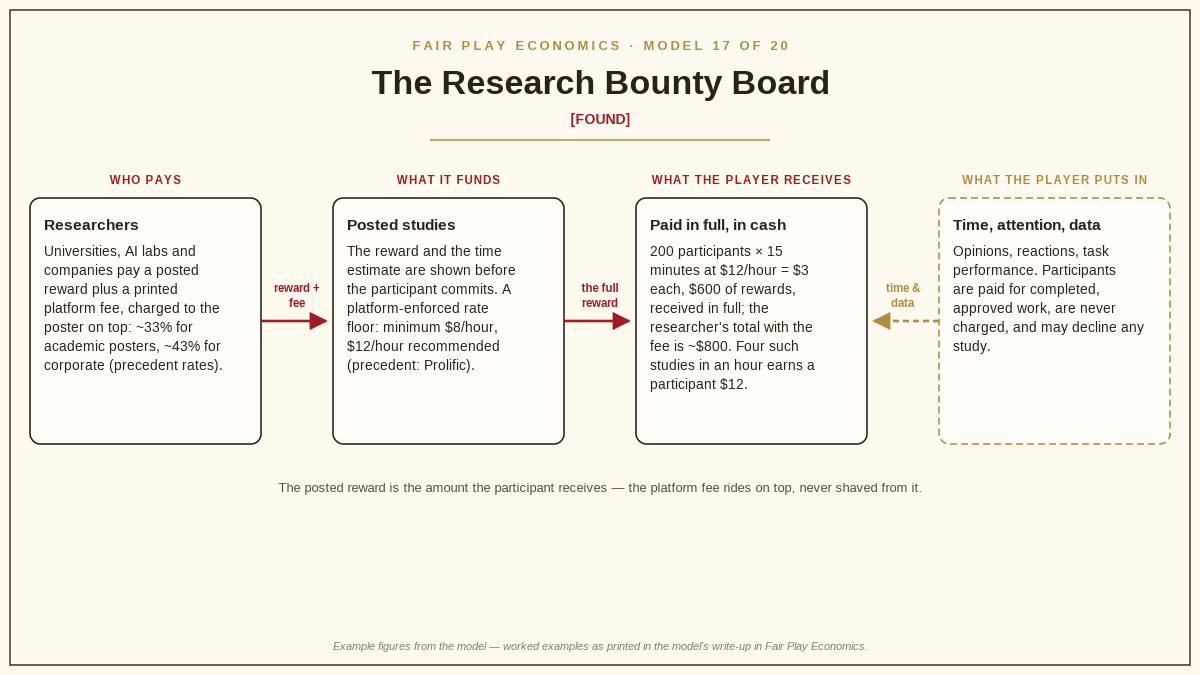
Diagram — The Research Bounty Board: who pays, what it funds, what the player receives, what the player puts in.
The payer and their reason. Researchers and institutions — universities, laboratories, companies — pay for human participation in studies and tasks, because data from verified humans is the input their work runs on. They pay a posted rate plus a printed platform fee; participants are paid for completed, approved work and are never charged.
The flow. Posters list studies with the reward and the time estimate shown before the participant commits. A platform-enforced minimum hourly rate floors the market. The platform fee is charged to the poster, on top of the reward — the posted reward is the amount the participant receives, not a gross figure quietly shaved. Screening is pre-matched from profiles, so unpaid screen-outs are structurally minimized, and participants may decline any study.
The arithmetic. A researcher needs 200 participants for 15 minutes at a recommended $12 an hour: $3 each, $600 of rewards. At a 33.3 percent academic platform fee, the researcher's total is about $800, and participants collectively receive the full $600. A participant completing four such studies in an hour earns $12 — real money, paid in cash in the precedent, with no points conversion.
The contribution, named. Time, attention, and study data — opinions, reactions, task performance. The pre-commitment display of pay and time is the model's honesty mechanism and should be treated as non-optional in any adaptation.
The precedent. Full precedent. Prolific, founded at Oxford in 2014, runs the model with more than 300,000 vetted participants: an enforced minimum reward of £6/$8 per hour with £9/$12 recommended; platform fees of 33.3 percent for academic and nonprofit posters to 42.8 percent for corporate posters, charged on top of rewards; customers including Google, the National Institutes of Health, and Carnegie Mellon; payment in cash via PayPal. Prolific also demonstrates the quality side of the design: identity verification and pre-screening are what make researchers willing to pay real rates — the fee funds the trust that funds the rates.
The verdict. Workable now; cold start is the whole game. Both sides must arrive together — participants without studies leave, researchers without participants cannot recruit. The model clears only where research demand is steady; in the precedent, AI evaluation tasks are the current demand engine. Participant classification, minimum-wage analysis if an adaptation drifts toward directed work, and research-ethics norms for academic use are the flags.
Model 19 — The Idle Engine [FOUND mechanic / ORIGINAL pool-distribution form]
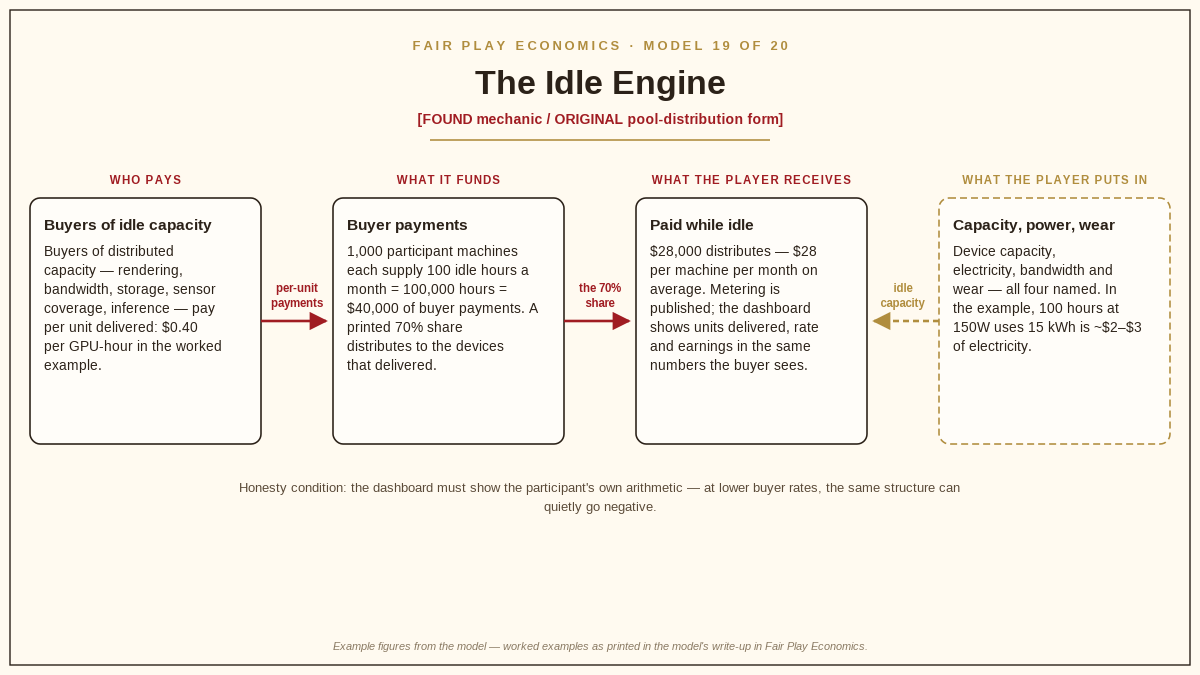
Diagram — The Idle Engine: who pays, what it funds, what the player receives, what the player puts in.
The payer and their reason. Buyers of distributed capacity — rendering, bandwidth, storage, sensor coverage, inference — pay for capacity that already exists in participants' devices and premises, because it is cheaper than building data centers for spiky demand. Participants are paid a printed share of buyer payments for capacity their devices supply while idle.
The flow. Participants install a client that supplies specified capacity only under specified conditions — idle, charging, on unmetered connections; the conditions are part of the consent. Buyers pay the operator per unit delivered. A printed share of buyer payments — say 70 percent — distributes pro-rata to the devices that delivered; metering is published, and a participant's dashboard shows units delivered, rate, and earnings in the same numbers the buyer sees.
The arithmetic. A rendering buyer pays $0.40 per GPU-hour wholesale. One thousand participant machines each supply 100 idle hours a month: 100,000 hours, $40,000 of buyer payments; at a 70 percent participant share, $28,000 distributes — $28 per machine per month on average. Against that: a machine drawing 150 watts for 100 hours uses 15 kilowatt-hours, about $2 to $3 of electricity. The margin is real at these rates — which is exactly why the printed conditions matter. At lower buyer rates or higher power draw, the same structure can quietly go negative for the participant, and the dashboard must show the participant's own arithmetic, not just the gross.
The contribution, named. Device capacity, electricity, bandwidth, and wear — the most physically real contribution in this book. All four components must be named, and honest metering of the electricity side is a design requirement, not a nicety.
The precedent. Partial analogue. Volunteer computing — Folding@home and BOINC — proves millions will contribute idle capacity unpaid, for a mission. Bandwidth-sharing applications (Honeygain is the known example) prove the paid version exists, and also its reputational hazards: opaque buyer use of residential connections. Distributed compute networks (Render, Golem) prove buyer demand at market rates. What was not found is the pooled, game-form version: contributors' earnings pooled and redistributed by a printed percentage as a shared prize pool, run as a rewards program with published metering rather than as a crypto network or a bandwidth reseller. That distribution rule, over a well-established core, is the model's stated element.
The verdict. Fragile. Unit economics swing with buyer rates and energy prices; abuse — emulated devices, farmed capacity — attacks the same metering fairness depends on; and the category carries a trust problem the precedent makes vivid: if participants cannot see who used their capacity and for what, the model reads as renting out the participant's connection. The design is viable only with radical metering transparency — which is why it is in this book, and why it closes the chapter.
Chapter 13 — Funded by People Who Want You Skilled
Three models in which the payer is buying attainment — someone else's. The participant's contribution in all three is study and demonstrated learning — the Bond adds a refundable lockup, named in its entry; the difference is who pays for it and why.
Model 4 — The Patron's Ladder [ORIGINAL DESIGN]
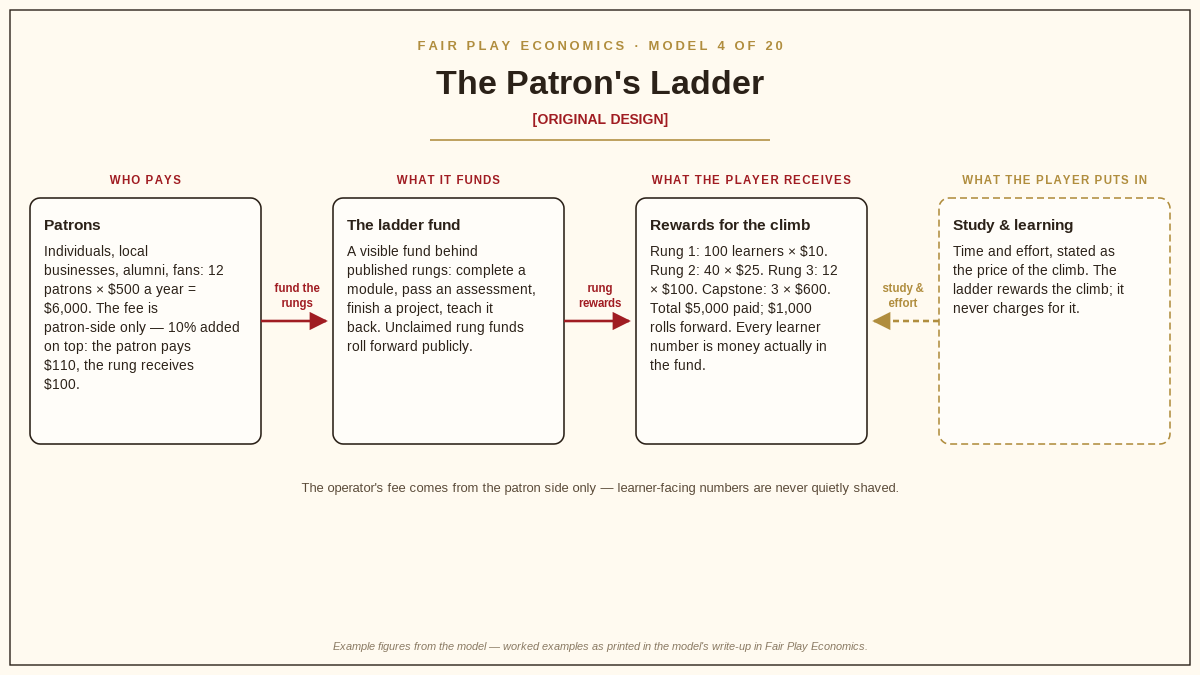
Diagram — The Patron's Ladder: who pays, what it funds, what the player receives, what the player puts in.
The payer and their reason. Patrons — individuals, local businesses, alumni, fans — fund ascending reward tiers for learners. The patron pays because the ladder is visible, named, and narratable: "the third rung is funded by ___" is a form of patronage as old as prizes themselves. The operator's fee comes from the patron side only — a printed percentage of patron funds, or a flat listing fee — never from learners.
The flow. A learning program publishes rungs: complete a module, pass an assessment, finish a project, teach it back. Each rung carries a reward funded by patrons into a visible ladder fund. Learners climb free. Patrons choose rungs to fund; unclaimed rung funds roll forward publicly. The fee is collected on top of patron contributions — the patron pays $110, the rung receives $100 — so the learner-facing numbers are never quietly shaved.
The arithmetic. Twelve patrons × $500 a year = $6,000, with the 10 percent fee collected as $600 on top. Rungs: 100 learners × $10, 40 × $25, 12 × $100, 3 × $600 for the capstone — $1,000 + $1,000 + $1,200 + $1,800 = $5,000, leaving $1,000 to roll forward. Every number a learner sees is money actually in the fund.
The contribution, named. Study and demonstrated learning — time and effort, stated as the price of the climb. The ladder rewards the climb; it never charges for it.
The precedent. Partial analogue. Employer-funded learning at scale (Model 18) proves institutions will prepay education; prize philanthropy — named prizes, scholarship funds — proves patrons fund visible attainment. No standing platform was found that sells rungs of a public ladder to patrons with a patron-side-only fee. Scholarship funds are the closest relative, but they fund access, not attainment rewards, and their fee structures are not printed on the ladder. The ladder as a fundable, visible structure appears original.
The verdict. Workable now; patron retention is the business. The mechanics are simple — a fund, a ladder, assessments. Completion funnels in open online learning are steep, often under 10 percent reaching late rungs, which is favorable to fund solvency; publish expected completion rates per rung so patrons see the same math the operator sees. The real cost centers are assessment integrity and patron renewal. Rewards for attainment are income to the learner for reporting purposes; and if any rung were awarded by chance rather than attainment, sweepstakes analysis would replace skill-contest analysis — keep the rungs earned.
Working exhibit: Chess Tactics Ladder, aboard FreeDough — twenty-six forced-mate puzzles climb in three ladders, and a miss teaches the idea.
Model 18 — The Training Purse [FOUND]
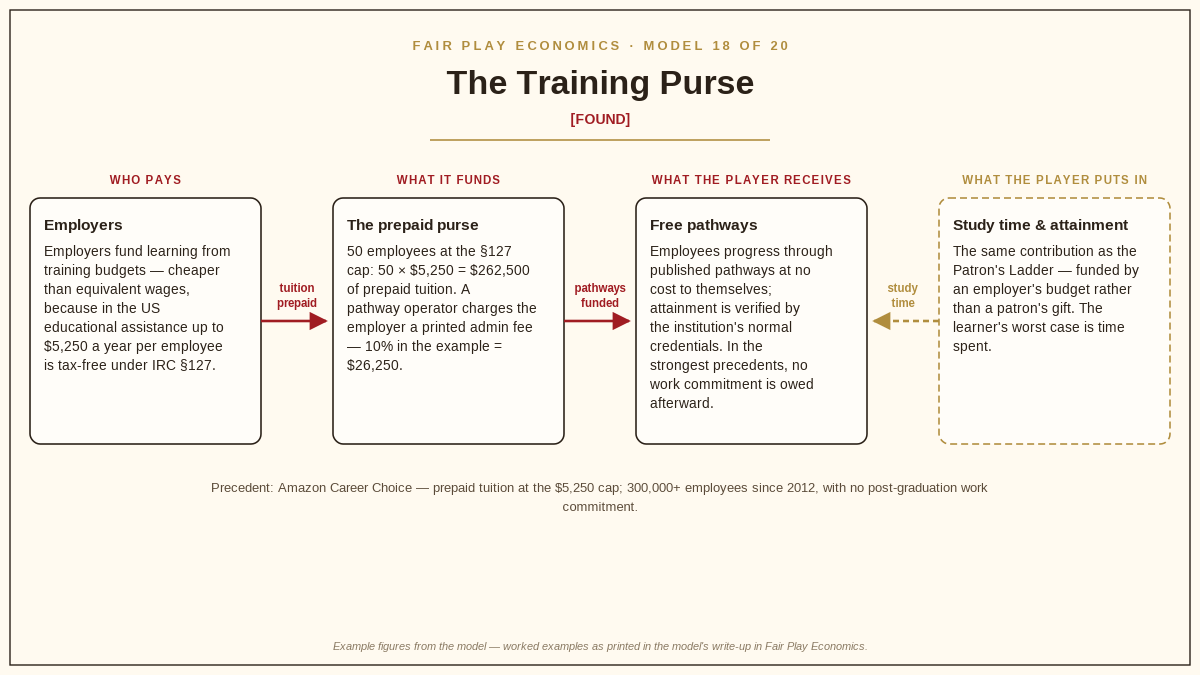
Diagram — The Training Purse: who pays, what it funds, what the player receives, what the player puts in.
The payer and their reason. Employers fund employee learning from training budgets, because skilled, retained employees are worth more than the tuition — and because, in the United States, educational assistance up to $5,250 per employee per year is tax-free under IRC §127, which makes the purse cheaper than equivalent wages. Unused training budgets are use-it-or-lose-it; the Purse gives them a structured place to go.
The flow. The employer prepays a partner institution or a program operator. Employees progress through published pathways at no cost to themselves; attainment is verified by the institution's normal credentials. An operator running the pathways charges the employer a printed admin fee. The learner never pays — and, in the strongest precedents, owes no work commitment afterward.
The arithmetic. An employer funds 50 employees at the §127 cap: 50 × $5,250 = $262,500 of prepaid tuition. A pathway operator charging a 10 percent admin fee earns $26,250 for running pathways the employees experience as entirely free. The learner's worst case is time spent; the employer's return is measured in retention and internal mobility, which the precedents track publicly.
The contribution, named. Study time and attainment — the same contribution as the Patron's Ladder, funded by an employer's budget rather than a patron's gift. The model is kept separate from the Ladder because the payer archetype, the tax mechanics, and the precedents differ.
The precedent. Full precedent, at very large scale. Amazon Career Choice, running since 2012, prepays tuition for hourly employees at more than 400 partner schools, capped at $5,250 a year for full-time hourly associates — the §127 tax-free maximum. More than 300,000 employees have used it to pursue new careers, with no post-graduation work commitment; Amazon has committed $2.5 billion to its broader Future Ready 2030 skills initiative. Walmart's Live Better U — no dollar cap, day-one eligibility, a tax gross-up above $5,250 — is the competing precedent and shows the design space's upper end.
The verdict. Workable now, as a business-to-business product. The precedents prove employer demand; the work is sales cycles and institutional partnerships, not mechanics. Treat the §127 cap as the natural unit size of the US purse rather than a limitation to engineer around. The flags are the written-plan and nondiscrimination requirements of §127, and the line between education benefits and taxable wages above the cap.
Model 10 — The Mastery Bond [ORIGINAL DESIGN — combination only]
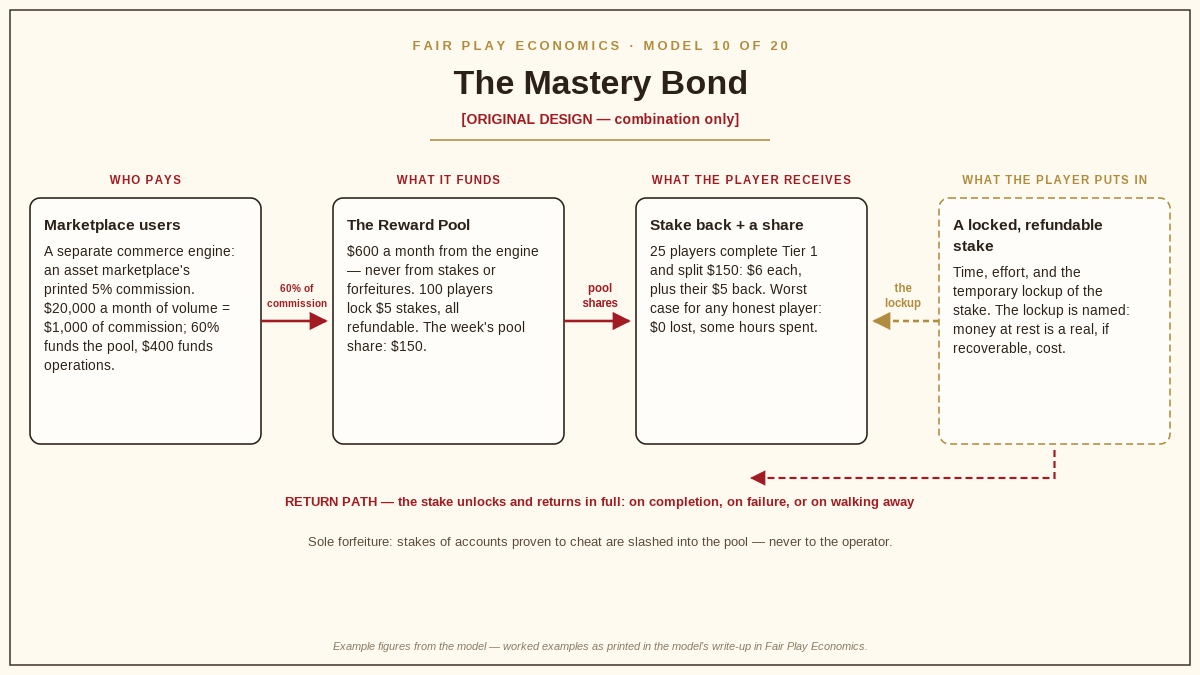
Diagram — The Mastery Bond: who pays, what it funds, what the player receives, what the player puts in.
The claim for this model is stated narrowly, because the record requires it. Refundable stakes and separately funded prize pools each exist in prior designs — including a patent family claiming refundable entry, up to fully refundable profiles, with prize pools funded by float and third-party contributions in chance gaming. The broad claim that this model invents the refundable gate does not survive that record, and this book does not make it. What is claimed is a specific combination: a refundable stake gating a skill-mastery tier, returned in full on failure or withdrawal as a rule; a reward pool funded by a separate commerce engine, never by stakes or forfeitures; and the sole forfeiture being the stakes of accounts proven to have cheated, slashed into the pool and never to the operator.
The payer and their reason. The separate engine. In the worked form, an asset marketplace charges a printed 5 percent commission, of which a printed share — 60 percent — funds the Reward Pool. Marketplace users pay commissions for liquidity and discovery; skilled players are paid from the pool because their activity is what gives the marketplace's tiers and assets meaning.
The flow. To attempt a skill tier, a player locks a refundable stake. Complete the published objectives, and the stake unlocks and the player shares in the period's Reward Pool. Fail or walk away, and the stake unlocks after a cooldown. The gate allocates; it does not collect.
The arithmetic. A marketplace doing $20,000 a month at 5 percent commission produces $1,000; $600 goes to the pool and $400 to operations. One hundred players lock $5 stakes — $500 at rest, all of it refundable. Twenty-five complete Tier 1 and split the week's $150 pool: $6 each, plus their $5 back. The worst case for any honest player is $0 lost and some hours spent.
The contribution, named. Time, effort, and the temporary lockup of the stake. The lockup must be named, because money at rest is a real, if recoverable, cost.
The qualification, with its edges in the open. On money, the model qualifies: the stake is a lock, not a payment, and every honest participant's principal returns in full. Two edges are recorded, not hidden. First, the slashing rule means a participant adjudged to have cheated can lose the stake — so the design needs a published evidence standard and an appeal, or the slash becomes the operator's discretionary weapon: the prop industry's termination problem in miniature, the exact failure Chapter 4 named. Second, a stake held in a volatile asset could lose value while locked; the stake should be denominated in the same unit in which it is returned.
The precedent. Partial analogue — and a strong one. Germany's Pfand deposit system is the refundable-stake mechanic running at national scale for two decades: €0.25 on single-use containers, refunded in full on return, with return rates of about 97 to 98 percent — the highest recorded — because the stake is real enough to act on and certain to come back. Pfand proves the behavioral core: a refundable stake changes conduct at population scale without consuming anyone's money. Even the best refundable system has a residual — the unredeemed 2 percent or so is that system's breakage, and Chapter 3's question applies to it.
The verdict. Workable now, conditional on the engine and on identity. Without a second revenue engine there is no pool, and the design collapses back into a fee gate. The pool also moves with its engine: a marketplace downturn shrinks rewards in exactly the season when participant morale matters most, and an honest operator prints that dependence rather than discovering it aloud later. Sybil farming — automated accounts completing tiers for pool shares — is the main attack; the refundable lock is itself part of the defense, because farming requires capital at rest per identity. Holding user stakes, even refundable ones, is custody: segregation and return mechanics need counsel, and slashing needs a defensible process.
Working exhibit: IQ Vault, aboard FreeDough — fifty-two questions in four vaults; right answers earn Dough, and a miss teaches the reasoning.
Chapter 14 — Funded by Each Other, Honestly
Three models in which the community itself is the funder — of time, of surplus, and of allocation. Each is old. Each works. Each fails in a characteristic way that its chapter names.
Model 5 — The Skill Barter Bank [ORIGINAL DESIGN — the institutional bounty layer only; mechanic and platform form FOUND and old]
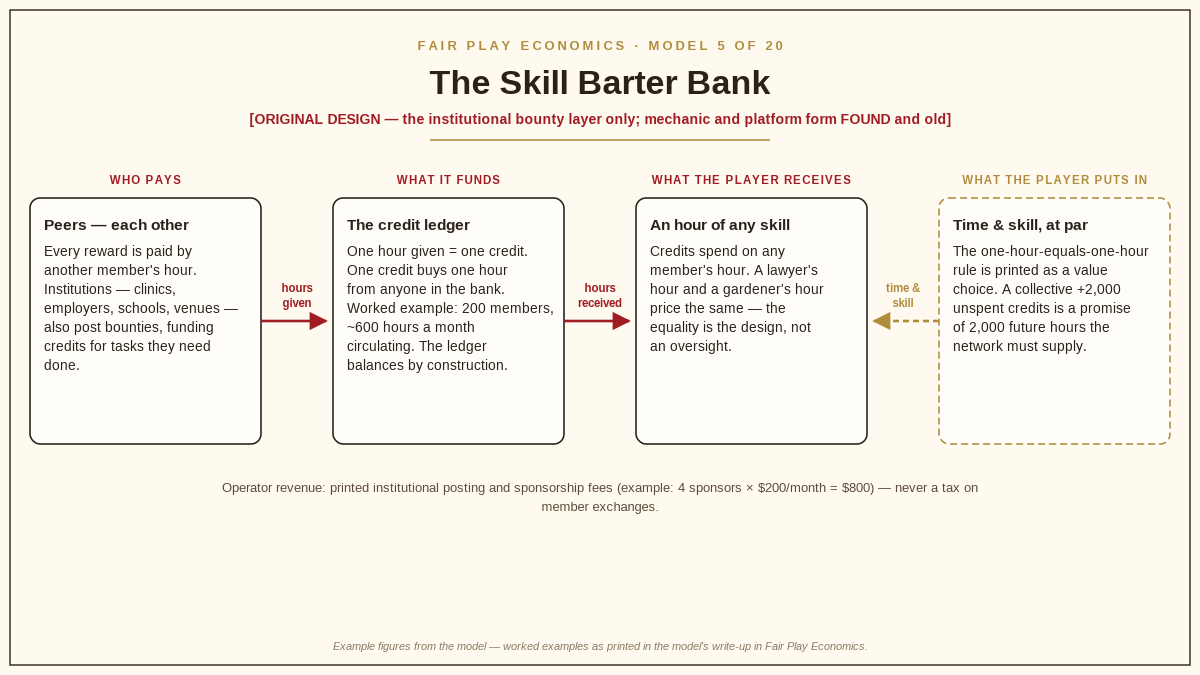
Diagram — The Skill Barter Bank: who pays, what it funds, what the player receives, what the player puts in.
The payer and their reason. Peers pay each other in kind. One hour given earns one credit; one credit buys one hour from anyone in the bank. The payer of every reward is another member's hour. The operator's revenue comes from the business layer around the bank — employers, clinics, schools, and venues pay printed fees to post bounties, tasks the institution funds in cash-to-credits or in sponsorship of the bank — never from taxing member exchanges. That institutional bounty layer, third parties paying to post bounties denominated in the bank's own service credits, is the design's original element; the bank itself is conceded, old, and proven.
The flow. Members list offers and needs. Exchanges are logged in a shared ledger at one hour equals one credit, regardless of the market wage of the skill — the equality is the design, not an oversight. Institutions post bounties: a clinic funds credits for volunteer drivers; an employer funds a teaching series. Operator revenue is the institutional posting and sponsorship fees, printed.
The arithmetic. Two hundred members averaging three exchanges a month each: 600 hours a month circulating, with no cash moving between members. The operator's cash is, say, four institutional sponsors × $200 a month = $800, against ledger, hosting, and moderation costs. The bank's real balance sheet is hours: if members collectively bank 2,000 unspent credits, that is a promise of 2,000 future hours the network must be able to supply. Manage it like a reserve, and publish the aggregate.
The contribution, named. Time and skill, at par. The one-hour-equals-one-hour rule must be printed as the value choice it is, because it deliberately prices a lawyer's hour and a gardener's hour the same.
The precedent. Full precedent. Timebanking — Edgar Cahn's Time Dollars in the 1980s, now coordinated in the United States by TimeBanks.org and run on shared ledger software; Japan's Fureai Kippu elder-care credits predate and parallel it; Timebanking UK counted more than 25,000 members across more than 4,000 organizations by 2025. The movement's decades of operation prove the ledger works socially. They also prove the chronic weakness: most banks survive on grants and volunteer coordination, not revenue. On taxes, this book prints the narrow statement and no more: the Internal Revenue Service's general published position is that barter income is taxable at fair market value in the year received. Private IRS determinations have held that specific volunteer time-dollar programs were not "barter exchanges" required to file information returns under IRC §6045 — an organization-level reporting question — expressly without opining on whether a member earns income by participating, and binding only on the organizations that requested them. The stronger claim sometimes repeated in movement literature, that time credits are tax-exempt for members, is not supported by the primary sources and does not appear in this book.
The verdict. Workable now as community infrastructure; fragile as a standalone business. The ledger balances by construction — credits are created by giving and destroyed by receiving — so the solvency risk is service solvency: banked credits with nothing desirable to buy. The business layer must cover real costs without taxing exchanges, which caps operator income. Say so, and the model is honest infrastructure; hide it, and the model is a grant application with a ledger attached.
Model 16 — The Patronage Pool [FOUND]
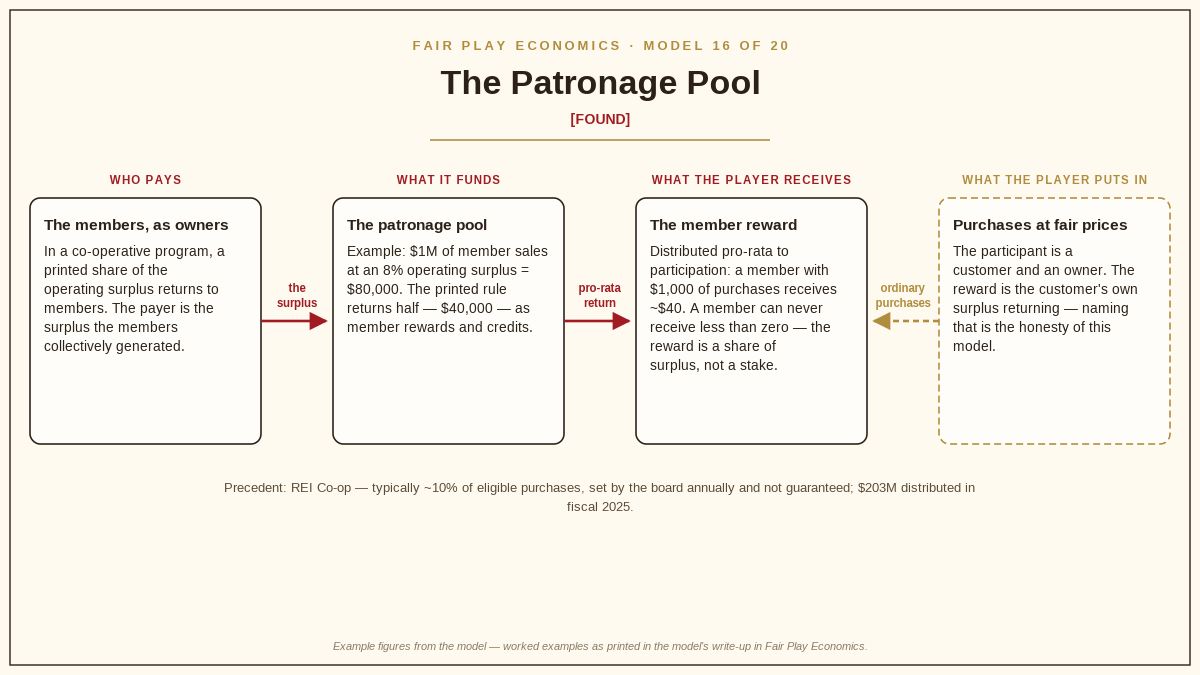
Diagram — The Patronage Pool: who pays, what it funds, what the player receives, what the player puts in.
The payer and their reason. The members themselves, in their capacity as owners. In a cooperative program or store, a printed share of the operating surplus returns to members pro-rata to their participation. The payer is the surplus the members collectively generated; the design decision is to return it by formula instead of retaining it by default.
The flow. Members transact normally, at fair prices. At period end, the surplus is computed and a printed share is distributed as member rewards or credits. The distribution rule, the surplus definition, and the limits on the board's discretion are published in advance. A member can never receive less than zero: the reward is a share of surplus, not a stake.
The arithmetic. A cooperative program with $1 million of member sales and an 8 percent operating surplus has $80,000; if the rule returns half the surplus as patronage, $40,000 flows back pro-rata — a member with $1,000 of purchases receives about $40. The numbers are modest and real, and the precedent shows they compound into serious loyalty over decades.
The contribution, named. Ordinary purchases at fair prices. The participant is a customer and an owner, and the design must not pretend the reward is free money: it is the customer's own surplus returning. Naming that is the honesty of this model.
The precedent. Full precedent, at national scale, for more than 85 years. REI Co-op, founded in 1938, pays an annual Co-op Member Reward of typically about 10 percent of eligible full-price purchases, issued each March; REI distributed $203 million in member rewards in fiscal 2025 across more than 25 million members. The qualifiers are part of the precedent and are printed here because they must survive any retelling: the reward is typically about 10 percent and is not guaranteed — the board decides annually, the reward may be structured as a patronage dividend, a promotional reward, or a mix, and it is issued as merchandise credit that itself expires. Patronage dividends of $10 or more are reported on Form 1099-PATR.
The verdict. Workable now. The cooperative form is mature law and mature practice. The pool can only distribute surplus that exists — years without surplus pay nothing — and the printed rule must say so in advance; REI's "typically, not guaranteed" language is the honest template. The flags are cooperative tax treatment, which rewards proper structure, and a bright line: membership must never be marketed as an investment.
Model 20 — The Quadratic Commons [FOUND mechanic and prize-allocation practice; this book's contribution is the season framing for general programs]
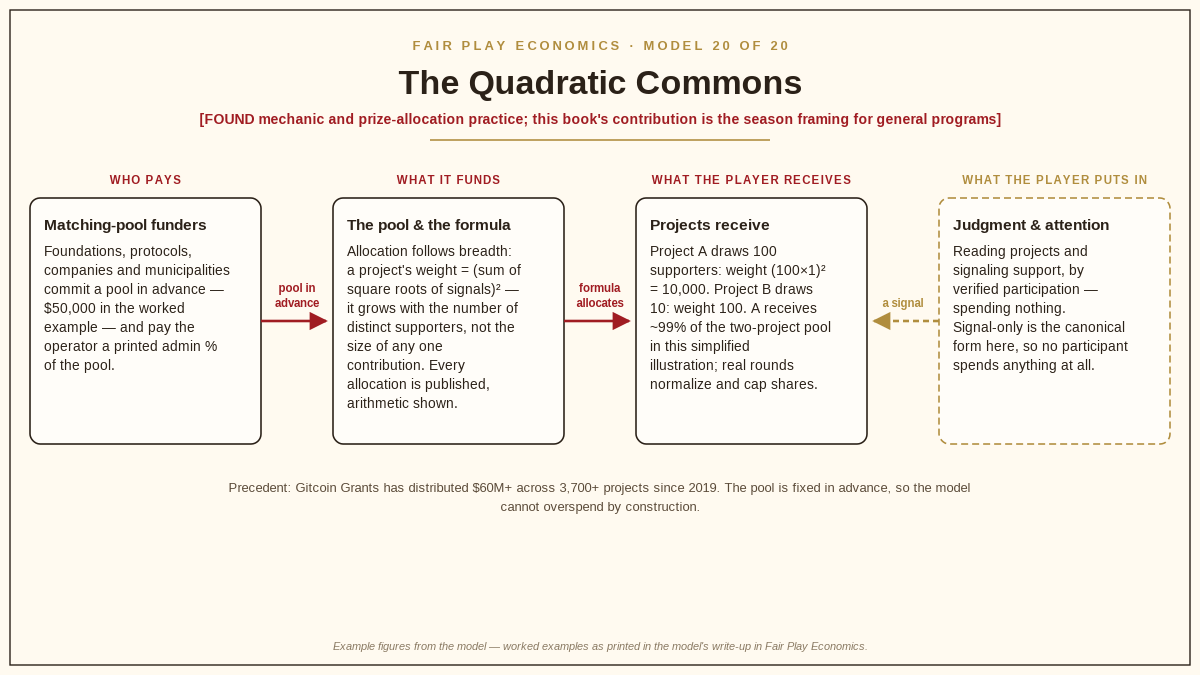
Diagram — The Quadratic Commons: who pays, what it funds, what the player receives, what the player puts in.
The payer and their reason. Matching-pool funders — foundations, protocols, companies, municipalities — commit a pool in advance. Community members then direct the pool by breadth-weighted signals: allocation follows the number of distinct supporters, not the size of any one contribution, under the quadratic rule — a project's weight grows with the square of the sum of the square roots of its signals. Funders pay because the mechanism discovers what a community actually values, with receipts.
The flow. A season opens with a printed pool and a printed formula. Participants signal support for projects — in the canonical form used here, by verified participation, an account in good standing casting weighted votes, spending nothing. At season close, the formula allocates the pool, and every allocation is published with its arithmetic shown. The operator is paid a printed admin percentage of the pool, by the funders.
The arithmetic. A $50,000 pool across five projects. Project A draws 100 supporters; Project B draws 10. Under the signal-only quadratic weight, A's weight is (100 × 1)² = 10,000 against B's (10 × 1)² = 100 — breadth dominates by design; real rounds normalize across all projects and cap per-project shares, but the direction is the design's whole point. The precedent's canonical illustration makes the same point in donation form: 100 donors giving $10 each attract roughly ten times the matching of 10 donors giving $100 each, on the same $1,000 of direct contributions.
The contribution, named. Judgment and attention — reading projects and signaling. In donation-based rounds, participants may also give money; a gift is a voluntary transfer, not a loss mechanism, and the distinction is recorded here rather than blurred — but program designs in this book default to signal-only, so that no participant spends anything at all and the qualification needs no footnote.
The precedent. Full precedent for the mechanic. Gitcoin Grants, running since 2019, has distributed more than $60 million across more than 3,700 projects through quadratic funding rounds, with matching pools from foundations and protocol treasuries — and with industrial-strength identity verification, because breadth-based allocation invites fake crowds. Municipal pilots — Split's triple-match citizen funding among them — show the form leaving its original habitat. The mechanic and its prize-allocation practice are found; this book's contribution is the season framing: a recurring, published, prize-like allocation season run for a program's own community projects.
The verdict. Workable now. The formula and the anti-sybil tooling both exist and are battle-tested. The pool is fixed in advance, so the model cannot overspend by construction; its failure mode is not insolvency but capture — coordinated blocs steering allocations, and manufactured identities inflating breadth. Identity cost is therefore a load-bearing part of the design, not an accessory, and a Commons that skimps on it will be governed by its most organized minority. Charitable-solicitation rules apply if donations are accepted, and allocating other people's money carries duties of care even outside formal charity law.
Chapter 15 — Funded by Savings and Surplus
Five models in which the payer pays out of money that exists only because the system worked: a sister business's sales, an avoided cost, an insurer's prevented claims, a funder's purchased outcome — and, in the closing model, breakage itself, rerouted.
Model 7 — The Cross-Subsidy Atelier [FOUND mechanic / ORIGINAL destination]
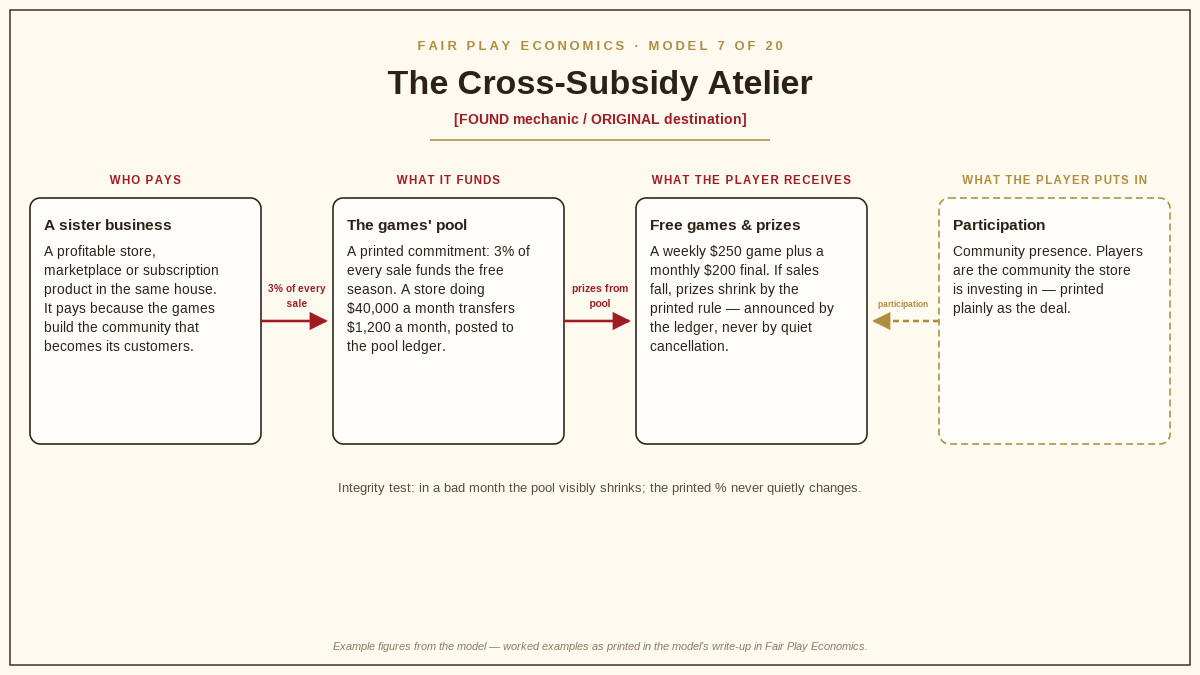
Diagram — The Cross-Subsidy Atelier: who pays, what it funds, what the player receives, what the player puts in.
The payer and their reason. A profitable sister business — a store, a marketplace, a subscription product — prints a commitment: a stated percentage of every sale, or of gross margin, funds free games and rewards run by the same house. The business pays because the games build the community that becomes its customers, and because a printed percentage converts marketing spend into a public, checkable promise instead of advertising fog. Printed-percentage funding commitments are old and famous — Patagonia's 1% for the Planet has run since 1985. The destination is the model's element: the percentage funding free games and rewards for the seller's own community.
The flow. The rule is stated where customers can see it — "3 percent of every order funds the free season." Each period, the transfer is computed from published sales figures and posted to the games' pool ledger. Games are free to enter; prizes come only from the transferred pool. If sales fall, prizes shrink — by the printed rule, announced by the ledger, never by quiet cancellation.
The arithmetic. A store doing $40,000 a month at a 3 percent-of-sales commitment transfers $1,200 a month: a weekly $250 game plus a monthly $200 final. A store doing $4 million a month transfers $120,000. The model's integrity test is the bad month: the pool must visibly shrink rather than the percentage quietly changing.
The contribution, named. Participation and community presence. Players should be told plainly that they are the community the store is investing in. That is the deal, and it is a fair one when printed.
The precedent. Full precedent for the mechanic; partial for the printed-percentage form. McDonald's Monopoly, running since 1987, is the canonical brand-funded prize game — prizes funded from the marketing budgets of the restaurant business and its supplier partners, entry attached to purchases with a free mail-in entry route. Its history also supplies Chapter 6's cautionary case: the funding was honest and the pipeline was not, for over a decade. Many modern analogues exist — grocery and fuel rewards funded by manufacturer trade spend — and few print the subsidy percentage.
The verdict. Workable now, conditional on the engine — the model is exactly as strong as the sister business. Size the commitment against margin, not hope: 3 percent of sales at a 10-percent-margin business is 30 percent of profit, which will not survive the first bad quarter. Print the basis — sales or margin — with the percentage. If game entry is tied to purchases, a free entry route is required.
Model 12 — The Shared-Savings Split [FOUND mechanic, single-domain / ORIGINAL cross-domain synthesis (framing)]
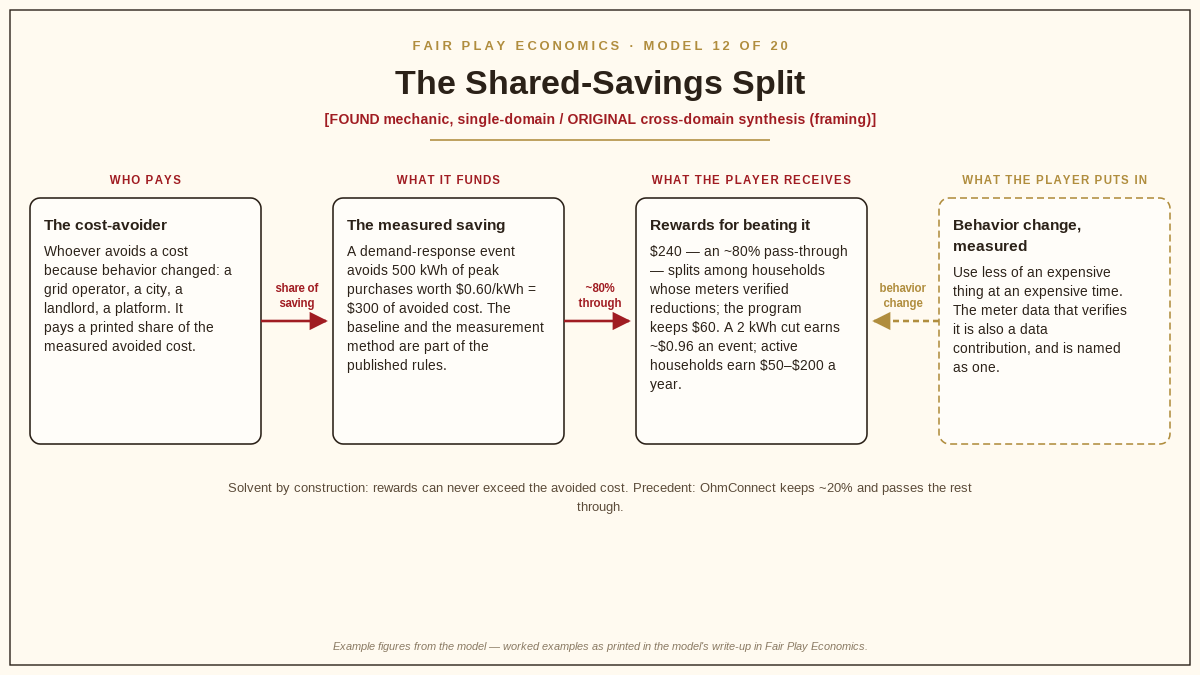
Diagram — The Shared-Savings Split: who pays, what it funds, what the player receives, what the player puts in.
The payer and their reason. Whoever avoids a cost because participants changed behavior: a grid operator avoiding peaker-plant runs, a city avoiding landfill tonnage, a landlord avoiding vacancy, a platform avoiding support burden. The payer shares the measured avoided cost — money that exists only because the saving happened. Gainsharing within a single domain is established, patented practice; the model's contribution is naming the pattern across domains, a synthesis offered as a framing, not an invention claim.
The flow. A baseline is published — say, a household's forecast peak-hour energy use. Participants who verifiably beat the baseline during called events earn rewards from a pool funded by the payer at a printed share of the measured saving; the working example passes about 80 percent through and keeps about 20 percent as the program margin. The measurement method and the baseline formula are part of the published rules — the baseline is the game's integrity surface.
The arithmetic. A demand-response event avoids 500 kilowatt-hours of peak purchases worth $0.60 per kilowatt-hour to the grid operator: $300 of avoided cost. At an 80 percent pass-through, $240 splits among the households whose meters verified reductions, and the program keeps $60. A household that cut 2 kilowatt-hours earns about $0.96 for the event; active households in the working example earn $50 to $200 a year. Nobody paid anything to be in the pool.
The contribution, named. Behavior change, measured: use less of an expensive thing at an expensive time. The measurement — smart-meter or equivalent data — is also a data contribution, and is named as one.
The precedent. Full precedent in one domain. OhmConnect (now Ohm Energy) pays households in California, New York, and Texas to reduce electricity use during grid-stress events: energy authorities and utilities pay for aggregated reductions because avoided peaker generation is cheaper than generation. OhmConnect has historically kept about 20 percent of the payment and passed the rest to users as cash or charity donations; typical user earnings run $50 to $150 a year, by its co-founder's account. The generalization — the same split applied to any measurable avoided cost, with split and baseline printed — is the step beyond the precedent.
The verdict. Workable now, wherever measurement exists. The model lives or dies on baseline integrity: if participants can inflate the baseline, they manufacture "savings." Rewards can never exceed the avoided cost, so the design is self-limiting and solvent by construction; its ceiling is the size of the inefficiency it attacks. Utility-market participation is regulated — the payer relationship, not the player side, carries that weight.
Model 13 — The Non-Event Dividend [FOUND]
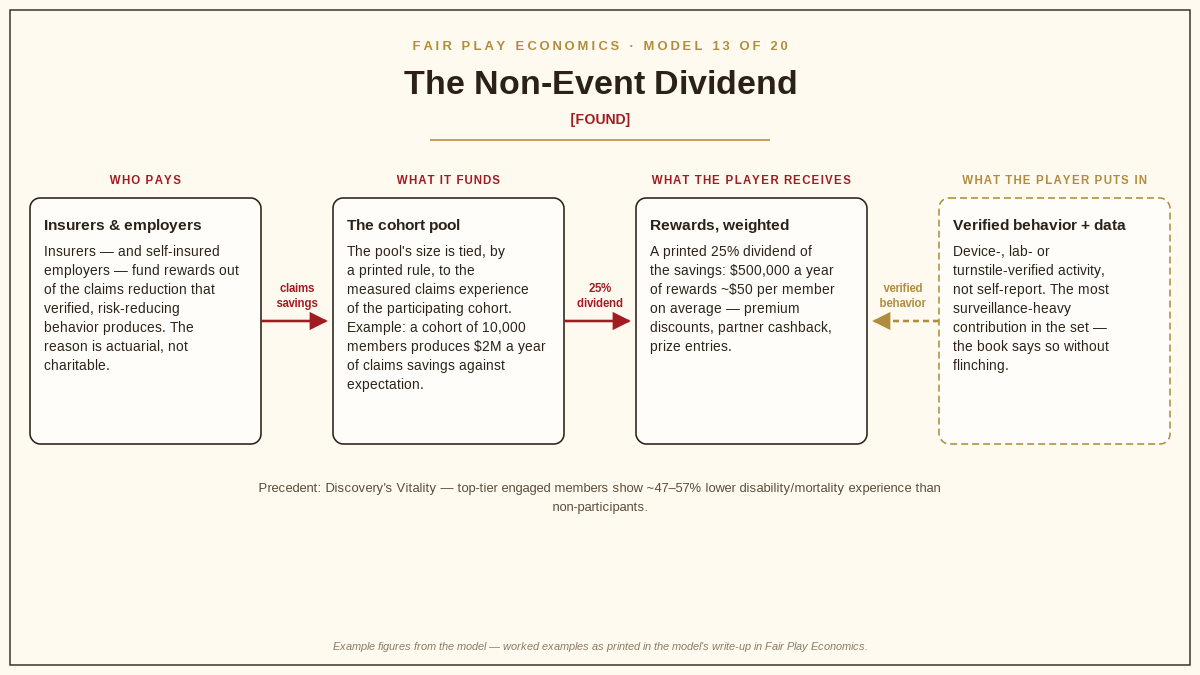
Diagram — The Non-Event Dividend: who pays, what it funds, what the player receives, what the player puts in.
The payer and their reason. Insurers — and self-insured employers — fund rewards for verified risk-reducing behavior: activity, health checks, safe driving. The payer's reason is actuarial, not charitable: the reward costs less than the claims the behavior prevents. The dividend is paid, in effect, for the event that did not happen.
The flow. Participants opt into verified behavior tracking — the named data contribution is device-, turnstile-, or lab-verified activity, not self-report. Behavior earns points and status; status converts to rewards — premium discounts, partner cashback, prize entries — funded from a pool whose size is tied, by a printed rule, to the measured claims experience of the participating cohort. The game form this book proposes is the cohort challenge: the whole cohort's verified activity this quarter funds next quarter's reward table, so the funding loop is visible to the people generating it.
The arithmetic. An insurer's engaged cohort shows materially lower claims — in the precedent, top-tier members show roughly 47 to 57 percent lower disability and mortality experience than non-participants. If a cohort of 10,000 members produces $2 million a year of claims savings against expectation, a printed 25 percent dividend is $500,000 a year of rewards — $50 per member on average, weighted by verified behavior. The program operator is paid by the insurer from the same savings, at a printed rate.
The contribution, named. Verified behavior, and the data that verifies it. This is the most surveillance-heavy contribution in the set, and this book says so without flinching, here as in Chapter 8: the participant trades continuous proof of behavior for rewards funded by their own risk reduction.
The precedent. Full precedent for the funding loop. Discovery's Vitality, running in South Africa since 1997 and now in more than 40 markets covering about 49 million lives, pays members points for verified healthy behavior, with rewards including up to 75 percent off gym memberships and 25 percent cashback on healthy food. Discovery Life paid R2.4 billion in shared-value rewards in 2024 — R1.4 billion in PayBacks and R1.0 billion in cash conversions — funded by the actuarial loop: engaged members' lower claims. The precedent is reported with its critique, because both belong in the record: academic critics argue the model also commodifies health data and shifts risk responsibility onto individuals. The funding loop is proven; its social terms are contested.
The verdict. Workable at scale, or with a partner. A standalone publisher cannot be its own insurer; the model requires an insurer or employer partner, or a narrow self-funded version — a company funding its own workforce's dividend. Rewards must trail measured savings by at least a year of claims data; paying ahead of the actuarial evidence is how such programs quietly die. Insurance rebating and inducement rules vary by state, and behavior-based pricing deserves anti-discrimination review alongside the privacy analysis.
Working exhibit: The Calm Watch, aboard FreeDough — the boat's mutual collects the Café's daily premium, pays a dividend to everyone who stood the watch on the days the bad day does not happen, and pays repairs out of the same pool when it does.
Model 14 — The Outcome Buyer's Table [ORIGINAL framing — printed per-outcome price table paying producers directly; funding family FOUND]
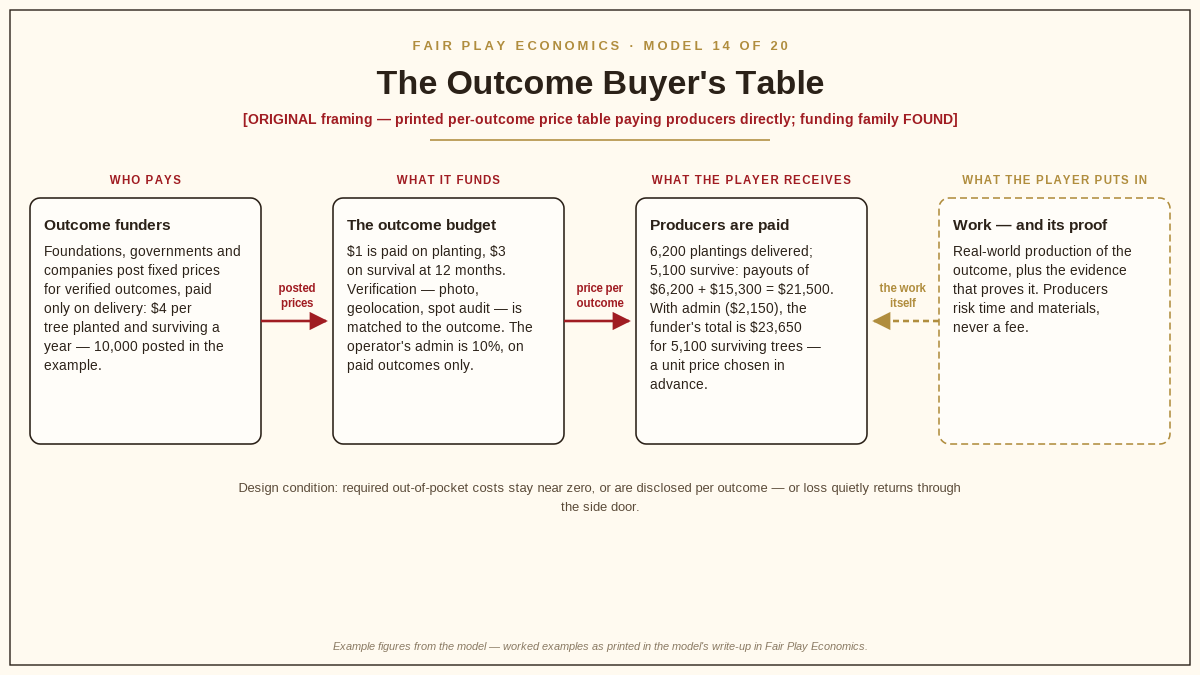
Diagram — The Outcome Buyer's Table: who pays, what it funds, what the player receives, what the player puts in.
The payer and their reason. Outcome funders — foundations, governments, companies with commitments — post fixed prices for verified outcomes: a stated amount per tree planted and surviving a year, per learner certified, per kilogram of electronic waste collected, per home weatherized. The funder pays because it wants the outcome itself, priced in advance, paid only on delivery. Results-based financing is the found funding family; the model's framing is the element claimed here: funders posting printed per-outcome prices whose purchases pay rewards directly to the participants who produce the verified outcomes.
The flow. The Table publishes outcome prices and verification standards. Anyone may produce an outcome and claim its price; verification matched to the outcome's cost of proof — photograph plus geolocation plus spot audit, certification records, weighbridge receipts — releases payment. The operator charges the funder a printed admin percentage on paid outcomes only. Unsold outcome budget returns to the funder or rolls to the next season, printed at posting.
The arithmetic. A foundation posts 10,000 verified tree-plantings at $4, with survival checked at twelve months: $1 on planting, $3 on survival. Producers deliver 6,200 plantings; 5,100 survive. Payouts are $6,200 + $15,300 = $21,500; admin at 10 percent is $2,150. The funder's total cost is $23,650 for 5,100 surviving trees — a unit price it chose before spending anything. Producers risked time and materials, never a fee.
The contribution, named. Work — real-world production of the outcome, plus the evidence that proves it. One honesty condition is part of the design: producers may spend their own money on materials pursuing an outcome, so required out-of-pocket costs must be kept near zero, or disclosed per outcome — otherwise the model quietly reintroduces loss through the side door.
The precedent. Partial analogue. Results-based financing and development impact bonds — the Educate Girls development impact bond of 2015 to 2018 is the standard example — pay for verified outcomes, but in an impact bond the investors front the working capital and can lose it. The Table removes the investor layer and pays producers directly; that structural difference is why producers here cannot lose money. Pay-for-success contracts in US social policy are cousins. No standing open Table — any producer, posted prices, direct claim — was found.
The verdict. Workable now, for cheaply verifiable outcomes. The binding constraint is verification cost per outcome: if proof costs more than about 15 percent of the outcome price, the Table eats itself. Digital-native outcomes — certifications, merged code, labeled datasets — verify cheapest; physical outcomes need audit sampling. Fraud pressure scales with price, and Chapter 6's lesson applies to verifiers as much as to prizes. The flags are contractor and employment classification for producers working at volume, and charitable-funds handling where foundation money is the pool.
Working exhibit: Predictions Desk, aboard FreeDough — the Desk takes calls on sealed readings, returns every stake in full, and pays a printed prize for a right call.
Model 11 — Reverse-Breakage Commons [ORIGINAL DESIGN]
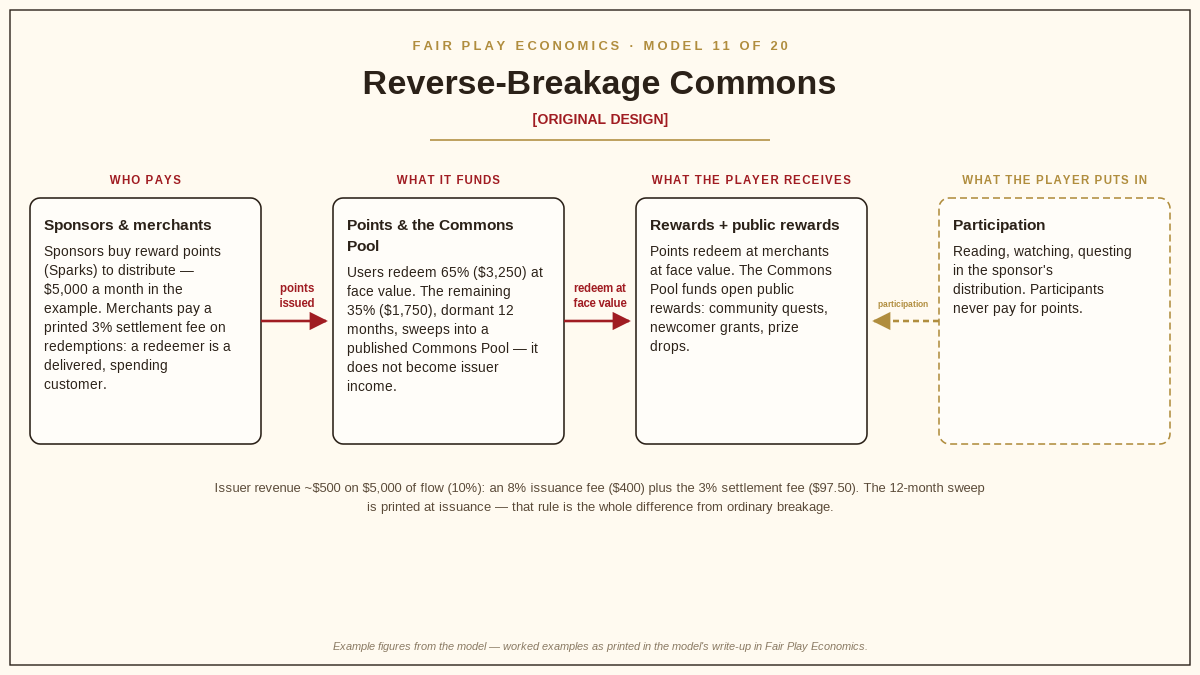
Diagram — Reverse-Breakage Commons: who pays, what it funds, what the player receives, what the player puts in.
The last model in this chapter closes the loop Part I opened. Chapter 3 described breakage: value that evaporates becomes the issuer's income. This design keeps the evaporation — people will forget points in any system ever built — and changes who receives it.
The payer and their reason. Sponsors buy reward points to distribute as marketing; merchants pay a printed settlement fee on redemptions, because a redeeming customer is a delivered, spending customer. The issuer is paid for issuance and plumbing — never for value that quietly evaporates.
The flow. Points are issued against sponsor funding and redeemed at merchants at face value. Points dormant for twelve months are not cancelled into issuer income: they sweep into a published Commons Pool that funds open public rewards — community quests, newcomer grants, prize drops. Issuer revenue is a printed issuance fee plus a printed settlement fee on redeemed value.
The arithmetic. A sponsor buys $5,000 of points monthly. The issuance fee at 8 percent is $400. Users redeem 65 percent — $3,250 — producing settlement fees of $97.50 at 3 percent. The remaining 35 percent, $1,750, would in a conventional program become breakage income; here it is a liability that migrates to the Commons Pool after dormancy. Issuer revenue is about $500 on $5,000 of flow — 10 percent. That is less than the breakage model's potential capture, and the whole of it prints on one page.
The contribution, named. Participation in the sponsor's distribution — reading, watching, questing. Participants never pay for points.
The qualification, stated plainly. The model qualifies: participants lose nothing they paid in, because they paid nothing in. But the dormant value that sweeps to the Commons was the participant's earned reward, and the design must say so: after twelve months dormant, unredeemed points become community property by a rule printed at issuance, not by a term discovered later. That printed-at-issuance rule is the entire difference between this design and ordinary breakage.
The precedent. None found. Loyalty breakage is universal — the ranges of Chapter 3: 10 to 19 percent of gift-card value, roughly 15 to 40 percent of loyalty value — and no issuer was found that routes its own breakage to a visible community pool instead of income. The inversion appears genuinely unused, plausibly because breakage is the margin for many issuers.
The verdict. Fragile — and the fragility has a name, stated in Chapter 7 and repeated here because it governs this model: escheat. Dormant balances may be unclaimed property owed to the owner or to the state, not to any pool an issuer designs. Whether earned points are "property" for unclaimed-property purposes varies by state and by how the points were acquired — purchased value is treated more strictly than promotional value, and promotional cards sit outside the federal gift-card protections, which cuts both ways: fewer consumer-protection constraints, and no federal safe harbor either. The design likely works in some jurisdictions with points structured as promotional, non-purchased value and a dormancy rule disclosed at issuance — but this is the set's clearest "lawyer before launch" item, and no honest version of the model ships without that review. Two secondary fragilities ride along: the merchant-network bootstrap, and Commons governance — who designs the quests the Pool funds is a real institution to run, with real capture risks of the kind Chapter 14 named, and it deserves the same printed-rule treatment as the money.
Working exhibit: Bingo Commons, aboard FreeDough — cards are free, the prize tables are printed, and the caller seals the full draw order before the first ball.